



It’s Never Too Late to Go Back to College

For millions of Americans, leaving college isn’t the end of the story.
While many students stop out before earning a credential, they often plan to return. Yet re-enrolling can prove just as challenging as enrolling in the first place. As colleges look to re-enroll adults with some college but no credential, they are rethinking how to support students whose educational journeys aren’t linear.
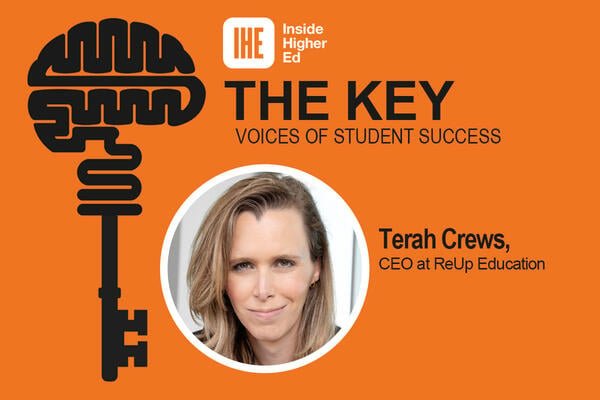
Terah Crews, chief executive officer of ReUp Education, a national organization dedicated to helping adults navigate re-entry into higher education, joined Inside Higher Ed student success reporter Joshua Bay on Voices of Student Success to discuss why students stop out, what motivates them to return, the barriers colleges still place in their way and what it will take to build institutions that truly serve today’s adult learners.
Here are five takeaways for colleges working to better support adult learners returning to higher education.
- Stopping out isn’t the end of a student’s college journey.
Crews said referring to students as “stop-outs” rather than “dropouts” better reflects the reality that, for most, leaving college is a pause, not a permanent decision to abandon higher education.
“Certainly there’s a subset of the population where that’s true, but the vast majority of learners stopped out because there was something going on in their life that kept them from continuing,” Crews said.
She noted that family responsibilities, health challenges, financial pressures and the general complexity of balancing college with life circumstances often interrupt students’ educational journeys.
“The most important thing to understand is most of these learners don’t quit thinking they’re never going to come back,” Crews said. “But once they’re out for about a semester, inertia takes over and it really gets challenging.”
Recognizing that is critical, she said; many institutions stop actively engaging students once they’ve been away for an extended period.
“This sort of nuance is really important because for the vast majority of institutions, they do nothing once learners have been out for more than a year,” Crews said.
- Most stop-outs want to return, but colleges often make coming back harder than leaving.
Crews said students who stop out leave for a wide range of reasons, but institutions often overcomplicate the process of re-enrolling them by trying to solve every barrier before simply reconnecting with them.
“You don’t need to have a solution for every complexity in a person’s life on why they can’t come back, nor do you need to understand the unique situation that they’re in right now,” Crews said. “You simply need to start a conversation with them, and then you have to have the ability to actively serve them for, in some cases, a long period of time before they’re actually able to make that step back.”
She added that colleges also need to rethink how they view returning adult learners. Unlike many traditional-age students who are still weighing the value of higher education, most adults have already experienced firsthand what not having a credential can cost.
“We spend so much time talking about how younger generations aren’t valuing higher education the way that they used to, [but] adults are,” Crews said. “They are because they applied for that job and were told that they weren’t eligible because they didn’t have a bachelor’s degree or they didn’t have an associate degree or they didn’t have a credential.”
“This is a population where you don’t have to sell them on the value of higher education the way you would an 18-year-old,” she added. “They see it, they feel it, they know the barriers that are keeping them from economic security and opportunity in life.”
- Adult learners need colleges designed around their lives.
Crews said many of the barriers institutions create for returning students stem from policies designed with the traditional 18-year-old college student in mind. Given that the average college student is now 31 years old, she argued that colleges should be designing systems around the realities of today’s learners.
“Maybe that hold on registration due to a parking ticket or a $200 fee makes sense for an 18-year-old because it’s the forcing mechanism to get somebody who’s still developing responsible behaviors to come in and pay their bill,” Crews said. “But for a 31-year-old, telling them you can’t come back because of a $200 bill that they forgot 10 years ago, it serves as a signal: ‘I don’t belong,’ or it serves as a signal of ‘You’re not interested, you’re not invested in me.’
“Moreover, it’s a bad financial decision for the institution,” she added. “Oftentimes when I’m talking to CFOs, they’re like, ‘Wait a minute, we have a policy that says if they owe $200, they can’t come back and pay us $4,000 in tuition. Who came up with that?’”
Crews said colleges can better support returning learners by removing unnecessary barriers, such as registration holds and application fees, streamlining admissions, and making it easier for students to understand how previously earned credits apply toward a degree.
“The easier you make it for them to take that first step, the more you will get back,” Crews said. “It’s really that simple.”
- Flexible pathways are creating more ways back to college.
Crews said growing interest in short-term credentials, workforce pathways and prior learning assessment is creating more flexible entry points for adults returning to higher education. Rather than expect every student to re-enter through a traditional degree program, colleges are beginning to offer multiple pathways that better align with learners’ goals and circumstances.
“That’s really important because currently we’re not enrolling as many new stop-outs every year,” Crews said. “So if we want to really stem the tide and start shrinking that 40 million population, we’ve got to develop new solutions, new pathways for learners to get back in.”
She said short-term credentials, in particular, can help students improve their economic mobility while building toward a longer-term credential.
“If they can do that by pursuing some shorter-form credential that gets them a better job, more salary, more income while they’re pursuing a degree that’ll give them a pathway to a career, that’s an added benefit,” she said.
- Returning is as much an emotional journey as an academic one.
Crews said re-enrollment is more than an administrative or financial decision. Many returning students also carry feelings of failure, shame or uncertainty that institutions often overlook.
Drawing on her own experience as both a high school and college stop-out, Crews said those emotions are common—and shouldn’t be mistaken for a lack of motivation.
“Many years ago, I was a high school stop-out, and then I was actually a college stop-out as well,” Crews said. “The more we realize it, the more we engage, the better we’re going to get at meeting people where they are and helping them realize that these fears, these anxieties, are OK. They’re normal, but they’re welcome.”
Get more content like this directly to your inbox. Subscribe here.
You may be interested

U.S. Treasury to unveil new Iran sanctions after Trump warned of “economic D-Day” for Tehran
new admin - Aug 24, 202610m ago Iran-Oman talks on Strait of Hormuz to continue Tuesday Oman and Iran are set to continue their…

Regatta rain jacket that 'kept me completely dry' during storm now £8 with deal
new admin - Aug 24, 2026[ad_1] "Lovely colour, great lightweight jacket that is breathable. Makes a nice change from other jackets I've worn. Folds up…

'Heart-wrenching' war film 'terrifies' viewers on Netflix now
new admin - Aug 24, 2026A true story about a photographer in a camp is leaving viewers 'terrified' as they see behind the walls of…