



ED Threatens ABA’s Ability to Accredit Law Schools

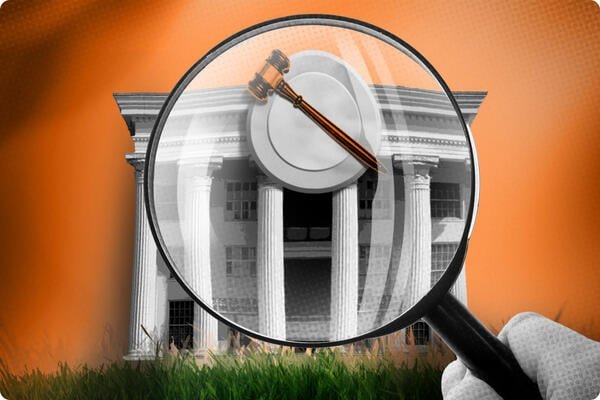
The Trump administration is trying to strip the American Bar Association’s accreditation council of federal recognition—a move that could threaten law students’ eligibility for federal student aid and disrupt legal education more broadly.
The ABA currently stands as the nation’s leading law school accreditor and the only one that is federally recognized; it oversees nearly 200 colleges across the country. In many states, a law school’s graduates cannot qualify for the state license needed to practice law unless they are authorized by a federally recognized legal accreditor and/or the ABA specifically. That means denying recognition to the ABA could be a major disruption to students’ ability to obtain a license.
The Education Department accused the bar association and its accreditation council—the Section of Legal Education and Admissions to the Bar—of violating federal regulations in nearly 30 ways, according to an 86-page report released Friday that outlines the agency’s findings and recommends revoking recognition.
One allegation says the Section of Legal Education is not sufficiently independent from the ABA itself. Another argues it did not begin to change its standard for diversity within the necessary time period following the Supreme Court’s 2023 ban on race-conscious admissions policies.
The council’s standard requires law schools to “demonstrate by concrete action a commitment to diversity and inclusion by having a faculty and staff that are diverse with respect to gender, race, and ethnicity.” It suspended that standard in February 2025. Friday afternoon the council announced that its members will convene Sept. 8 to vote on whether to repeal the standard entirely. It said that the standard hasn’t been enforced since 2024.
In an email to Inside Higher Ed, Melissa Hart, chair of the council, said she is confident the council complies with federal law and the department’s requirements for accreditors.
“We look forward to the opportunity to address any misconceptions and clarify the record at our upcoming hearing before the NACIQI committee next month,” Hart wrote. “As a national accrediting body for American law schools, we remain focused on ensuring quality legal education that produces competent, ethical attorneys who are eligible for licensure.”
Regardless, the department’s recommendation is not final.
Members of the National Advisory Committee on Institutional Quality and Integrity—who are scheduled to meet Sept. 23 and 24—must first discuss the report and vote to put forward their own recommendation. Only then will the senior department official, Under Secretary Nicholas Kent, have the final say.
If the Education Department does follow through, the decision would at least upend the 13 freestanding law schools that depend on the ABA’s seal of approval to access federal student aid. It would also mark the first time the Trump administration has revoked recognition from a long-standing accreditor, a move that has few precedents.
The Wall Street Journal reported that officials have outlined their findings in a different 500-page report that’s not yet publicly available.
This is the latest step in the Trump administration’s monthslong battle with the ABA, which it accuses of promoting a “radical leftist” ideology and forcing institutions to adhere to allegedly illegal diversity, equity and inclusion practices. In an April 2025 White House executive order, the president cited ABA as a prime example of “unlawfully discriminatory practices” in accreditation.
Some state Supreme Courts have already changed their licensure requirements, allowing institutions to seek accreditation elsewhere in order to be admitted to the bar. But law schools don’t currently have any other law-specific options that are federally recognized, and many states still require ABA recognition. The American Association of Law Schools did not respond to a request for comment on how the recommendation would affect its members.
At least one NACIQI member has raised concerns about ABA’s accreditation arm. Like the department, the committee has expressed concerns that the council is not separate enough from the ABA and therefore may not be an adequate way to evaluate a law school’s quality and whether it deserves federal funding.
“Frankly, for as long as I’ve practiced law, I have heard attorneys—mostly but not only conservative ones—complain about the ABA and the role that it plays not only in the profession but the accreditation of law schools,” Bob Eitel, a NACIQI member appointed by Secretary of Education Linda McMahon in November, said during a 2025 panel on law school accreditation. “There’s a number of things that have come out of this [panel] in terms of what is wrong with accreditation generally and then what is specifically wrong with legal accreditation,” he added, including “the woke criteria requirements” and “issues of separation and independence.”
Recognizing Nuance Is Key
It’s uncertain exactly what the denial of recognition would mean for law schools and their students in the immediate future. The ABA will have the opportunity to appeal to the department and “if required, [seek] judicial review,” Hart explained, so a final decision isn’t imminent.
Peter Lake, a professor at the Stetson University College of Law, said that while he wasn’t the “least bit surprised” by the department’s decision, it is important not to jump to conclusions about what it will mean.
For example, though it may appear that only the 13 stand-alone law schools are at risk of losing access to federal loans, the department’s decision could also affect law schools that are part of a larger college or university financially, especially if they maintain an affiliation with ABA.
And even if students can still access loans, it won’t matter if they can’t get a license that’s portable, he added.
States will likely take different approaches if ABA loses recognition. Some could remove the requirement to attend a federally accredited school and say that ABA accreditation is enough, but others might force institutions to find another accreditor. That would mean that if a student enrolls in a state that still allows or requires ABA accreditation, but they want to practice law in a state that doesn’t, their academic training might not be recognized.
It’s also unclear what would take the ABA’s place in states that continue requiring federally recognized accreditation to obtain a license or for colleges that try to maintain a partnership with the ABA and join a second federally recognized legal accreditor.
“I’ve heard some conversations behind closed doors about entities that might be forming,” Lake said. But gaining federal recognition takes time, and it’s unclear what would happen in the short term. “The other option is the ABA can take maneuvers to create a new accreditor that’s more independent of the national organization.”
Regardless, “there could be a lot of nuance to this,” he said. No matter what, “it’s going to be disruptive.”
You may be interested

Next James Bond odds slashed on rising star gaining on Jack Lowden
new admin - Aug 22, 2026Daniel Craig's final two James Bond movies are on TV this weekend, but just who will replace him? Source link

Chef Philippe Massoud serves elevated Lebanese delicacies at ilili
new admin - Aug 22, 2026Chef Philippe Massoud shares his love of Lebanese cuisine with eager diners at ilili, which has locations in New York…

Saturday Sessions: Grace Potter sings "Love Me Not"
new admin - Aug 22, 2026Four-time Grammy nominee Grace Potter returns to "CBS Saturday Morning" to jam out. Her seventh album, "Trespasser," is inspired by…