


Iran indefinitely closes Strait of Hormuz and attacks ship, prompting more U.S. strikes

The United States launched another round of strikes against Iran overnight in retaliation for its attack on a Cyprus-flagged container ship in the Strait of Hormuz.
Subscribe to read this story ad-free
Get unlimited access to ad-free articles and exclusive content.

U.S. Central Command said Saturday ET that the strikes are being carried out at the behest of President Donald Trump.
Before the announcement, Iran’s Islamic Revolutionary Guard Corps navy declared the disputed Strait of Hormuz closed, blaming foreign interference and attempts by several vessels to pass through unauthorized routes, as it said it struck one transiting ship.
Iran’s shuttering of the strait was not mentioned in the U.S. Central Command statement on the fresh strikes, which only mentioned the attack on the Cypress-flagged vessel.
CENTCOM said a crew member is missing and the ship, the M/V GFS Galaxy, cannot continue its voyage after a fire and engine room damage.
“The United States is imposing a heavy cost by continuing to degrade Iran’s ability to attack civilian mariners and commercial ships freely transiting the strait,” it said in a statement.
In announcing the closure of the strait, the IRGC said it was the result of “insecurity created by the unlawful interference of foreign actors” and warned that any military strikes over the matter would be met with “a forceful response.”
“Additional enemy bases in the region will be targeted,” the IRGC said via official state news agency the Islamic Republic News Agency, early Sunday local time.
Strait of Hormuz closed
The strait, the key waterway that served as the route for roughly one-fifth the world’s oil supply before the war, has been a sore spot for Iran and the United States amid attempts to broker peace.
The IRGC said it had warned that “foreign interference and the unlawful designation of shipping routes in the Strait of Hormuz would be met with a firm response and would disrupt the increasing flow of maritime traffic through the strait.”
It said Sunday that its military struck one vessel with warning fire and stopped it after it “switched off its tracking and identification systems, thereby endangering maritime security.”
“The Strait of Hormuz is closed until further notice and will remain closed until the end of U.S. interference in the region,” the IRGC said.
“No vessel will be permitted to transit the strait,” it said.
Khamenei pledges revenge
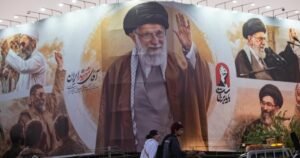
The rapid return to warlike stances took place in the wake of the burial of Ayatollah Ali Khamenei, who was killed Feb. 28 in the opening strikes of the war, in the holy city of Mashhad.
Iran’s new Supreme Leader Mojtaba Khamenei pledged Sunday to take revenge for the death of his father.
“We pledge that we will take revenge for the pure blood of the martyred leader and all the martyrs of these two wars from the criminal and disgraced killers,” he said in a funeral message reported by Iranian state media.
“Revenge is the demand of our nation and must certainly be carried out,” he added. “Soon, the free people of the world will carry out a part of this divine mission.”
Mojtaba Khamenei, 56, was seriously wounded in the same attack that killed his father, sources previously told NBC News. Though Iranian officials have downplayed reports of his injuries, no photo or audio recording of him has been released.
The younger Khamenei, who has not been seen since the war began, did not attend any public events as part of his father’s sprawling funeral ceremony that saw his body taken to five cities in both Iran and Iraq. The stateyea ment attributed to him, like all others issued in his name as supreme leader, was a written message.
The late supreme leader was laid to rest at the shrine of Imam Reza, Iran’s holiest Shia Muslim site on Thursday, marking the end of six days of public mourning ceremonies. Neither the U.S. nor Israel directly targeted funeral sites during the ceremonies.
Warning from Trump
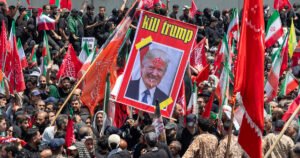
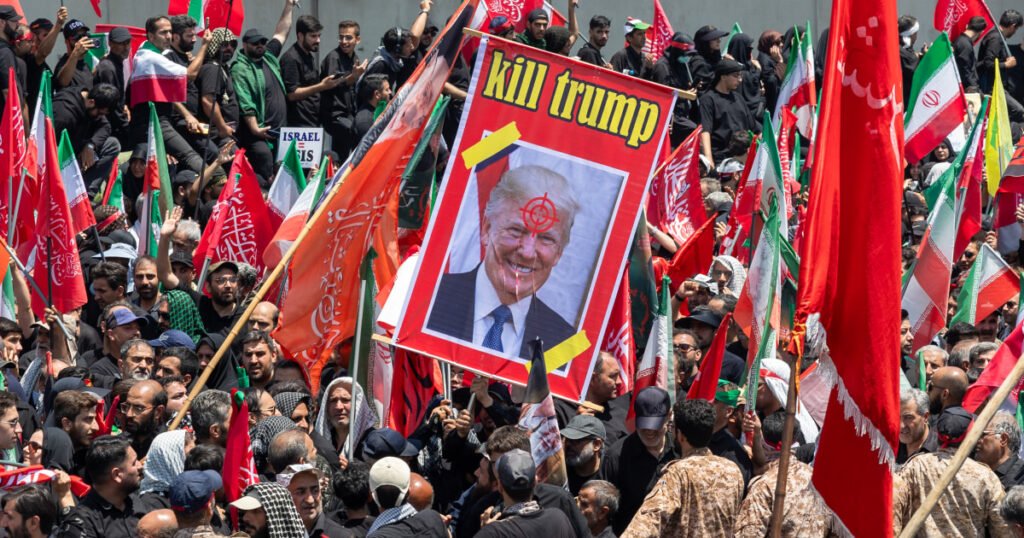
President Trump earlier warned Iran against any attempts to assassinate him after Khamenei’s funeral saw numerous English-language banners openly calling for Trump to be killed along with Israeli Prime Minister Benjamin Netanyahu.
A thousand missiles “are Locked and Loaded and aimed at the Islamic Republic of Iran, with thousands of more to immediately follow, should the Iranian Government act on its threat,” Trump wrote in the overnight post.
Trump said he had issued instructions to the U.S. military to follow in the event of his death, adding that they would “completely decimate and destroy all areas of Iran.”
He signed off the post “PRAISE BE TO ALLAH!” — an invocation the leader has repeatedly used during the war. The Council on American-Islamic Relations, a nationwide advocacy group, in the past has criticized Trump’s “deranged mocking of Islam.”
The threats against Trump have further underlined the tensions gripping the Middle East as an interim deal to end the war buckles under repeated crossfire in the region.
There had been multiple days of U.S. airstrikes targeting Iran, as well as Iranian retaliatory fire targeting nations across the region. Those strikes had been sparked by Iran attacking three ships in the strait earlier this week.
Foreign ministers meeting
Iran and Oman’s foreign ministers met on Saturday to discuss the Strait of Hormuz, which lies between them, after days of Iranian attacks on ships and U.S. retaliation that dealt a blow to the interim deal to end the war.
Oman said it and Iran agreed to keep talking about the crucial waterway “at the technical and political levels,” a day after the United States called on Iran to publicly say the crucial waterway is open and ships won’t be attacked.
Iran has said the strait must be under its sole control and that vessels should begin to pay fees to Tehran — even though the world for decades has considered it an international waterway. About a fifth of all traded oil and natural gas passed through the strait before the war began.
Iran’s grip on the strait during the conflict led to a global energy crisis, though oil prices have sharply dropped since wartime highs of $120 a barrel.
Iranian Foreign Minister Abbas Araghchi on Saturday accused the U.S. of violating the interim deal by ending waivers allowing Iran to sell crude oil on the open market in U.S. dollars, which Washington did in response to the attacks on ships in the strait.
“Reality check: There can only be mutual compliance,” Araghchi wrote on X.
You may be interested

What did Dana Chandler do? Inside the case of the Kansas woman convicted of double murder after three trials
new admin - Jul 12, 2026Dana Chandler has spent decades maintaining her innocence against allegations she was responsible for the 2002 murders of her ex-husband,…

Seattle Seahawks sold to Khosla family in record $9.6 billion deal
new admin - Jul 12, 2026[ad_1] NEWYou can now listen to Fox News articles! Months after capturing their second Super Bowl title, the Seattle Seahawks…

At least 2 killed in mass shooting at Toronto street festival, police say
new admin - Jul 12, 2026At least two people were killed and four more wounded in a mass shooting Saturday evening at a street festival…