



Inside the mini factory where GM builds its EV future

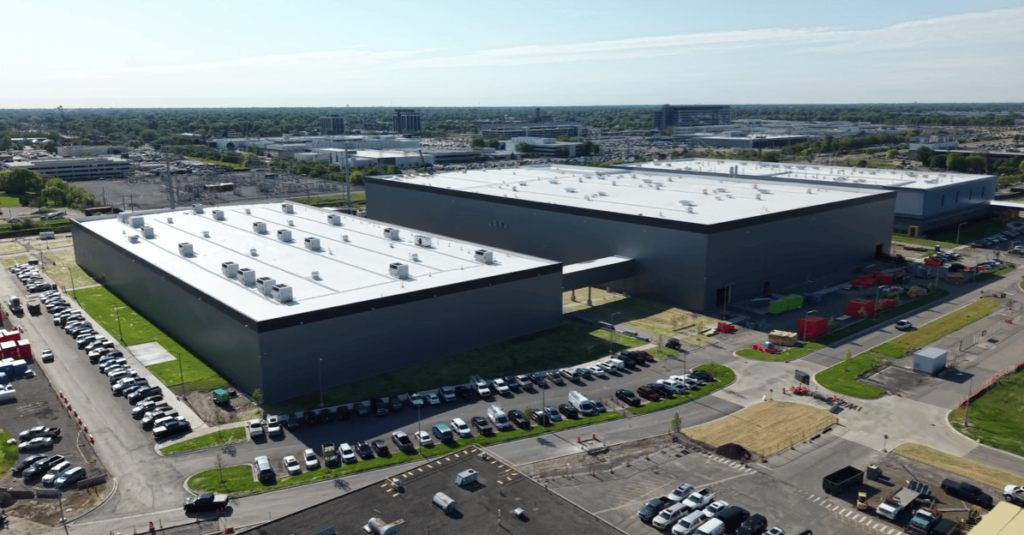
If you’re driving through GM’s sprawling campus in Warren, Michigan, you’d likely ignore the pair of adjacent, anonymous white buildings tucked away in the upper reaches of the 710-acre space.
Inside those buildings, which total half a million square feet together, is a massive construction project that’s still in progress. Once completed, it will house GM’s new Battery Cell Development Center, where the automaker is working furiously to build new prototype cells with the goal of slashing the cost of its EVs.
GM has to build faster and cheaper to meet its goal of selling affordable EVs in much higher volumes. Those EVs will have to compete not only with longtime sales leader Tesla, but also with the flood of Chinese EVs that, sooner or later, will land in the US. And while EV sales in the US appear to be leveling out, America has a long way to go before it can credibly compete with China, the world’s leading EV market.
The number of shoppers interested in new and used EVs spiked when gas prices rose 40 percent this year as a result of the war in Iran — but mostly in models priced lower than the average $50,000 cost of a new vehicle today. While GM sells more EVs in the US than any other company after Tesla, most of its lineup is still too expensive thanks to a battery pack that makes up 30 to 40 percent of the total cost.
During an early September tour, after putting on a hard hat, safety glasses, and a hi-vis vest, I saw up close the tools GM will use to build these newer, cheaper batteries: huge vats for mixing cell slurry, coating machines that deposit electrode material onto film, and machines for a dozen other steps in the process of turning minerals into cells that hold and deliver energy. The plant I toured will be a low-volume factory that lets engineers prototype the higher-volume production to come from giant, billion-dollar factories.
The new facility suggests GM is playing a long game, working to develop new cells that use less — or none — of the minerals China controls globally. Although US scientists developed the original R&D on most new cell chemistries, Asian companies were the ones to develop, refine, and put those chemistries into volume production.
The 15-year Chinese effort that gave the country global control of supply and processing for minerals used in today’s cells, especially cobalt, nickel, and rare earths, means future cells must use different minerals to escape the country’s dominance. One example: GM’s new LMR, or lithium manganese-rich, cells use very little cobalt or nickel. A second: This spring GM announced it’s working with startup Peak Energy on sodium-ion cells for energy storage.
Getting such new chemistries out of the lab and into volume production can last a decade or more. But GM doesn’t have that long. China may already be selling its EVs to Americans by then. The company’s battery engineers are confident that using the new facility inside those anonymous buildings 15 miles north of Detroit can launch new cell chemistries and formats for EVs and battery energy-storage systems in less time than predicted. The company’s future will rest on whether it can succeed.

In June, GM battery czar Kurt Kelty told me the new Battery Cell Development Center, or BCDC, will provide “the critical bridge from R&D lab to production” by combining virtual modeling, physical test capabilities, and small-scale production lines. The aim is to fill the missing link between creating and prototyping new cells and getting them into high-volume production.
BCDC head Mo Gallegos puts the total cost at $900 million. At maximum production, the BCDC might produce 4 to 5 gigawatt-hours of cells. But the goal isn’t quantity; it’s quality.
Inside the 500,000-square-foot lab, I saw much of the machinery needed to fabricate a cell, from mixing slurry for the coating that forms a cell electrode to the charging hardware that energizes a finished cell for the first time. The mini factory will be used for multiple cell chemistries and different formats, starting with prismatic cells. Its purpose is to test industrial cell manufacturing processes, proving and optimizing production techniques and recipes before they’re implemented at scale.
While the BCDC will produce actual working cells, it will do so in far lower volumes and at slower speeds than the production lines at full-scale cell plants. GM’s battery developers will then transfer the knowledge gained from this process testing to its cell production partners that will take the new designs to full-scale volume.
Those would likely include the two plants operated by Ultium Cells LLC, the joint cell production venture between GM and its cell partner, LG Energy Solution. The first plant in Warren, Ohio, opened in 2022 and makes large-format nickel-manganese-cobalt-aluminium pouch cells for GM’s line of EVs (excluding the 2027 Bolt). The second, in Spring Hills, Tennessee, opened in early 2024 and now produces lithium-ion phosphate cells for battery energy storage.
Of the two BCDC buildings, the first houses anode and cathode fabrication on opposite sides, with electrode assembly in the middle. A bridge transports rolls of electrode film to the second building, where the cells are assembled, charged, and tested for eight to 11 days. The second stories house supplies of the metals, films, and components needed, as well as a very substantial set of HVAC equipment to keep the processes sterile, dust-free, and at the right temperature.
The BCDC is slated to produce its first test cells — LMR prismatic cells — in the fourth quarter of this year. But they won’t go into volume production at the Ultium plant in Spring Hill until 2028. Once tests for LMR cells get underway, it will add the sodium-ion prismatic cells it’s developing for BESS with startup Peak Energy.

The problem the BCDC is meant to solve is the chasm between creating new cell chemistries at a small scale and cranking them out in massive quantities in the hundreds of thousands or millions. Taking them all the way through development to commercialization means understanding how to build them; that requires testing production processes and methods to ensure the quality of the finished cells as well as their quantity.
You can think of getting a cell to market in four phases: creating a new chemistry, testing early prototypes, figuring out how to build it, and then ramping up volume production.
The first phase has been centered in GM’s Kettering R&D laboratory for decades. It created and tested new chemistries and cells for the pioneering EV1, the 2011 Chevrolet Volt, and the LMR chemistry the company plans to launch in 2028. But it’s limited to proving out a chemistry one cell at a time, in “coin” or small pouch formats.
GM brought the second phase in-house when it opened its Wallace Battery Cell Innovation Center in 2023. That lab takes new chemistries and expands them into large-format cells up to 200 amp-hours. Wallace can fabricate these new cells in tiny batches of a few dozen, testing whether a new chemistry will continue to perform and remain practical in cells identical to those to be used in end products.
Now, the third phase has arrived in the BCDC, right next door to Wallace. It will use real-world cell fabrication and battery assembly machinery to build thousands of cells a day — ideally assuring the ultimate ramp-up in a bigger plant goes smoothly. And it’s been built with double the floor space used initially to allow for future expansion, multiple chemistries, and multiple cell formats.
Historically, those second and third phases were done by battery manufacturers. They were the missing link between a new chemistry and volume production — virtually always done overseas. Wallace and the BCDC together give GM almost 1 million square feet of battery development space. (GM declined to specify how many employees worked at either facility, saying it varied.)
The fourth and last phase is commercial production at scale, whether at Ultium Cells or other high-volume plants.
To compare the scale of each phase, Kettering R&D might produce 1 liter of slurry with which to coat electrode film to test individual cells. The Wallace lab takes that to 40 liters at a time. Now, BCDC will be able to make 1,500 to 2,000 liters at a time in a single process — whereas high-volume cell plants will run several dozen identical copies of that process at once, or two orders of magnitude more.

Before any physical fabrication starts, cell engineers use virtualization throughout the process. Agility in developing and refining new designs fast comes from using “digital twins” to simulate processes well before production hardware enters the process, said Radu Theyyunni, GM’s director of virtual engineering for global propulsion. In the automotive world, a well-known example is the use of CAD software to model structural designs and crash responses. Over decades, simulations let carmakers speed up their engineering and substantially cut the number of costly prototype vehicles they must inevitably crash to confirm their safety.
Similarly, from the internal behavior of new cell chemistries to the steps of manufacturing each component — how thoroughly molecules are blended in a “high-shear double planetary mixer” to produce slurry, for instance — the time saved through modeling can cut weeks and months out of the timetable to get a new cell from the lab to market.
More recently, GM has leaned heavily on AI in a variety of different virtualization models. Informed by its huge trove of 10 years of prior battery data, Theyyunni said its large language models now predict the results of dozens of minor chemistry changes and process variations far faster than any physical prototyping and testing could. Those results have proven extremely accurate, he said, when they are transferred into real-world prototyping.
At the chemistry level, this simulation lets GM model “what happens if we add more silicon, what happens if you lower the cobalt content,” said Theyyunni. “We can simulate what that would be in a couple of days,” added Kelty. That lets the company tweak production processes as needed, then model again. If done by a cell maker overseas, that process could take months.
Intensive modeling of the molecule blending in slurry mixers let GM cut mixing time by half against the recommended industry practice, Theyyunni said, with no impact on quality or cell performance. Overall, Theyyunni said, the company expects to take a cell through the end-to-end process in “roughly half the time” — although GM declined to quantify timelines or put a number on the time saved. Previously, Kelty suggested it could let GM shave up to a year off development of promising new cell chemistries.
The modeling spans every level of vehicle development: a digital twin of the entire EV; one for the battery pack; one for the cells inside; a digital twin of the electrode that models particle behavior on the electrodes as the cell discharges and recharges; and finally a twin at the atomic level to model lithium diffusion through the electrodes and electrolyte.
The methods transfer easily and simply among chemistries. For battery cells, “atomistic modeling is chemistry agnostic,” Kelty said. To go from NMCA to sodium-ion cells, “we just change the atoms in the model.” After all, “the core equations for quantum mechanics are well known,” added Theyyunni.

Simulating cell behavior on an atom-by-atom level, even before simulating the entire production process to build the cell in volume, takes a huge amount of computing power. During our tour, Gallegos noted the battery development complex draws more power than any other single part of the sprawling Warren campus.
But the company has long done intensive computing, starting well before the modern era of EVs. Soon after the first emission regulations came into force half a century ago, GM began to use computers to model the phases of gasoline combustion inside its engines. Over time, as engines acquired multiple valves, multiple cams, variable valve timing, direct injection, turbochargers, and the growing array of hardware to make an inherently wasteful combustion process more efficient, they came to rely on constantly more powerful computer models. A specific example might be modeling the formation of soot particles within diesel combustion — and how to reduce them.
That experience and available compute power let the company “unlock a lot of value” because it was “comfortable applying these multi-physics, highly detailed tools across lots of different domains where they’ve probably never been applied before,” said Theyyunni.
During the tour, Theyyunni said the company’s compute power is second within the US only to the country’s national laboratories. And “the pace of growth in atomistic modeling is fast,” Theyyunni added, suggesting that over the past six months the company’s AI capabilities have expanded significantly.
The combustion engine side of the house is now aggressively adding AI to its tool chest, though the cell modelers seem to feel they’re still ahead of the curve. The atomic and process modeling done within developing LMR cells, said Theyyunni, required three times the compute capacity that modeling the combustion processes for a gasoline engine does.
Kelty is clearly energized by the possibilities of these new AI-informed modeling and simulation tools. Over the long haul, he said, “We want to get rid of testing” — or at least greatly reduce physical testing of prototype cells and their production methods. Less physical testing to develop and refine new cells would give GM more agility to respond to real-world test data. The ultimate goal, Kelty suggested, would be for the system to do its own R&D to the point that its AI models could “synthesize a new cell chemistry” on its own. But they’re not there yet, he said.
Meanwhile, every large global battery maker has full-cycle development labs very similar to GM’s. Those let them figure out how to build cell chemistries that come in from R&D labs, automakers, consumer electronics companies, and many other sources. But few carmakers aside from Tesla have joint-venture cell plants to make cells they design, as GM does. And even fewer have the full set of R&D-to-prototype-to-process-to-production labs.
Most of the world’s carmakers continue to rely on their cell partners to do parts of that process, in part because it costs a lot — both in compute power and physical plants. GM is betting its investment will give it an edge in speed and agility bringing new cells to market. We won’t know for years to come whether that bet will pay off.
You may be interested

Pope Leo to undergo surgery Tuesday to remove a lung nodule
new admin - Oct 12, 2026Pope Leo XIV will be admitted to a hospital Tuesday morning to undergo surgery to remove a lung nodule discovered…

139 people dead, including 15 children, after migrant boat capsizes off Africa: “Overwhelmed with all the bodies”
new admin - Oct 12, 2026At least 139 people, including children, have died after a boat carrying more than 300 migrants capsized off the coast…

How Apple can win the smart home
new admin - Oct 12, 2026This week, Apple is hosting its first-ever dedicated smart home event. While the company hasn’t shared details about what it…