



Inside the Exclusive Music Gigs at Private-Members Clubs

A
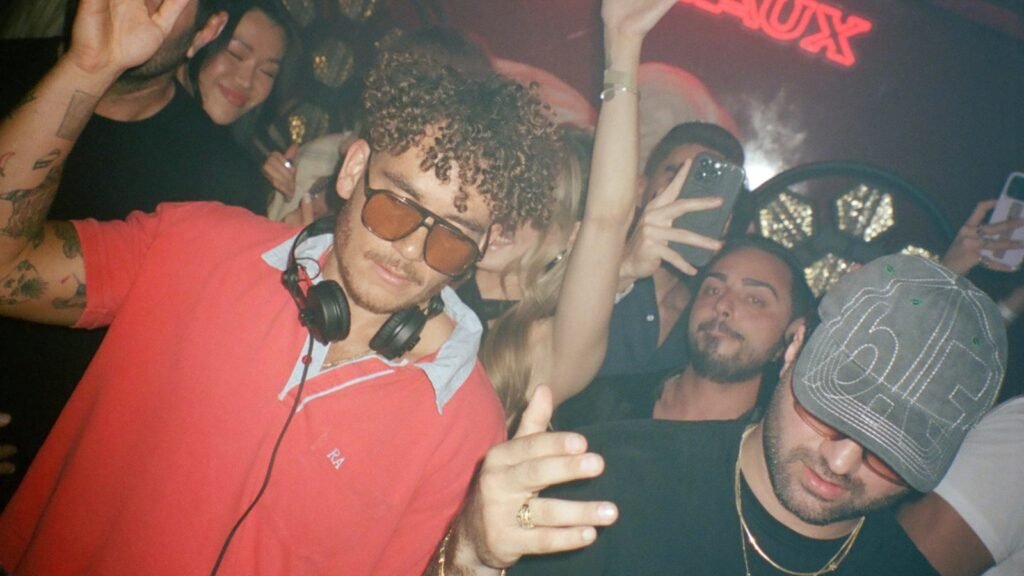
mid a glow of red and orange lights, a chic underground room in New York’s trendy Meatpacking District is alive with bodies. It’s just after midnight, and women are dancing on velvet banquettes, men are two-stepping on luxe, carpeted floors the color of merlot, and everyone is table-hopping with icy martinis in hand, as the groovy house jam “Talk to You” pumps through the venue’s sound system.
It’s one of the latest tracks from ANOTR, an Amsterdam DJ duo who timed the release of the feel-good anthem for the summer. And before the in-demand producers jetted off to Cannes and Ibiza to kick off the European party circuit, they made an unadvertised pit stop here, at the members-only club Chez Margaux.
There’s something surreal about watching some of the most sought-after acts in house music perform for 250 people rather than the thousands they typically draw at festival stages and international gigs. Imagine Foo Fighters playing Irving Plaza before a world tour, or Justin Bieber performing at a tech conference fresh off headlining Coachella. “We aim for the top one percent of the top one percent in terms of DJ talent and musical talent,” Riccardo Ambrosio, the club’s director of events and partnerships, tells Rolling Stone.
The likes of Rüfüs Du Sol, Black Coffee, &ME, and PAWSA have already graced the European-inspired lounge and restaurant for similar private, ticketed shows held roughly twice a quarter. And for jet-setting clientele accustomed to having a Euro Summer, they could catch ANOTR at a pop-up that the club hosted in St. Tropez. But unless you are a Margaux member paying $4,000 in annual dues and a one-time $3,000 initiation fee, you’d be none the wiser.
“I hate to say it, it was a great time. It was nice to have a more intimate space,” says Michal Cohen, who attended the ANOTR spring set, where tickets went up to $1,000. “I think prices are insane, but I do like it more than going to, like, a Brooklyn warehouse.”
In a world where a $15,000 initiation fee isn’t unheard of, exclusive, premium music experiences are emerging as the latest means to attract and amuse deep-pocketed members in the increasingly competitive world of private clubs.
THE CONCEPT OF MEMBERS’ clubs is hardly new. In New York City alone, prestigious, academic-based institutions like the Harvard Club, the scientific Explorers Club, and the old-money haunt The Union Club, which predates the Gilded Age, still stand. But since 2003, with the arrival of London export Soho House to New York City — its rooftop pool earning a cameo in Sex and the City — there’s been a growth of younger-skewing ventures that have sexy-sounding names like Maxine’s, ZZs, and Crane Club, all materializing around the city’s most affluent and buzzy neighborhoods. (The field is so saturated, Vogue came up with a handy guide to determine what clubs best fit someone’s personality.)
The business behind these clubs is booming, and hospitality experts forecast that the private-club trend will only continue to accelerate, with applicants for New York City alone increasing 42 percent last year, according to Zach Bates, an industry expert and marketing strategist.
These clubs have always strived to maintain an edge on competitors by hiring award-winning chefs, hosting curated events, and decking out their interiors with millions of dollars worth of art. Still, the more competitive landscape has led clubs to drill deeper into hyper-specialization. Moss, a wellness-focused hub near Bryant Park, offers heated thermal pools. New York Vintners in Tribeca is a best-kept secret among wine aficionados and New York Knicks players, with its three-level space serving as an ultra-private storage cellar, entertainment venue, and dining room. Cult streetwear brand KITH introduced the sports-centered KITH Ivy, a “luxury padel brand and club” with $25 Erewhon smoothies and a boutique store.
“There’s going to be this shift where clubs are going to be able to connect you with like-minded people,” explains Bates, who is CEO and founder of Private Clubs Inc., a development and management firm for such ventures. “They’re looking for experience over possessions.”
Take Zero Bond — a favorite members-only haunt of former New York City Mayor Eric Adams and billionaires Jeff Bezos, Kim Kardashian, and Michael Rubin — who created Baby Disco in its new Las Vegas outpost, offering a scaled-down alternative to the city’s multilevel mega-clubs. On opening night, Doja Cat performed before the Chainsmokers deejayed a set to a few hundred people, versus the thousands they’d attract elsewhere on the Strip. “These clubs went from 2,000, 3,000 to 6,000 people,” explains owner Scott Sartiano, whose résumé includes New York institutions 1 Oak and Up & Down. “[They] got bigger and bigger and bigger. That’s not for everybody. We thought: ‘What can we do that’s right for Zero Bond and its members that gives them that feeling of what they want?’”
Next weekend, Soho House, a longstanding staple of the membership club scene, is bringing its long-running music festival to New York City for the first time. Headlined by Alanis Morissette, the one-day $450 ticket available to members and their guests, will feature a throwback indie-rock line-up that includes the Flaming Lips, MGMT, Santigold, Questlove and friends, as well as Justine Skye, Pauli Lovejoy, and Hamilton Leithauser. Their clubs around the country also offer discounted concert tickets, as well as intimate moderated conversations and live performances within the clubs from artists such as Norah Jones, 50 Cent, Leon Bridges, James Pay, All-American Rejects, and Ja Rule. “We’ve definitely noticed a craving from our members … people are really craving those experiential moments,” explains Dominique Belas, the company’s global head of events.
Members of Aman New York can stop by its Jazz Club, a swanky underground venue for guests of the five-star property. On Valentine’s Day, members were treated to a special set by Diplo, and Jack Harlow dropped by for a scaled-back set of his latest album, Monica. Space permitting, members of the public can also reserve tables to see the likes of Mike Yung, a subway singer-turned-breakout star of America’s Got Talent; acclaimed jazz drummer and composer Terri Lyne Carrington; and vocalist April Varner. There’s also a residency series, kicked off by Black Thought of the Roots, whose semi-regular “One of Those Nights at The Jazz Club” evenings feature rotating surprise guests.
And newcomer Stylus — envisioned as a “shrine to music” — will be a first-of-its-kind space built around a state-of-the-art listening room in the Lower East Side in early 2027. Priced at $10,000 in annual dues and a $5,000 initiation fee, the club will have a high-fidelity sound system designed by Devon Turnbull and 40-hertz sound and light therapy sessions.

The All-American Rejects at Soho House
Courtesy of Soho House
The ramp-up of exclusive music-based events comes as the live music industry reaches a crisis point over exorbitant prices and hyper-commercialization. This summer, for example, Pacha New York charged up to $600 a ticket to secure a spot in its “VIP Zone,” set apart from the general area that can hold more than 5,000 people. And depending on the DJ, which has recently included Rampa, Black Coffee, and ANOTR, a designated table for a dozen people may require a minimum spend of more than $10,000.
Erika, who asked to be identified only by her first name, says she gladly paid upwards of €1,200 for two tickets to watch Rampa descend upon the slopes of Courchevel in the French Alps for an après-ski set hosted by Chez Margaux earlier this year.
“It was the highlight of our trip,” Erika says, recalling how the sun set against a backdrop of powdery mountaintops. “We are in our thirties now, and the experience of having that type of exclusive and intimate event was really appealing to us. It obviously comes with a much higher price tag than a music festival or warehouse venue that you might otherwise see these types of DJs. [But] as we get older, we are looking for more experiences like that, compared to a massively crowded event.”
Of course, exclusivity translates to steep prices, but costs have been rising across the board. Between 2019 and 2024, the average cost of a traditional concert ticket in the U.S. rose more than 30 percent, according to Billboard. Fans have been forced to battle scalper bots for seats as small independent venues shutter at an alarming rate. While megastars like Harry Styles, Olivia Rodrigo, Noah Kahan, and Taylor Swift can easily sell out stadium-sized shows, the “blue dot fever” — where a sea of blue dots on online seller platforms represents hundreds of unsold tickets — has seen artists like Kid Cudi, the Pussycat Dolls, and the Black Keys scale back shows or scrap tours entirely, citing weak ticket sales.
Some New York nightlife venues have tried to find middle ground by introducing membership models that focus less on exclusivity and more on encouraging frequent concertgoing. Live music venue Baby’s All Right sells an 8-ball chain necklace that doubles as a yearly $250 membership, with free entry to any show. Subscribers to Nowadays’ Patreon — priced as low as $5 a month — are guaranteed entry to every party and can skip the line. Bushwick venue Elsewhere rolled out membership tiers, where the top seasonal pass at $45 a month earns the member and a guest unlimited free entry to shows, VIP guest-list drops, and invites to private events.
“The angle we’ve always taken is more around accessibility and just bringing together music fans first,” says Rami Haykal-Manning, co-founder of Elsewhere. “I feel like memberships have always been around at clubs. It’s not a new concept, but a lot of spaces in the last couple of years have really tried to tap into it in a more hospitality-forward or higher-end version.”
As live music events are increasingly turning into big format spectacles backed by blue-chip sponsorships, some members’ clubs see an opening in the opposite direction: private sets and scaled-down performances for those who can afford it.
“There’s nothing that compares to it,” Ambrosio says. “That’s what makes them so special and what people are willing to pay the price for.”
You may be interested
Hurricane Polo grows into Category 5 storm off Mexico, could produce life-threatening flooding
new admin - Sep 22, 2026Hurricane Polo rapidly intensified off the coast of southwestern Mexico on Tuesday, growing into a powerful Category 5 storm that…

Save $30 on Apple’s Magic Keyboard with Touch ID and a numpad
new admin - Sep 22, 2026Until the end of the day on September 22nd, 2026, Best Buy and Amazon have the black Apple Magic Keyboard…
Tupac Shakur Murder Trial Documentary Is in the Works
new admin - Sep 22, 2026[ad_1] The film will follow the trial of Duane “Keffe D” Davis, who was convicted in the 1996 death of…