

How Does Noise Damage Your Hearing?

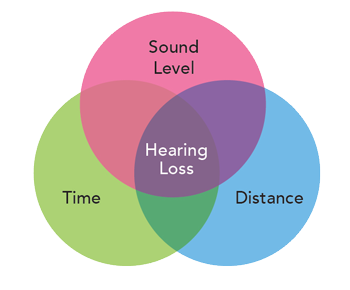
Sounds that are too loud for too long can damage your hearing permanently. This is called noise-induced hearing loss (NIHL). The louder the noise, the faster it can damage your hearing. If the noise is very loud, you could lose your ability to hear instantly. If the noise is not as loud but long-lasting, hearing damage can build slowly. NIHL can happen to anyone at any age, so it’s important to start protecting your hearing—and your children’s hearing—early.
Think of the many sounds at different volumes you hear in a day, a week, or a year. The effects of loud sounds add up over a lifetime. Because the damage from noise exposure is usually gradual, you might not notice it, or you might ignore the signs of hearing loss until they become more serious.
Over time, sounds may become distorted or muffled. You might find it difficult to understand people when they talk, or you might turn up the volume on the TV. The damage from NIHL can lead to hearing loss serious enough that you need to make sounds louder with devices like hearing aids, to help you hear, communicate, and participate fully in daily activities.
The good news is that you can prevent NIHL. By teaching children healthy hearing habits, you can help them keep their hearing too.
How You Hear
You hear because of a series of steps in your ear that change sound into electrical signals. The auditory nerve carries these signals from your inner ear to your brain, which makes sense of the sounds you’ve heard.
- The cochlea—a snail-shaped structure in your inner ear—is lined with sensory hair cells.
- On top of each hair cell is a wispy bundle of stereocilia (pronounced STARE-ee-oh-SILL-ee-ah), which sways with sound vibrations. Over time, sounds that are too loud can damage these hair cell bundles. When that happens, hair cells can’t send information about sounds to the brain. In humans, the hair cell bundles cannot be fixed or replaced, so this damage leads to permanent hearing loss.
Causes and Signs of Noise-Induced Hearing Loss
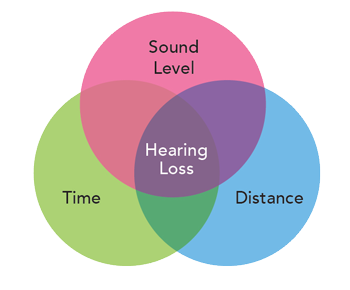
There are three key factors that affect whether and by how much a sound will damage your hearing:
- Decibel level: How loud the sound is.
- Distance: How close you are to the source of the sound.
- Time: The length of time you are exposed to the sound.
NIHL can result from a one-time exposure to a very loud noise, like a nearby explosion or a shotgun firing. You’re more likely to lose your hearing gradually, however, from sounds that aren’t as loud but that you’re exposed to repeatedly for long periods.
Some examples of noisy activities that could damage your hearing are:
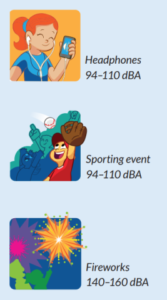
- Listening to loud music through headphones, at a concert, or while you’re playing an instrument.
- Going to the movies in theaters or cranking up the volume on the TV at home.
- Going to sporting events attended by large, noisy crowds.
- Going to fireworks shows.
- Working with loud power tools.
Your hearing might return to normal a day or two after you’ve been exposed to loud noises. Recent research suggests, however, that your hearing can be permanently damaged even if you don’t have noticeable hearing loss right away.
Because NIHL can build slowly over time, you might not notice the early signs of hearing loss. As your hearing gets worse, certain sounds—particularly speech—begin to sound muffled. As a result, you may:
- Ask others to repeat what they’ve said more often.
- Turn up the sound on the TV, music player, or other devices.
- Have ringing or buzzing in your ears (a condition called tinnitus).
- Have trouble hearing high-frequency speech sounds, like some consonants. For example, the sentence, “I asked Skip if he felt sick” might sound like a series of vowels: “l a____ __i_ i_ _e _el_ _i__.”
How Can You Help Your Kids Protect Their Hearing?
Just as wearing sunscreen can protect you from sun damage, healthy hearing habits can help protect you from NIHL. When you talk to your kids about noise and hearing loss, remind them to:
*Note: PDF files require a viewer such as the free Adobe Reader.
You may be interested

Details on Ed Sheeran tour as all acts quit after Macklemore dropped for pro-Palestine comments
new admin - Sep 17, 2026Ed Sheeran is facing intense public backlash after rapper Macklemore, who was set to open his upcoming tour dates, was…

Oregon In Trouble? UCLA Turning Heads? Klatt Names Alarming, Exciting CFB Teams
new admin - Sep 17, 2026[ad_1] NEWYou can now listen to Fox News articles! Week 2 of the college football season was nothing but thrilling. Oregon…
Patrick Clancy sits down with 60 Minutes
new admin - Sep 17, 2026Patrick Clancy sits down with 60 Minutes - CBS News Watch CBS News Patrick Clancy spoke with 60 Minutes this…