


House Ed Panel Tackles Scholarship Bias, Financial Aid Fraud

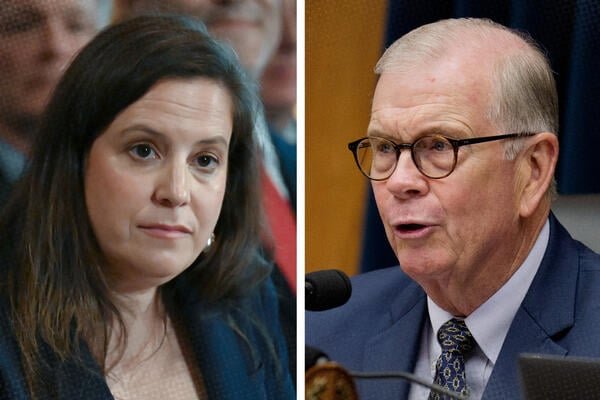
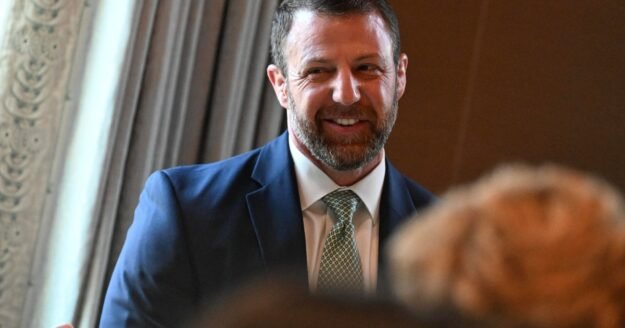
Rep. Elise Stefanik of New York (left) introduced the bill regarding bias in the Truman Scholarship Program, and Rep. Tim Walberg of Michigan (right) introduced the most contested financial aid fraud bill.
Photo illustration by Inside Higher Ed | Will Waldron/Albany Times Union/Getty Images | Andrew Harnik/Getty Images
The House Education and Workforce Committee advanced a bill Tuesday that would allow President Trump to fire multiple leaders and dismiss all board members of the Harry S. Truman Scholarship Foundation, an independent government agency and annual grant competition that multiple Republican committee members claim has become a “program to train professional leftists.”
Established with bipartisan congressional support in 1975, the prestigious award was designed to honor its namesake each year by financially supporting 50 high-achieving undergraduates interested in pursuing a “public service–related” career. But recently, Republican lawmakers have alleged that despite being overseen by a bipartisan governing board, the program disproportionately favors applicants with Democratic beliefs.
“The Truman program has strayed far from its original purpose,” said Rep. Randy Fine, a Florida Republican and one of the most vocal supporters of the bill. “It’s increasingly become a pipeline for radical liberal activists—a job training ground for one political party—rather than a bipartisan award where every student, no matter who they are, has an equal chance.”
The bill, introduced by Rep. Elise Stefanik, a New York Republican who currently sits on the board, would also require that no more than half of each interview panel come from the same political party, institute a new code of conduct and codify that only U.S. citizens are eligible for the scholarship.
Democrats on the committee uniformly opposed the bill, doubting the existence of the alleged political bias. But if such a bias existed, the proposed legislation was not the solution, they said.
“This bill would allow the president to immediately dismiss the entire board and replace them with his own picks, ensuring his handpicked board could remake the scholarship and foundation as the president sees fit,” said Rep. Bobby Scott, a Virginia Democrat and ranking member of the committee. “It would weaponize a historically bipartisan program that could now be used to seek retribution for perceived ‘anti-conservative’ bias in higher education.”
The Truman Scholarship Clean House Act was just one of four higher ed–related bills that passed through the committee Tuesday afternoon. Although few of the bills are likely to become law, they offer a glimpse of what House Republicans are prioritizing ahead of the midterm elections this fall. The other three bills were relatively similar and designed to crack down on what Republicans described as waste, fraud and abuse within the federal student aid system, though each in slightly different ways.
Two bills were broader, essentially codifying existing practices at the Education Department to identity fraud-detection services and requirements that institutions conduct in-person or virtual identity verifications for flagged students. One, the Student Aid Fraud Oversight and Accountability Act of 2026, recommends regular audits of universities where fraud is suspected. The other is called the No Aid for Ghost Students Act.
And while Democrats raised a few technical concerns about how the fraud-detection process could lead to racial discrimination, delay disbursement of awards for real students and create administrative burdens for institutions, Republicans said they were willing to meet with financial aid experts and make the adjustments needed to account for those concerns.
In the end, both passed with unanimous support from both parties.
However, the last bill from Rep. Tim Walberg, a Michigan Republican and chair of the committee, received significant pushback and advanced narrowly along party lines.
The FAFSA Verification Efficiency Act would grant the Education Department authority to verify the Social Security number and citizenship status not only of the student applying for aid but also of their parents and/or guardians.
Democrats on the panel as well as outside experts fear that this bill could discourage students who have undocumented parents or guardians from applying to college for fear of outing their family members, especially in light of President Trump’s ongoing campaign against undocumented immigrants.
“Congress should never authorize the citizenship verification of anybody who is not [directly] receiving federal student aid. And we certainly should not give the Trump administration more authority to surveil or intimidate students and their families for simply applying to college,” Scott said.
Other Democrats, including Rep. Suzanne Bonamici of Oregon and Rep. Mark Takano of California, said students’ fear of losing family members and their distrust that the government will solely use their citizenship status to prevent fraud should be taken seriously.
“I wish that we could trust government agencies, but we’ve seen government agencies and their policies be responsible for the death of American citizens,” Takano said.
Scott proposed multiple amendments to try and address these concerns, but each was struck down. Instead, Walberg encouraged the committee to “ratchet down the venomous statements” about Immigration and Customs Enforcement and “the law itself.”
“I appreciate the sensitivity, the compassion, the emotion, but again, the underlying bill allows the department to use citizenship for identity verification, without restricting student aid based on the citizenship status of a student’s parents, stepparents or spouse. Full stop,” Walberg said. He added that fears among students applying for aid stem from “an inaccurate spin” of information about the Immigration and Customs Enforcement agency. “It’s time to stop that.”
All four pieces of legislation will now move to the House floor for a vote. However, since a bill requires 60 votes to pass the Senate and Republicans hold a narrow majority in the upper chamber, they are unlikely to all become law.
Still, financial aid experts and college access advocates remain concerned. Social Security numbers are needed to help set up parental Federal Student Aid ID accounts and ensure the required tax information is provided on the application. But unless the parent or guardian is seeking to borrow a Parent PLUS loan, they explained, their citizenship status is “irrelevant” and “constitutes a privacy breach.”
“While we appreciate the desire for operational efficiency, it should not be at the expense of basic privacy rights,” Melanie Storey, president and CEO of the National Association of Student Financial Aid Administrators, told Inside Higher Ed. “This bill would simply codify a process for gathering information that is not necessary to verify student eligibility and is outside the boundaries of current computer-matching agreements.”
You may be interested

Maxx Crosby details ‘off’ meeting with Ravens, emotions during ‘rollercoaster’
new admin - Mar 18, 2026[ad_1] NEWYou can now listen to Fox News articles! Maxx Crosby was set in stone to be the next Baltimore…

Benjamin Netanyahu tries to dispel viral rumors of his death, fueled by AI paranoia
new admin - Mar 18, 2026Israeli Prime Minister Benjamin Netanyahu has become the subject of a widely debunked but ongoing claim that he is dead,…

Vince Gill Says Taylor Swift Will One Day Be in Country Hall of Fame
new admin - Mar 18, 2026[ad_1] When Vince Gill was inducted into the Country Music Hall of Fame in 2007, the singer, songwriter, and guitarist…