
Hegseth is Waging War on Colleges. His Targets Are Unclear.

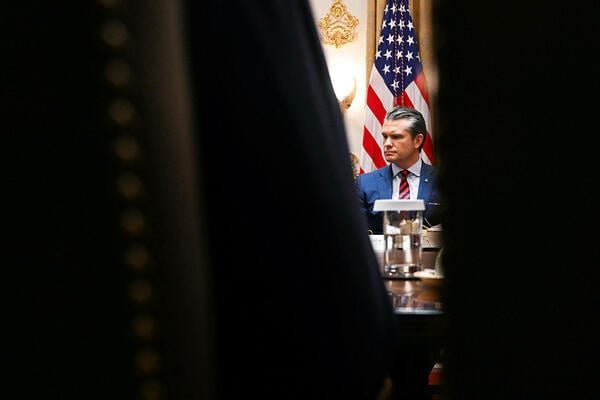
Last month, Secretary of Defense Pete Hegseth made several announcements, stating he was ending partnerships with multiple highly selective colleges and universities that have long educated military service members. But it remains unclear what he’s actually canceling, why specific universities have been targeted or favored and what he plans to replace these programs with.
Lindsey Tepe, government relations director for the American Council on Education, said the uncertainty stems in part from the fact that the Defense Department is primarily communicating the changes through videos and news releases, rather than talking with institutions themselves. “The drip of news over the past month has not been conducive, I think, to clear implementation or any sort of ability for institutions to communicate to applicants what is happening,” Tepe said.
“I think it’s created a lot of confusion,” she said, adding that “disrupting those partnerships and those programs is not going to help meet the needs of the branches of service.”
This week, a spokesperson for the Defense Department (which now calls itself the Department of War, or DoW) told Inside Higher Ed that, beyond Hegseth’s videos, memos and a Feb. 27 statement from chief Pentagon spokesperson Sean Parnell, “we don’t have anything additional to provide on this, at this time.” Parnell’s statement said the department is eliminating fellowships at universities that “diminish critical thinking, have significant adversary involvement, or fail to deliver rigorous education grounded in realism. The policy changes will not impact any Service members or DoW civilians currently enrolled in the affected programs.”
Defense Department documents that Inside Higher Ed has obtained suggest that Hegseth’s announcements about what the department is doing go much further than what is actually happening on the ground.
At stake is a slice of universities’ lucrative partnership with the military, which both sides have called beneficial in the past. And Hegseth’s changes to which institutions can train top military leaders come just as the U.S. has entered into a war with Iran that’s upended the Middle East.
‘Radical Ideologies’
A month ago, Hegseth said in a video on X, “America’s highly ranked universities no longer live up to their founding principles as bastions of free speech, open inquiry” and commitment to “American values.”
“Take Harvard University, for example—I know it well,” said Hegseth, who earned a master’s degree in public policy from the Harvard Kennedy School.
He proceeded to denounce his alma mater, calling Harvard “one of the red-hot centers of hate-America activism.” He added that “too many faculty members openly loathe our military” and “squelch anyone who challenges their leftist political leanings.”
“Even more troubling is Harvard’s partnership with our adversaries,” he said, suggesting that the university has partnered with the Chinese Communist Party and “encouraged a campus environment that celebrated Hamas, allowed attacks on Jews and still promotes discrimination based on race.” He even accused Harvard of ideologically tainting military leaders.
“For too long, this department has sent our best and brightest officers to Harvard hoping the university would better understand and appreciate our warrior class,” he said. “Instead, too many of our officers came back looking too much like Harvard: heads full of globalist and radical ideologies that do not improve our fighting ranks.”
Then he announced the breakup: “I am discontinuing all graduate-level Professional Military Education (PME), all fellowships and certificate programs between Harvard University and the War Department for active-duty service members.” He suggested more was coming, vowing that the military would evaluate “all existing graduate programs for active-duty service members” at all Ivy League and other civilian universities. He backed that up with a matching written memo.
(The Harvard Kennedy School has interpreted this as fully discontinuing “graduate school enrollment at Harvard for active-duty service members,” according to a message its dean sent prospective students Wednesday. In response, the school is allowing admitted students who are barred from attending to defer enrollment for up to four years—or to apply to other selective institutions, such as the University of Chicago, and have their applications reviewed on “an expedited timeline.”)
On Feb. 27, Hegseth dropped another video, announcing “the complete and immediate cancellation of all Department of War attendance at institutions like Princeton, Columbia, MIT, Brown, Yale and many others, starting next academic year.” That could be interpreted as ending even undergraduate tuition assistance for service members at these universities—which is further than he’d gone with Harvard.
But this time, the accompanying memo didn’t match. It said only that “we are eliminating certain Senior Service College (SSC) Fellowship programs for the 2026-2027 academic year and beyond”—which is just one type of fellowship. Attached to the memo was a list of 15 higher ed institutions, showing 78 Senior Service College fellowships canceled across them. (Fellowships were also canceled at several nonprofits, for a total of 93.)
“The Senior Service College Fellowship programs are fairly narrow compared to the wide range [of programs] … that the different branches partner with civilian institutions to offer,” said Tepe, with the American Council on Education.
Furthermore, a “Rollout Plan” for that Feb. 27 memo, which Inside Higher Ed obtained, clarified specifically that “there is no impact to ROTC programs, tuition assistance and voluntary education programs, grant programs, professional degrees (i.e., medical, dental, law, or business degrees), or military-to-military educational exchange with foreign military education institutions.”
Though 93 canceled fellowships “doesn’t seem like a lot,” Tepe said, “I do think this sets a really troubling precedent for the politicization of opportunities that senior military officers have to pursue professional learning.”
Some of the institutions where fellowships were canceled—as well as those listed as potential replacements—never received notification from the Pentagon, these universities told Inside Higher Ed. It’s unclear if any did.
Institutions Ambushed
Retired U.S. Army colonel Peter Mansoor, a military history professor at Ohio State University, said that, typically, those selected to go to a military-run war college, such as the Army War College, can instead apply to go into one of these Senior Service College Fellowship programs at a think tank or university. The military does this so “some of the uprising potential officers, who might potentially become generals, get a broader education and a broader perspective on a variety of things,” he said.
Among the universities with now-canceled Senior Service College Fellowship programs are the Massachusetts Institute of Technology, William & Mary, Carnegie Mellon University, Yale University and Harvard.
An MIT spokesperson wrote in an email Thursday, well after the Feb. 27 memo, that it hasn’t “received any official communication and cannot comment on any reported change in policy.”
“Over 12,000 military officers have been commissioned from MIT, with more than 150 reaching the rank of general or admiral,” the spokesperson said. “We have taught military science classes dating back to the opening of our doors. MIT has top-ranked programs in AI, quantum, computer science, nuclear science and engineering, naval engineering, and more—all of which are critical to modern defense. We’re honestly surprised at the idea of taking such educational opportunities off the table.”
A William & Mary spokesperson said in a statement, “We have not received official notification from the Department of War about any change in status affecting our programs or our students, or any information related to why we were included in the department’s February 27 announcement.” Noting it educated President George Washington, the college said it’s “puzzled and saddened” and that “the culture on our campus is one of longstanding support for our military and veteran students.”
A Carnegie Mellon spokesperson wrote in an email that “this change set to begin next academic year will have a limited impact; only five fellows are designated to CMU through the fellowship program.” The spokesperson also noted what wasn’t affected: “ROTC, graduate master’s or Ph.D. programs, certificate or training programs, students attending on veterans’ benefit programs, cooperative agreements, or any research programs or activities.”
The spokesperson said that current initiatives include preparing officers to support Navy nuclear missions and training sailors and soldiers in AI and robotics, “ensuring our military are the best in the world in understanding and deploying cutting-edge technology.”
A Yale University spokesperson said that the university is “working to understand the changes in the department’s policy and remains deeply committed to educating leaders who serve our nation.”
“Yale has a long history of faculty research on national security and global affairs as well as teaching students who aspire to careers in the military, national security and statecraft,” the spokesperson said.
Mansoor called Hegseth’s cancellation of these partnerships “shortsighted.”
“It is to the detriment of our nation’s national security that military officers will no longer be able to learn from some of the best minds in the nation and that, vice versa, that military officers won’t be able to interact with some of the senior civilian thinkers in the nation,” Mansoor said, adding that “this interaction won’t occur anywhere else, and now you’ve completely cut it off.”
Hegseth’s Feb. 27 memo also listed 24 civilian higher ed institutions among its “potential new partner institutions.” Among them are the University of Michigan, the University of North Carolina, Virginia Tech, Regent University, Hillsdale College and Liberty University.
The memo said, “These institutions meet the following criteria: intellectual freedom, minimal relationships with adversaries, minimal public expressions in opposition of the Department, and Graduate-level National Security, International Affairs, and/or Public Policy Programs.” It provided no further details on how those criteria were judged.
A Liberty spokesperson told Inside Higher Ed in an email Thursday that “so far, there has been no coordination between Liberty University and the Department of War regarding their announcement of a potential partnership.”
“Liberty University is grateful for the Department of War and its ongoing mission to defend this great nation, and for Secretary Pete Hegseth’s leadership,” the spokesperson said.
A Virginia Tech spokesperson similarly said the university “was not contacted by the United States military about being a potential partner, nor did the university contact the military, prior to the issuance of [the] February 27 memo.” Still, the spokesperson said, “we are not surprised to be mentioned in this conversation … Virginia Tech has a decades-long history with the United States military … We are open to cultivating new ways to strengthen that relationship in the decades to come.”
A Regent spokesperson said that university “is in discussions with the Department of War about contributing to the professional development of senior military leaders,” but didn’t provide further detail or an interview. The spokesperson said Regent “has a long-standing commitment to educating and supporting members of the U.S. military and their families,” including “working with the Naval Preparatory Program to help prepare future Navy officers.”
UNC at Chapel Hill chancellor Lee Roberts said in a statement that the university is proud to be “identified as a potential education partner.”
“Our University has a long and distinguished history of educating and collaborating with military leaders through broad, pan-university academic offerings that span public policy, global affairs, national security, public health, business, law, data science, leadership and emerging technologies,” Roberts said.
You may be interested

Lehigh’s March Madness dreams continue with epic half-court buzzer-beater
new admin - Mar 06, 2026[ad_1] NEWYou can now listen to Fox News articles! Both the calendar and basketball court say it is March.Lehigh University…

The best microSD Express cards for the Switch 2
new admin - Mar 06, 2026Unlike the original Switch, the Nintendo Switch 2 requires microSD Express cards for storing and playing games. While physically identical…

Why ‘Coming Up Roses’ Is Harry Styles’ Emotional Powerhouse
new admin - Mar 06, 2026[ad_1] Harry Styles spends most of his delightful new album on the dance floor. Kiss All The Time. Disco, Occasionally…