


Calif. Bills Could Expand Community College Bachelor Degrees

Two California bills that would expand community college bachelor’s degree offerings in the state have advanced through the Assembly and could be up for final votes before the session ends on Monday.
The California Community College system has been offering bachelor’s degrees within strict parameters for more than 10 years. The new proposals would increase the kinds of programs community colleges can offer, in some cases even if a nearby public four-year university already offers similar programs. AB 2694 would require that colleges meet certain performance standards in order to offer bachelor’s degrees, and SB 960 would cap the number of bachelor’s degrees a community college could grant at 15 percent of the total number of associate degrees granted.
Despite the success the bills have seen so far in the Legislature, the question of whether community colleges should offer bachelor’s degrees at all has divided higher education leaders in the state. And even if the bills do pass, it’s unclear whether California Gov. Gavin Newsom would sign them into law. In 2024 and 2025, Newsom vetoed bills that would have allowed community colleges to grant bachelor’s degrees in nursing.
The sponsor of AB 2694, Democratic Assemblymember David Alvarez, said in a statement that his bill would make higher education more accessible to more people and allow community colleges to better address workforce shortages.
“Our economy has changed, our workforce needs have changed and our students have changed. Many are working adults, parents, caregivers and first-generation students who are rooted in their communities and cannot relocate or commute long distances to earn a degree,” Alvarez said in a statement. “We have regions facing shortages of nurses, technicians or other skilled professionals. When existing programs are not meeting that need, our community colleges should be empowered to respond to those workforce needs. Transfer pathways will remain essential, and CSU and UC will always be the backbone of baccalaureate education in California.”
At least 24 states already have laws that permit some community college bachelor’s programs, according to the Community College Research Center based at Teachers College at Columbia University. Still, enrollment data from last spring shows that only about 2 percent of all community college students were enrolled in a bachelor’s degree program, according to the CCRC.
Thomas Brock, director of the CCRC, said that these arrangements are in the best interest of students and communities, and the more community colleges work with public four-year colleges, the better.
Although policies that allow community colleges to grant bachelor’s degrees often have bipartisan support among legislators, they have become a major point of contention between two- and four-year college leaders around the country.
A spokesperson for the California State University system declined to comment on the legislation.
Rowena M. Tomaneng, deputy chancellor of the California Community College system, said in an email that her office supports the expansion of high-quality, affordable education pathways that contribute to economic opportunity and social mobility for people across the state.
“As our state’s economy continues to evolve, students need flexible and affordable options that prepare them for in-demand careers and the future of work,” Tomaneng wrote.
Eloy Ortiz Oakley, who served as chancellor of the California Community College system from 2016 to 2022, disagreed. He said that community colleges would be better off creating workforce credentials or partnering with private nonprofit colleges to offer bachelor’s degrees than creating their own.
“Community colleges continue to twist themselves into pretzels trying to find an angle that allows them to offer more baccalaureate degrees, and I think that’s a mistake,” said Oakley, who is now president and CEO of the College Futures Foundation. “I think we’re missing the point in California.”
Oakley pointed to declining interest in traditional higher education and growing enthusiasm for shorter-term programs that are responsive to the evolving workforce as evidence that community colleges should put their energy elsewhere.
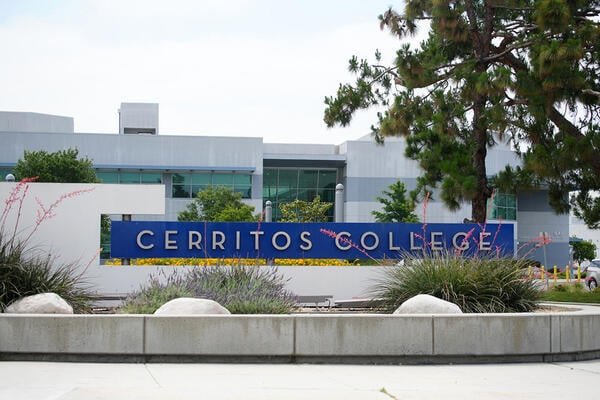
Jose L. Fierro, president and superintendent of Cerritos College in Southern California, agrees that community colleges should focus on regional workforce development and socioeconomic mobility for their students by offering associate degree and certificate programs. But, in some cases, they can also include bachelor’s degree programs, he said.
Cerritos began offering a bachelor’s of science in dental hygiene last fall. And starting in spring 2027, Cerritos will offer a bachelor’s degree in field ironworker supervision, which is meant to prepare students for leadership positions in the construction industry.
Fierro said he got pushback from leaders of California State University campuses that offer construction management when he proposed the program. They were concerned that Cerritos’s new program might enroll students who would have otherwise gone to their universities. Fierro said he expects very little overlap of interested students because Cerritos’s program is designed to serve primarily working adults who are already involved with local labor unions.
“It’s very unlikely that someone with a family, with a good-paying job, is going to quit their job and move 300 miles away to take a program and come back,” Fierro said.
Carlo Salerno, managing director of education insights at the Burning Glass Institute, a labor and policy think tank, said the community college bachelor’s degree debate is representative of a larger shift in higher education: the blurring of the traditional boundaries between two- and four-year colleges. For example, more four-year universities are offering professional certificates and other short-term opportunities for graduates to build on their education. He said he’s generally a proponent of the way higher education is evolving, but he understands why the changes are stressful to college leaders.
“There are only so many students out there that can be trained, and so I think both school structures are trying to make the case that, like, ‘Hey, look, if you want us to abide by our traditional roles, then let us abide by our traditional roles, but stay out of my student pool,’” Salerno said.
At the same time, he said, “Maybe we don’t have to adhere to two-year programs [providing] vocational training and four-year programs [offering] traditional bachelor’s degrees just because we’ve always done it that way.”
You may be interested

PVA’s important work on the world people with disabilities 1860
new admin - Sep 23, 2026[ad_1] For people with disabilities, accessibility is not simply a convenience. It is a fundamental civil right, and at its…

YouTube is building AI creator tools that do almost everything for them
new admin - Sep 23, 2026Part of the job of a content creator is to figure out how to get their work in front of…

Tampa Bay Rays Secure AL East Crown: ‘It’s A Tough Division’
new admin - Sep 23, 2026[ad_1] NEWYou can now listen to Fox News articles! Playing in perhaps baseball's toughest division, the Tampa Bay Rays were…