

Boy George on His Israel Trip and Backlash to ‘We Will Dance Again’


“I’ve always joked that I’m a little bit Jew-ish-ish with a big hyphen,” says Culture Club frontman Boy George. He had recently returned from an eight-day trip to Israel, where he performed two sold-out shows at Tel Aviv’s Menora Mivtachim Arena on Nov. 4 and 7. George’s arrival is a rare one, as most Western artists have steered clear of the country, which has been plagued by political infighting, wars in Gaza and Iran, and global criticism for its handling of the conflicts.
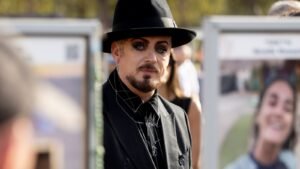
But the 65-year-old is defying convention with characteristic flair. George burst on the pop scene in 1982, one of the first MTV stars with the New Wave hit “Do You Really Want to Hurt Me?” Challenging gender and cultural norms in an oversize hat, Rasta dreads, drag makeup, and a T-shirt that spelled Culture Club in Hebrew (Havurat Aguda), Boy George was an instant sensation and ruled the pop charts for years to come.
Four decades later, Boy George is still advocating for multiculturalism and LGBTQ+ rights, but his hometown of London feels less tolerant. On his way to the doctor in April, he arrived at the Jewish neighborhood of Golder’s Green moments in the wake of an antisemitic stabbing spree, the culmination of a disturbing 82 percent uptick in physical assaults in the U.K. in the first half of 2026, per the Community Security Trust. He then visited the Nova exhibit in London and released the reggae-infused single “We Will Dance Again” (Od Nirkod in Hebrew) in late July on Instagram and X. He made his position clear through the lyrics: “You say genocide/I say war…. You condemn the Jews with selective memory/Musicians holding flags, mouthing like sheep…. You never mention Oct. 7/Young girls raped against trees, murdered brutally/For the crime of dancing.”
The song prompted a swift and harsh backlash. He said he “parted ways” with longtime manager of his BGP label, Tony Pontius, was removed from Bandcamp for using AI on the track, lost old friends like Human League and Heaven 17 founder Martyn Ware, was disinvited from a memorial honoring stylist friend Pam Hogg, and was pulled from a West End revival of “Jesus Christ Superstar.”
Never one to back down, George spoke out, released his single with live instrumentation on Warner Music/ADA in October (it charted in the U.K., France, Greece, and Latvia), and announced he would perform in Israel, boycotts be damned. While there, he met with Oct. 7 survivors, victims’ families and held a press conference at the site of the Nova Festival in Re’im, where Hamas killed 378 concertgoers and staff, took 44 hostages, and sexually assaulted concertgoers, according to an independent U.N. investigation.
Upon his return to London, George reflected on his trip, the blowback he received, and the alarming rise in antisemitism in an interview with Rolling Stone.
Rolling Stone: Is it true that “We Will Dance Again” was inspired by your visit to the Nova Exhibition in London?
Boy George: Well, it started before that. A lot of musicians were putting flags onstage and using words that I didn’t necessarily support. I had posted a few positive comments online [supporting Nova survivors], and a couple of artists did the usual “shame on you, shame on you.” And I started to see it was getting a lot of rage online. I [thought], I’ll write about what’s going on, because there’s only so many love songs you can write. I’ve known Jewish people since I was a teenager in London. Being in the fashion world and obviously rock ‘n’ roll, it would be very amazing if you didn’t know someone Jewish.
Given that, were you surprised by the lack of compassion for Oct. 7 victims?
I think people were very quick to celebrate what happened on October the 7th and change the narrative, twist it around, make it about something else. And it felt that some of the reaction was already planned. As soon as I saw a Palestinian umbrella, I was like, they got products. This isn’t just people with cardboard and some words scratched on it. A lot of musicians I respected were saying ‘Free Palestine.’ And there was no voice for the Jewish community in London. I went to New York and was given an award by [ewish publication] Tablet magazine for my support of the Jewish people, and I felt a little bit like a fraud. But at that point, nobody was saying anything. So I was kind of like a lone wolf in that sense.
Did that inform the single?
The song really came out of me going to New York, getting this award, and thinking, “I really want to do something measured and powerful.” I almost didn’t go to [to Nova]. I thought it was going to be really traumatic. I grew up not that long after the Second World War. We knew about the Holocaust, and anyone that says it’s not true makes me really angry. So when this [Oct. 7 denial] started to happen, I thought to myself, “I never thought I would live in a world where this would happen again, where this language was being used again.” I wasn’t able to not say something. My Jewish friends said to me, “You’re saying things that we can’t say.”

Boy George performs at Menora Mivtachim Arena on November 04, 2026 in Tel Aviv, Israel.
Shlomi Pinto/Getty Images
Being an ally can be fraught these days…
Sometimes you need allies from outside, like straight guys supporting gay people and trans people. You need allies that are not part of that group. In the Seventies, when we started Culture Club, our whole ethos was about anti-racism and anti-prejudice. All that stuff was really the backbone of what we were singing about, which is why we called ourselves Culture Club, and why we wore the Jewish star and presented Rastafarian images. We probably naively were mixing up a lot of religious ideas, but it was more about that feeling of why can’t people just live in harmony? … My tastes are very eclectic, not only musically but also culturally. As a kid, if I saw a religious Jewish guy, I’d be like, “That look!” I am interested in other people and human beings.
So, was your iconic hat a nod to the Hasidic look?
That hat was an original Hasidic hat, and in fact, when John [Moss, Culture Club drummer and George’s former boyfriend] went to buy it, because my initials are G.O.D., for George O’Dowd, they wouldn’t put that in the hat. It would have been great!
What’s it like performing your old hits now?
I feel like it’s an ending of something for me. I’m not saying I’ll never sing those songs again. Of course I will, but my feeling is that next year I might start a very different type of band, a punk band or a reggae band. I just need to do something different, because I feel like that old boy George doesn’t really exist anymore.
Do you mean the insecure 20-something George who dated his bandmate, got into drugs, and went to prison, as depicted in the Culture Club documentary?
I was dealing with a very complicated relationship. I’d grown up in a very dysfunctional family, where there was a lot of fighting, and you grow up thinking that that’s normal. I went from one dysfunctional relationship to another, which is why I joke now that creativity is my lover. One thing I’ve learned in the last 10, 15 years is that songwriting is not hard. Finding what you want to say is the biggest challenge. A song like “We Will Dance Again” kind of wrote itself. When I was at Nova, I saw “we will dance again” written everywhere, and I was like, well, there’s the hook! And then the rest of it was simply looking at what was being said and using those words in a very blatant way, literally reading stuff out of the newspaper and challenging that as a writer, which I think is the job of an artist to say, “Is there another way of looking at this?” I’ve never said anything negative about Palestine, or anywhere else. It’s about me saying, “I know my Jewish friends are good people. I know this to be a fact.” They fed me more than any other race. You want to be my friend? Feed me.
Having that personal connection, was it hard going from the NOVA exhibit in London to the NOVA massacre site in Israel?
I thought this is going to be really painful, but then you meet people, and they’ve gone through something you can’t possibly imagine. So you’re kind of guided by survivors. I had a beautiful meeting with Rachel [Edri, held captive with her husband by Hamas at her home in Kibbutz Ofakim], who survived by making cookies for the terrorists. And it was like meeting my grandmother. I just was very inspired by all the people I met. And bringing the survivors onto the stage, it just makes everything human.
So touring Israel was less of a political stance than a humanitarian one for you?
I don’t really have a stance. I don’t even know what that means. I’ve been called everything you can think of: Goy George, Genocide George, all of that stuff. I felt like I had to go, and now that I’m back in London, it was the right thing to do. I will go back and do a recording of the songs that I did at Menorah [Mivtachim Arena], because it would be great to put it out as a Boy George in Israel tribute.
Bringing former hostage Omer Shemtov onstage with you was so moving. Are you thinking of recording a song with him?
Hopefully, yeah.
So, as you get ready to hit the road for your Singles Tour with ABC and Haircut 100, opening, are you at all concerned about protests at your shows?
I’ll deal with it as necessary. Once you’ve got your makeup and your hat on, you become quite formidable.
You may be interested
Transcript: House Minority Leader Hakeem Jeffries on “Face the Nation with Margaret Brennan,” Nov. 22, 2026
new admin - Nov 22, 2026The following is the transcript of the interview with House Minority Leader Hakeem Jeffries, Democrat of New York, that aired…

Protesters storm Meta offices in India
new admin - Nov 22, 2026Members of the opposition Congress party protested outside Meta’s offices in Delhi on Friday and appear to have entered the…

Nature: Turkeys in New Hampshire
new admin - Nov 22, 2026We leave you this Sunday with turkeys on the run in Rye, New Hampshire. Videographer: Michael Clark. Source link