

Bankrupt Saint Augustine’s Will Not Offer Fall Classes

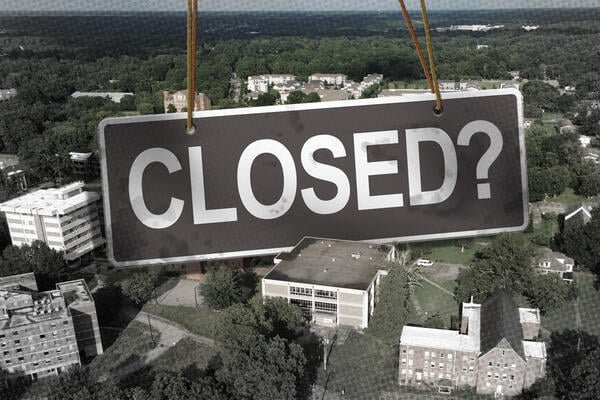
The bankruptcy judge acknowledged the complexity of the proceeds, especially since the university “is essentially closed.”
Photo illustration by Justin Morrison/Inside Higher Ed | zimmytws/iStock/Getty Images
Saint Augustine’s University is suspended in a zombie-like state between life and death.
In April, the embattled historically Black university in North Carolina declared bankruptcy, ending its access to federal financial aid. At the same time, officials said the university would not close. Instead SAU planned to pivot to offering online certificates and noncredit courses to continue to generate revenue as it grappled with a debt load of $74 million and a long list of creditors.
Now plans to launch those programs have been paused as Saint Augustine’s works through legal proceedings, university lawyer Ciara Rogers said in a bankruptcy court Thursday. She added that SAU has dissolved its partnership with third-party online education vendor Ed2Go.
“At this time, the university is not going to be offering any educational offerings, whether they be certification programs or internships, etc. We feel that the debtors’ best efforts should be focused on emerging as a new and stronger entity on the other side of this bankruptcy, and the board has agreed to and is looking forward to solely focusing its efforts on that,” Rogers said.
She added that the decision to pull the plug on online programs, which were slated to launch this fall, will help the university “reduce its payroll obligations and overall expenditures” at a time when it is living on borrowed money from Self-Help Ventures Fund, a nonprofit lender, and spending nearly $300,000 a month.
Bankruptcy administrator Brian Behr signaled support for the change in plans.
“This board is having to deal with a lot and its first priority needs to be exiting bankruptcy as quickly as possible,” said Behr, who noted concerns about costs related to online programs, which would require the university to spend money on personnel at a time when it is simultaneously trying to repay a long list of creditors.
As Saint Augustine’s fate hangs in the air, the university is looking to sell off some of its campus and plans to hire real estate firm Avison Young to help facilitate that transaction. (However, a Self-Help Ventures Fund official said in court the nonprofit plans to object to hiring Avison Young, which could complicate the process, since the court will need to approve the hire.)
Behr said that he was hopeful that “the path forward” would not involve “a wholesale sale of property.” Still, he said, the university needs to keep that option open for a worst-case scenario.
“I don’t think that’s necessarily in the best interest of the debtor, at least currently. But the debtor likely does need to have that on the back burner as a possibility if everything were to fall apart,” Behr said.
(SAU previously sought to lease its campus to a fledgling Florida developer on a $70 million, 99-year deal, but the proposal crumbled when state officials declined to sign off due to various concerns including SAU’s ability to continue to operate. Although SAU is a private institution, state law requires the attorney general to review the transfer of assets from a nonprofit.)
Rogers also noted that Saint Augustine’s had tapped a pro bono expert to advise trustees on how to move forward. She noted that Phillip Clay, a former chancellor of Massachusetts Institute of Technology who previously served on the board of the University of North Carolina at Chapel Hill, has been involved since this spring but took on a more active advisory role this month.
Bankruptcy Judge David Warren appeared to view the decisions to bring in outside expertise to advise the board and to pull back on plans to launch new online programs favorably. He also struck a hopeful tone about Saint Augustine’s potential to emerge from bankruptcy despite the work ahead.
“It’s very hard, especially when you’ve got a company or a university that is essentially closed and you’re trying to chart a new course and reorganize. I respect the time and effort that the board is putting into this, as well as the professionals. It’s not easy, and so I just hope that those persons involved will stay in there, hang in there and see if we can’t get to the end of this,” Warren said.
SAU officials did not respond to a request for comment from Inside Higher Ed.
You may be interested

Student Support Under One Roof
new admin - Aug 24, 2026[ad_1] Colleges and universities offer a wide range of resources designed to help students succeed, but having those supports available…

Humanoid robots smash Usain Bolt’s 100-meter record
new admin - Aug 24, 2026The 9.58-second 100-meter dash record set by Usain Bolt in 2009 has been outpaced by Chinese robots participating at the…

Trump puts autistic kids in the spotlight and cuts agencies built to protect them
new admin - Aug 24, 2026At Chain of Lakes Elementary School in Winter Haven, Florida, Josette Smith's 9-year-old son, Ethan, gets to do what he…