




Outgoing Iowa Civics Center Leader Lambastes Board

The inaugural interim director of the civics center that Republicans created at the University of Iowa wasn’t chosen as a finalist for the permanent position. The Iowa Board of Regents is set to vote Tuesday on who will win that title.
But Luciano I. de Castro, interim leader of the Center for Intellectual Freedom, is asking the board to suspend the permanent director search—even though he says he doesn’t want the position anymore under new rules for the center that the board approved last month.
“Any director, however capable, will operate under close, case-by-case control by the Board, whose decisions have consistently followed the preferences of the University administration,” de Castro wrote in a roughly 400-page report, dated last week, on his issues regarding the center.
The document caps de Castro’s yearlong feud with officials at the university, the board office and board members themselves over control of the center, which saw nearly half of its 26-member Advisory Council—including vocal conservative-leaning faculty—resign last month.
De Castro says higher-ups wrongly prevented him from hiring faculty, expensing travel and more. The voluminous report even includes an incident in which the Board of Regents’ executive director, Mark Braun, says five computer monitors provided to the center were unaccounted for, which de Castro says was based on a miscount by information technology staff.
De Castro’s “central finding” is that “University of Iowa administrators have used their influence over the Board of Regents to hinder the Center’s operations at nearly every stage of its development.” Among his concerns is that the finalists meant to replace him met earlier this month with the university president, provost and Faculty Senate president—meetings he said “open a path” for “the University’s administration to influence directly the choice of the director of a center designed to be independent of it.”
“If the Center is to continue, it must be given the independence [the law that created the center] intended; otherwise, it should be discontinued,” de Castro wrote. “Either course is preferable to sustaining a pretense of reform, which is cheap for those who pretend but costly for the people of Iowa.
“Appointing a permanent director under these conditions would lock the Center into this structure for years, at precisely the moment when the courses required by House File 2800 are being designed,” de Castro added. “A permanent appointment should be made only once the Center’s governance has been settled in a way that allows it to carry out its statutory mission.”
House File 2800 is the law Republican state legislators passed earlier this year requiring—starting in fall 2028—almost all University of Iowa undergraduates to complete one course in American history and one in American government. That law says only the center can offer these courses, but it currently has no faculty beyond de Castro. The university has more than 23,400 undergraduates as of this fall.
Whoever wins the permanent director position stands to make between $200,000 and $450,000, according to the job posting (de Castro said he made just over $300,000 while in the interim role, including his faculty salary). But the continuing disagreements at the Center for Intellectual Freedom are also another example of the tumult over hiring faculty and leaders at these civics centers, which Republican legislatures and some boards have established on prominent public university campuses in red states.
Despite being placed on these campuses, they’re often designed with autonomy from the broader university—a setup that allows them to hire conservative-leaning faculty without fear of being overruled by existing university departments and administrators. But this autonomy has contributed to issues in establishing these new centers and to arguments over when and whether the surrounding university should help with operations or make decisions. Even de Castro wanted center faculty to have tenure at the university in case the center disappeared. The stakes of how well these centers run—and who leads and teaches at them—have only increased as lawmakers in Iowa and Utah have passed laws saying only the civics centers they established can offer courses that fulfill specific gen ed requirements.
A Long Dispute
Disagreeing with administrators and board members is nothing new for de Castro, who kept his job as a tenured economics professor at the university during his interim director stint. He says he’s the university’s only professor who publicly supported creating the center, despite university administrators backing an alternative. He publicly asked lawmakers to create it.
And since the summer of 2025, when Republican Gov. Kim Reynolds signed the law creating the center and the board chose him as interim director, he has argued with employees of the university, the board office and board members themselves, alleging they were inappropriately sidelining him as its leader. The new report includes numerous accusations of board and university interference.
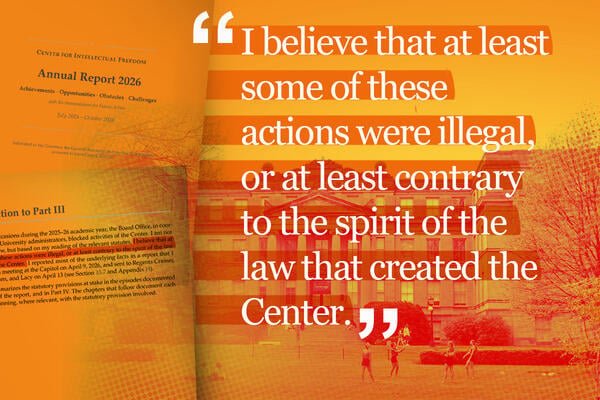
“On multiple occasions during the 2025–26 academic year, the Board Office, in coordination with University administrators, blocked activities of the Center,” de Castro said. “I am not an expert in law, but based on my reading of the relevant statutes, I believe that at least some of these actions were illegal, or at least contrary to the spirit of the law that created the Center.”
Board president Robert Cramer told Inside Higher Ed he sees things “very differently” from de Castro.
“We definitely deny that anything illegal is going on,” Cramer said. He also said he’s not planning to suspend the permanent director search, as de Castro requested, adding that the board plans to hopefully hire someone Tuesday.
Cramer also invoked the fall 2028 requirement for the center to offer the mandatory government and history classes, saying, “I’m looking for a director who will work with the university to pull off what has been mandated by the Legislature,” and adding that “this cannot be done on an island—we’ve got to work together.”
Christine Hensley, a board member who leads the board committee overseeing the center, said in an emailed statement, “We have received [de Castro’s] report and are currently reviewing it.” She also said the search won’t be suspended.
“We will continue to provide support to the Center to help meet its goals of providing scholarship on the intellectual foundation of free societies, as well as the principles, ideals and institutions of the American constitutional order, and the foundations of responsible leadership and informed citizenship,” she said.
The end of the permanent director search comes after nearly half the center’s advisory council resigned late last month, all of them faculty from institutions out of state. The prior chair of the search—Richard Lowery, a University of Texas at Austin associate professor—was among those who left. Only two faculty members remain on the council.
In his report, de Castro notes he wasn’t made one of the four finalists after his supporters left.
“In early September, with the support of the full [advisory board executive] committee, I had been one of the 11 applicants, out of 62, advanced for further consideration,” de Castro said, adding that “the decision not to advance my application was thus made only after most of the committee members who had supported it had resigned.”
De Castro also said he asked the Iowa Public Information Board to investigate whether the advisory council’s executive committee, which includes Hensley and decided on the list of finalists, violated the state’s open meetings laws during the search process. The board didn’t provide Inside Higher Ed an interview or answer written questions Monday.
Cramer told Inside Higher Ed he appreciated de Castro’s service and is looking ahead.
“We appreciate Professor de Castro taking on this role through this year, and he went through a lot of tumult to get through it,” Cramer said. “And we appreciate his time and effort. I disagree with a lot of what’s in the report, and the new director will have a chance to have a reset and change things going forward.”
You may be interested

Baseus’ new security camera has a spotlight that tracks and follows moving targets
new admin - Oct 20, 2026Baseus announced a new addition to its lineup of AI-assisted security cameras that’s more proactive about discouraging unwanted visitors instead…

Gun used in Oregon elementary school shooting was birthday gift from shooter’s mom, sources say
new admin - Oct 20, 2026The gun used by a 16-year-old who shot and killed three children and a teacher at Silver Rail Elementary School…

Managing the anxiety and depression of long COVID – UW Medicine
new admin - Oct 20, 2026While the pandemic era of masking and social distancing may seem a distant memory, for the estimated 15 million Americans…