



Cornell Rape Allegations Push Other Universities to Reflect

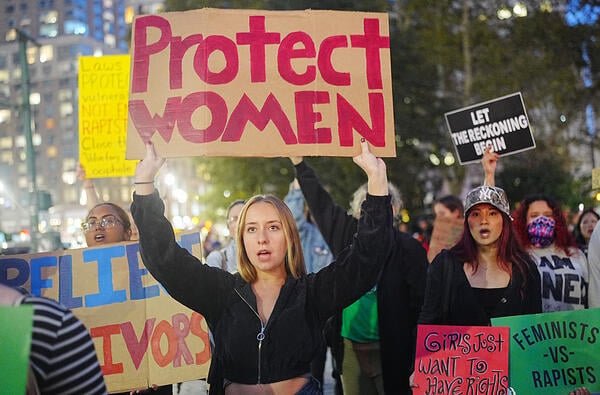
Students across the country rallied in support of survivors of sexual violence.
Selcuk Acar/Anadolu/Getty Images
One month after a former Cornell University student filed a lawsuit accusing seven students of drugging and raping her at a fraternity house in 2024, colleges and universities across the country are looking inward.
“We’ve spent the last two weeks looking at every process, every procedure, every policy, decomposing how things transpired at Cornell and asking the question ‘What decisions would we have made at every point in that particular process?’” Mike Haynie, chancellor of Syracuse University, said at a campus roundtable last week, according to Syracuse.com. “There’s always opportunities for us to do more, do better.”
At the University of Pennsylvania, President Larry Jameson announced that the university is expanding its sexual violence education and awareness efforts and increasing the capacity of its Title IX office, which responds to reports of sexual harassment and discrimination. “Everyone at Penn has the right to be safe, respected, and heard, and we condemn sexual misconduct and violence in all forms,” he told The Daily Pennsylvanian last week.
Meanwhile, faculty at the University of Wisconsin at Madison are worried that the university may soon become the next face of campus sexual assault.
“Currently there’s not a lot of structure for reporting and dealing with [sexual assault],” Al Kovaleski, an agriculture professor at Madison, told Interim Chancellor Eric Wilcot at a Faculty Senate meeting earlier this month, reported The Daily Cardinal. “We’re just one news article away from being Cornell.”
In September, reports of possible druggings and a sexual assault at a fraternity house and residence hall surfaced, though Madison police have since closed those investigations, according to local news station, Channel 3000. Nonetheless, UW Madison announced earlier this month that it’s created a new violence-prevention position that will be embedded within the Office of Fraternity and Sorority Life to address sexual violence, hazing and high-risk alcohol use.
“Recent conversations on our campus, online and in the news have brought an important spotlight to sexual violence on college campuses,” Lori Reesor, UW Madison’s vice chancellor for student affairs, wrote in an Oct. 8 email to students. “Incidences of sexual violence extend beyond fraternities and sororities, but research shows these communities are at higher risk, both as offenders and victims.”
‘I Am Jane Doe’
But students are calling for more action.
According to The Cap Times, roughly 60 people attended a Badgers Against Sexual Assault rally Friday evening on Madison’s campus. The organizers called on the university to implement stronger sexual violence education for students—especially those in fraternities and sororities—and stricter suspensions for fraternities with allegations of sexual assault, among other demands.
The rally at Madison came about a week after thousands of college students and other supporters across the country—in Boston, Denver, Los Angeles, Philadelphia, Salt Lake City, San Francisco and Washington, D.C.—protested sexual violence during a national day of activism. Their rallying cry, “I am Jane Doe,” referenced the unnamed woman who is also suing Cornell over the university’s alleged failure to prevent and then adequately respond to her report of sexual assault.
And as students have made clear, her story represents a larger culture of campus sexual violence.
“Jane Doe can be all over this campus,” one student told USA Today at a rally held at the University of California, Los Angeles, where organizers called on UCLA to review and expand its policies related to sexual assault response and prevention. Although the university has yet to publicly respond to those demands, Gabi Trujillo, UCLA’s internal vice president, at the rally mentioned “violence that has gone on for far too long,” and asked, “When will the oppressive state of the behavior of the man end?”
One anonymous student at Harvard University published an editorial in The Harvard Crimson saying the Cornell case motivated her to tell her own story.
“When a survivor speaks, the conversation can quickly become about whether she drank too much, why she was with him, what she remembers, or how quickly she made a report. I know because I asked myself those same questions,” wrote the student, who alleged that she was drugged and raped during her first week at Harvard, but didn’t file a Title IX complaint because she didn’t want to relive the incident and agonize over whether the university would find her attacker responsible. “Are we not angry enough? Why does it take high-profile cases like these for all of us to finally speak out?”
Several days after that Oct. 1 article ran, Hopi E. Hoekstra, dean of the Harvard Faculty of Arts and Sciences, spoke out about the Cornell case at a faculty meeting, characterizing the details as “horrific and really difficult to comprehend,” according to the Crimson. Hoekstra added that “the situation unfolding now is a tragic reminder of the responsibility we all share to keep working every day to make this the institution that our community deserves.”
But the renewed attention the Cornell case has brought to campus sexual assault has extended even beyond students, faculty and university administrators.
Last Thursday, Maryland Governor Wes Moore gave the Maryland Higher Education Commission 90 days to issue recommendations for improving campus policies related to preventing and investigating sexual assault.
“Deeply troubling accounts have emerged in recent days of how students outside of Maryland have bravely come forward to report sexual assault and have been failed by the institutions that are supposed to ensure their safety,” Moore wrote in a letter to Elena Quiroz-Livanis, interim secretary of the commission, according to The Baltimore Banner.
“This is a call to action,” he added. “In Maryland, we will continue to identify opportunities to enhance the safety of our college campuses and to ensure accountability when these efforts fail.”
You may be interested

Best Contemporary Country Album Nominees
new admin - Oct 19, 2026[ad_1] Leading up to the Grammy nominations on Nov. 16, Rolling Stone is breaking down 11 different categories. For each,…

Wyze moved the screen on its new smart scale to the handle so it’s easier to read at eye level
new admin - Oct 19, 2026Wyze announced a new version of its Ultra BodyScan smart scale that debuted nearly a year ago with additional electrodes…

Falling crucifix kills priest during livestreamed Mass in Ecuador
new admin - Oct 19, 2026A Catholic priest died Saturday when a wooden crucifix fell from a wall and crushed him against the pulpit during…