


New Book Looks at the Hidden Realities of College Cost

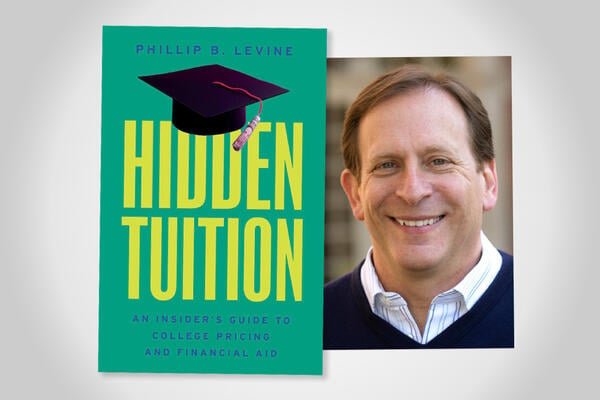
If you care about cost transparency in higher education, the name Phil Levine might be familiar to you. The Wellesley economist, who for the past 15 years has studied the gap between the prices colleges advertise and what students actually pay after discounts, is one of the most outspoken voices on the issue of college cost transparency. He’s also spearheading solutions; he founded MyinTuition, a nonprofit now owned by the College Board that provides simple cost-calculation tools to colleges using their internal data, so prospective students can calculate how much their education would actually cost.
But for 15 years, that work has been aimed mostly at higher ed change makers: those who can influence the price of college and the way that information is communicated. Last month, Levine released his first book for student, families and college counselors, drawing not only on the findings of his research but also on his years of experience working with college leaders and financial aid officers to spill the behind-the-scenes secrets of paying for college.
Levine hopes Hidden Tuition: An Insider’s Guide to College Pricing and Financial Aid (University of Chicago Press) will help prospective students understand how to pay for college, as well as some of the mechanics of how the financial aid system works.
He sat down with Inside Higher Ed to discuss the book. The interview has been edited for length and clarity.
Q: What is the niche you were hoping to fill with this book?
A: I’ve written many things in the past on higher education finance and college pricing. Usually it’s to a professional audience, and that’s great, except that the people who really need the information are people who are considering going to college or helping people go to college. So, I wanted to write a book that was targeted at parents and students and college counselors. So we’re taking all the things that I’ve learned over the many years of working on the problem and communicating it in a way that is accessible to all types of readers.
Q: At what point in your career studying college costs did you realize that a book like this was needed?
A: Well, let’s start from the beginning. I’ve been teaching at Wellesley College for 35 years. I spent 20 of them not even remotely thinking about college cost, and how I got interested in it was that I have kids, too. My kids got to be college age, or approaching college age, and I’m an economist, I make a good living; I don’t make a fortune, but I make a good living. I’ve been saving for college since the day my kids were born, and by the time they were in their teenage years, I just wondered, “Have I saved enough? Am I going to be eligible for any financial aid? What’s it really going to cost me?” And that’s when I realized, OK, wait, something’s wrong here. Because I couldn’t figure it out. Given my background, if it’s a struggle for me, it’s probably a struggle for a lot of other people, too.
The tools that I developed are sort of direct [tools for] trying to figure out how much it costs. And the book is sort of like, “Let’s understand the system and think about, what does it mean for me? And how does it affect my decision?”
Q: What specific facets of higher education pricing did you want to be sure to get into that you don’t think are well represented in other resources?
A: There are many, but the most basic element of the problem is the focus on the sticker price. There’s plenty of data out there that shows that families overestimate what they say college is going to cost them, that they typically focus exclusively on a sticker price. And then there’s research that shows that most people don’t pay the sticker price. And then the question arises, “Well, what do they pay? And how do you figure it out?” There’s lots of issues that are involved, but that’s the most important one.
Q: You get into sort of this broader picture of how college pricing works in the first part of the book, beyond what would seem to be immediately relevant to students and families. Why was that something you wanted to include?
A: There’s a public perception that colleges sort of make up these prices, that they want to bring in as much revenue as they possibly can. That’s just not the way the market works. Colleges are businesses, too; they have expenses. Revenue from students is certainly one way that they help pay those expenses; at some institutions, that’s a larger share than elsewhere. But they need to pay their bills, and so you need to generate enough revenue to pay bills. On the other hand, they can’t charge as much as they want because people aren’t willing to pay an unlimited amount. So, as a business, making a business decision, how do you set up the pricing system that generates the revenue that you need to pay your bills in a way that families are willing to pay?
That’s not a simple task, and pretty much every financial aid administrator I think I’ve ever talked to would be thrilled to be able to charge nothing to everyone, especially lower-income families. It’s just not feasible, because it’s still a business. It’s important to understand, from the institution’s perspective, why are they making the decisions that they make? Because that influences how the system is set up, which influences how you navigate the system.
Q: On that note, what are some pieces of advice that you thought were important about navigating the system? Again, especially advice that you thought was not included in some other prominent sources.
A: The importance of price shopping is critical. And price shopping is not necessarily focused on the sticker price, because you’re most likely not going to pay that. Some schools rely on merit aid in their financial aid systems. It’s great to receive merit aid, and it’s great to feel the admiration and respect that a merit award provides. But it’s really just a pricing mechanism. So ultimately, how much merit you get is not the question. It’s, how much are you going to have to pay? It’s not uncommon for me to hear people say, in casual conversation, “Oh yeah, my child decided to go to school X because they offered them a $20,000 merit award.” What instantly goes through my head is “Well, that’s great, but how much are you going to pay?” That’s what matters.
Q: Your own research is very prominent throughout and inspired how you wrote the book. Tell me about where and how you decided to incorporate that work into this resource.
A: The book is not written as an academic book, so there aren’t references and citations. But a good amount of it is based on things that I’ve learned through my own research and the research of the people that I work with as an economist. Specifically in terms of recent research, just last week I released a paper on free tuition [programs]. That’s in the book. There’s research that I’ve released six months ago on, how extensive is the use of merit aid awards. There’s certainly research in there [about] what people ultimately pay at different income levels, which is very difficult to find elsewhere.
And there’s everything that I’ve learned from the MyinTuition tools that I’ve generated over the years. The learning from that isn’t necessarily academic research, but I can’t even tell you how much I’ve learned from working with the colleges that I work with in terms of how they do the things that they do, why they do the things that they do, how that impacts the prices that they charge families with different financial resources. Getting sort of under the hood of, why do they think the things that they think?
Q: What are some of the takeaways from that that you included in the book?
A: I’m actually on a nonprofit board for college savings where the people on the board are financial aid administrators and admissions professionals. And it’s amazing what you can learn at lunch. They talk about the things that they think about and what their concerns are and how they navigate the world in sort of an informal way. And what’s interesting for me about it is that, as an economist, we’re having normal lunchtime conversation, but in the back of my head, it’s getting translated into the economics of how higher education works.
Q: I assume that the process of publishing this, rolling it out and trying to get it to the right audience has been very different for you. What has that been like? How can you get it into the hands of students and families for years to come?
A: I’d love to be able to do that. It’s definitely a different marketing issue. If I write a report at Brookings [Institute] about free tuition programs, and Inside Higher Ed picks it up, which they did on Monday [Sept. 28], that’s going to the right audience. I know how to do that. But how do you communicate with a broader audience? I’m an economics professor. That’s not what I normally do. So, I’m doing podcasts and webinars that are more public-facing. I’m doing a podcast in a few weeks for financial advisers, [who can be] an important source of information for parents.
It’s a very different exercise. The MyinTuition work that I’ve done has been advantageous because there are marketing efforts there, too. So I definitely have gotten greater exposure to communication strategies in ways that it happened earlier in my career. That’s not something they teach you in graduate school.
You may be interested

Pacific hurricane region sets record for big, long-lasting storms, due to El Niño
new admin - Oct 13, 2026The drumbeat of monster hurricanes in the Pacific has broken a record for nasty, long-lasting storms east of the international…

Proposed Changes to Census Could Affect Native Students
new admin - Oct 13, 2026[ad_1] The Census Bureau proposed counting citizens based on their “usual residence” and limiting demographic questions related to race, ethnicity…

SpaceX launches cargo ship to space station in spectacular pre-dawn flight
new admin - Oct 13, 2026A SpaceX Falcon 9 rocket boosted an unpiloted Dragon cargo ship into orbit Tuesday, setting up a rendezvous with the…