


Moral Lessons From the Demoralized (opinion)

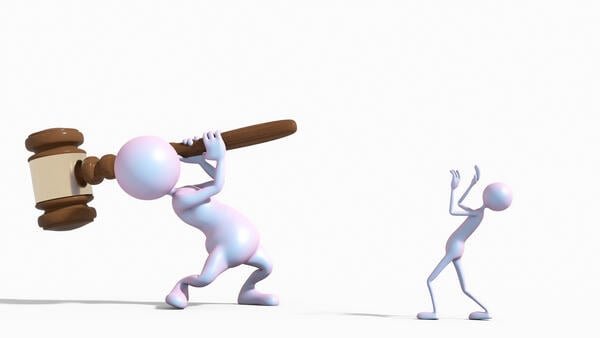
In a recent article in The Atlantic, John Paul Rollert describes the mistrust pervading college campuses as he outlines the emerging role of professor as judge. Faculty, he says, are becoming judge, jury and executioner. But he never asks what the evidence we act on is worth.
As a fellow ethics professor, I haven’t fully crossed over to the role of executioner. My old habits die hard. For the final grade for my online ethics course two semesters ago, I couldn’t resist the allure of my old friend, the final essay. I tried to directly address the elephant in the room and gave the following question to my students: “Should ChatGPT (or other AI models) be used to solve ethical dilemmas in the real world? Why or why not? Use at least two theories from this class (as well as examples and lecture materials) to support your answer.” I was so proud of my question I even posted about it on Instagram.
I gave detailed instructions on how this assignment should be submitted via Google Docs, where I could easily check version histories for large chunks of (AI-generated) material pasted in. I went about my business and waited for the submissions. When I sat down to grade this batch of assignments—one, two, three, the first 10 essays were all composed of many paragraphs simply pasted into Google Docs. All with similar and uncannily familiar opening sentences—that somehow sounded simultaneously like language rattling around in a tin can, but also oddly like a college sophomore writing in an introductory ethics class. The essays had all the tells, and they reeked eerily of mechanical reproduction—made all the more ironic in response to a question explicitly about AI and ethics.
I immediately wrote to all three sections, offering students a chance to self-correct: “If your paper appears directly cut and pasted, you have 48 hours to write a 300-word disclaimer or explanation of what informed this choice on your part.” I reminded them that the act of taking knowledge one has learned and putting it into one’s words is itself a creative act. It is literally the brain processing and making sense of the knowledge one has acquired. But even if they didn’t care about any of that, I appealed to my students’ basic decency: At least give me the pleasure of responding to the words of an actual human.
I received six responses. They were what you’d expect: a few poorly argued defenses of AI itself, claims that it’s inevitable so you just better get onboard, Professor. One who said how much she hates it, thinks it’s bad for humanity, but she had too much work to do and it was just too easy. And then there was one response that was pretty clearly AI-generated as well.
For years, I had a line in my syllabus about plagiarism. I’d tell a little joke about the irony of plagiarism in an ethics course and I’d get a light round of laughs. No one is laughing now.
I’ve sat on faculty committees for academic integrity, I was a keynote speaker at a symposium about intellectual honesty, I was on the honor council as a college sophomore and I’ve been teaching introductory ethics for more than 15 years, to hundreds of students in all sorts of majors, with all sorts of backgrounds. These actions didn’t happen because I don’t care, but instead because I am far too deeply, too morally invested. But more, I am demoralized. To lose heart, to corrupt morals, to lose faith—to demoralize.
By last semester, I had learned a few things. I still couldn’t let go of the final essay assignment, but I heard about a new AI-detection platform called Pangram. I knew these tools were controversial. Even though some studies had flagged AI detectors as extremely flawed, Pangram wasn’t included in those studies, and it proclaimed extremely high detection accuracy. I wanted to believe that was true. So, I paid for a subscription and ran every essay through. Any student whose essay was flagged at 60 percent AI-generated or more received an email from me. In very neutral terms, I told them their essay had been flagged as AI-generated, that they would have the opportunity to rewrite it, but if not, accept a C (what is AI writing except solidly average?).
This time students wrote back with passionate protests: “I didn’t use AI!” “I worked really hard on this assignment and wrote it myself!” I felt terrible and immediately started researching the efficacy of Pangram. I trust Pangram, but there’s a pretty large part of me that still trusts—still wants to trust—my students. Maybe that’s another old habit that will die hard. I had to admit to myself that for each of these essays that sounded exactly like sophomore writing has always sounded, I truly could not know if they were written by the students whose names were on the assignment. And it’s this unknowing that is the problem.
In the end, nearly all of the students that Pangram flagged received a C. Did they earn it? In my unknowing, I split the difference and settled on an average grade. Some of them deserved an F. And some of them may have written every word themselves and might have legitimately earned an A.
Ultimately, an AI detector doesn’t report on a specific student. It reports on what another AI model thinks about the formulation of the words in an essay. Turning that estimation, an assumed verdict, into an evaluation of a person requires an epistemological inference that few of us are really prepared to make. I decided not to use Pangram this semester. Not because I think it is often wrong, but because I don’t know. Despite the company’s claims of efficacy, who really knows? How do we know how to know?
These detection tools can be credible on the whole, while each individual accusation may require more certainty. We are just in a territory now where the criteria itself for that certainty is unclear. Rollert tells us that students are now criminals and faculty are the judge, jury, executioner—three roles no one ever agreed to sitting before a faculty hiring committee. I’m asking what the standard of evidence should be and what happened to the idea of innocent until proven guilty. Is this standard of guilt sufficient?
My flawed efforts with Google Docs and Pangram were not really an effort to catch cheaters. It was all ultimately an attempt to end an uncertainty that perhaps cannot be ended. What happens when faculty members—newly appointed judge, jury, executioners—proceed with the verdict even when no one has said what reasonable doubt looks like? I fear those who may be innocent may flee from the entire enterprise altogether.
You may be interested

Oil prices hit $105, stocks tumble as Trump weighs Iran strikes
new admin - Oct 08, 2026[ad_1] The price of oil on jumped sharply Thursday, as President Donald Trump weighs whether to resume large-scale U.S. military…

Xbox is launching a new film and TV division
new admin - Oct 08, 2026XBOX PICTURES: Bringing our worlds and characters to new audiences through film, television, and other forms of linear storytelling.XBOX PRODUCTS:…

CNN, MS NOW, Politico due back in court to fight Trump’s blocked White House ban
new admin - Oct 08, 2026Washington — The Justice Department and lawyers for CNN, MS NOW and Politico will be back in court Thursday as the…