

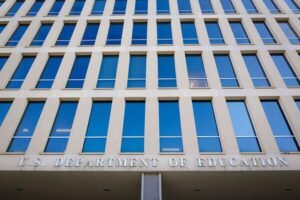


Default Rates Offer Warning for Colleges

At nearly 2,100 colleges and universities, at least 25 percent of borrowers are more than 90 days late on their payments, according to recent Education Department data.
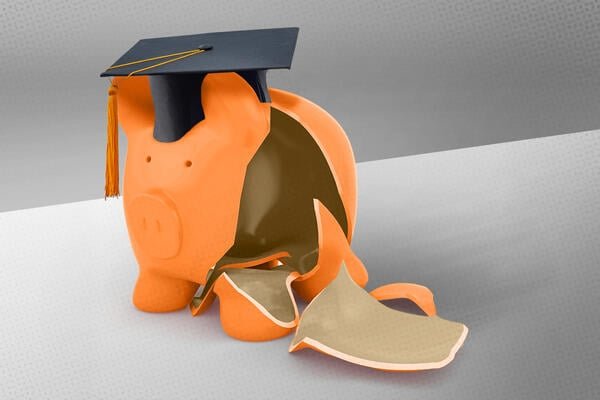
Photo illustration by Justin Morrison/Inside Higher Ed | DenisKot and EyeEm Mobile GmbH/iStock/Getty Images
As millions of borrowers default on their student loans, the clock is ticking for colleges to make a more concerted effort in response. If not, higher ed finance experts warn, hundreds of institutions could risk losing access to federal student aid.
The national cohort default rate—or the percentage of student borrowers who go more than 360 days without making a payment on their loans in the first three years after leaving college—rose from 0 percent to 0.4 percent over the last year, a recent report from the Department of Education shows. That’s the first increase in four years, as the rate fell to zero while student loan payments were paused during the pandemic.
As a result, experts say, the latest 0.4 percent default rate is artificially low and will likely jump over the coming years, pointing to department data on borrowers who aren’t repaying their loans. ED also noted that the recent default rate should be “interpreted with caution as the results may provide an overly favorable picture of borrower repayment outcomes.”
“My main takeaway from that report is don’t be fooled,” said Ben Cecil, deputy director of higher education policy at Third Way, a left-of-center think tank. “I would caution against using the 0.4 [percent] number as a measure of borrower health in repayment right now.”
Since the pause ended in September 2023 and other protections expired a year later, defaults have spiked to more than 9.3 million borrowers—including about 400,000 in the second quarter of this year. Department data on nonrepayment rates also shows that at nearly 2,100 colleges and universities, at least 25 percent of borrowers are more than 90 days late on their payments.
“I would treat the nonpayment rate like the canary in the coal mine of what could be to come,” Cecil said.
The nonrepayment rate counts borrowers who entered repayment since January 2020. It’s not the same as the cohort default rate, but ED has said it can give institutions “insight into their repayment portfolio until the CDR calculation.”
Colleges or universities with a cohort default rate of 40 percent or more immediately lose access to federal student loans. Those with a rate at 30 percent have to submit a default-prevention plan and could lose access to all aid if their default rate exceeds 30 percent for three or more years.
The department’s most recent report includes borrowers who entered repayment from October 2022 to September 2023 and then tracks whether they defaulted before the end of September 2025. Based on when pandemic protections expired, that group could have defaulted in the last of the three years that the rate measures.
Data on the next round of cohort default rates, based on the 2024 cohort, will be sent to institutions early next year. Borrowers in that group will have had two years in which they could default.
Cecil and groups like the National Association of Student Financial Aid Administrators say the next cohort default rate might still be low. But since the window for default is longer, the rate will likely start to climb. Some say it could exceed pre-pandemic rates, in part because borrowers were “unaccustomed to making payments for an extended period of time.” In 2019, the national CDR hit 10 percent.
Data for the 2025 cohort, which will be released in 2028, won’t be affected by any pandemic-era protections.
Experts say that is when the public will know the full scope of the rising cohort default rates. But it’s important for colleges to start responding and preparing now. The department has previously released its own guidance and will hold a webinar next week on managing and preventing loan defaults.
Cecil suggested that institutional aid offices use the most updated contact information they have for each student and work alongside loan servicers to reach out and remind students that their payments are due.
“For a long time the general notion has been that once a student is no longer on campus, it’s not necessarily the institution’s responsibility to make sure that these students are effectively repaying their student loans,” he said.
But now, if colleges want to protect their federal loan access, that needs to change.
“The borrower contact information that servicers have sometimes just isn’t as good, so schools can really play a role in helping get borrowers back into effective repayment,” he added. “It’s just a really easy place to start for schools in this conversation.”
You may be interested

A Trump Mobile breach may have exposed data of more than 3,600 people
new admin - Oct 06, 2026Trump Mobile appears to have suffered a data breach that may have exposed the data of 3,615 people, according to…

Paramount closes $110 billion deal to acquire Warner Bros. Discovery, creating Skydance
new admin - Oct 06, 2026Paramount Skydance on Tuesday completed its $110 billion acquisition of Warner Bros. Discovery, uniting the movie studios behind "The Godfather"…

Paramount Skydance completes $110 billion takeover of Warner Bros.
new admin - Oct 06, 2026[ad_1] IE 11 is not supported. For an optimal experience visit our site on another browser.Now PlayingParamount Skydance completes $110…