

Why a N.Y. Republican Is Taking On Grad Student Loan Caps

Thanks to a federal court order earlier this summer, the Trump administration’s narrow definition for professional degree programs is temporarily blocked and more graduate students can borrow up to $50,000 a year for their education—the higher of two loan caps set last year in the Republicans’ One Big Beautiful Bill Act. Now, one House Republican wants to make sure that access continues.
The Professional Student Degree Act from Rep. Michael Lawler, a New York Republican, would label 24 degree programs as professional, ensuring that their students are eligible for the higher loan caps. The administration’s definition only designates 11 programs as professional. Lawler’s list not only includes health-care programs for nursing, physician assistantship and occupational therapy—industries that were added to Trump’s definition following the court order—but it also includes programs for social work, education and architecture.

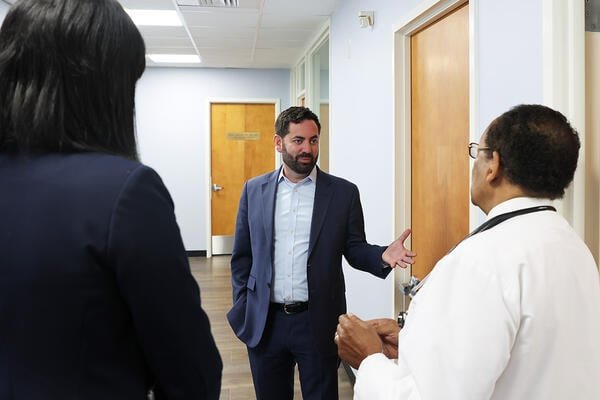
Congressional portrait of Rep. Michael Lawler (R-N.Y.)
U.S. House of Representatives
Lawler said his legislation aims to clarify and codify Congress’s intent when it first passed the loan caps. Several Democrats have also proposed their own bills to address the issue, but Lawler’s appears most likely to gain traction in the Republican-controlled Congress. The legislation has 26 co-sponsors—10 Democrats and 16 Republicans—which could give it a better chance of advancing in a narrowly divided Congress.
Inside Higher Ed sat down with Lawler, who is seeking re-election in one of the nation’s most competitive swing districts, about the status of the bill and why he took on this issue. The interview has been edited for length and clarity.
Q: First off, what’s the status of the Professional Student Degree Act?
A: Well, this is a piece of legislation that has garnered broad support among higher ed professionals and numerous associations representing different professions all throughout the country. So we’ve been working diligently to build support.
There’s been a real push, both in terms of the appropriations process to try and address this, but obviously to try and advance the bill as a stand-alone. But realistically, the best vehicle will be one of the kind of must-pass bills, inclusive of appropriations, and to try to get that through before the end of the year.
The action that the [Education] department took in response to the court order certainly was a positive step forward. But we still want to codify this and from the vantage point of my bill and expand out the number of professional degrees.
Q: Your bill would make a wider range of programs beyond medical and health-care degrees eligible for the higher loan caps. Why take that approach?
A: It’s a bigger issue than just health care. When we evaluated this, we looked at across the country at what were the most common degrees that require advanced degrees and certification. We came up with a pretty extensive list because we felt these are professions that are needed. These are professions that we’re having workforce shortages in, and we want to not make it more expensive or more difficult to obtain a graduate degree.
Q: Has there been any pushback or discussion, especially with fellow Republicans, about narrowing that list to not include social work, architecture and education in order to gain their support?
A: I’ve not really gotten pushback from colleagues on that. I think when we explain it, people acknowledge it makes sense. People recognize that it is broader than just health care, and the response from all the different professional associations have been strongly in favor of doing what we’re doing here.
Q: Earlier, you also mentioned tacking the Professional Student Degrees Act on to a larger must-pass bill like appropriations. Has there been any conversation about where and how this might be tacked on?
A: Well, I know there was a push by some of my colleagues in the [Appropriations] Committee on this in the Labor–[Health and Human Services] appropriations bill. So, part of this is just trying to work through whether or not we can get a final agreement on it.
Q: As someone who is not a member of the Education and Workforce Committee and historically hasn’t been the most engaged in higher ed policy, what prompted you to get involved in this issue and challenge President Trump and his administration?
A: What really was a catalyst for this for me was dealing with the nurses and health-care professionals across my district. I said immediately that I did not agree with that determination, and that I would introduce legislation.
But, when we went through that process of drafting the legislation, we felt there were other professions as well—as I just went through—that should be included. We really went about a comprehensive approach to it, and the response that we got to it was one of appreciation from a broad cross-section.
People appreciated that we didn’t just focus on just one profession or one industry, and really put in the work to make a rational case for all of these professions.
Q: When Republicans were developing the One Big Beautiful Bill, were you paying attention to the definition of professional degree and which students would qualify for what loan amount? If not, what sparked your interest?
A: As you said, I’m not on the committee of jurisdiction. So, it was not something that I was heavily engaged in the negotiations on as the committee drafted the language. It was certainly an issue I was aware of in terms of what the objective was and what the parameters were.
But obviously we do not agree with the department’s interpretation of it, and so that’s why it’s necessary to make clear what Congress’s intent is.
Q: You’re running in what is expected to be one of the most closely watched battleground districts this fall. What concerns are you hearing from constituents on each side of the political spectrum when it comes to higher ed? Is this bill an attempt to address some of them?
A: There’s a few things about higher ed. One, obviously, is the overall cost. The cost of a four-year degree has gotten insane. The second thing is the fact that a lot of these kids are coming out of college without a job. So, the workforce aspect of this is paramount.
That’s part of the reason why I also fundamentally believe our community college system needs to be a greater part of the discussion, especially around workforce development and certification.
It’s also why I fundamentally believe we need to evaluate our K–12 system and whether or not it is producing the workforce we need. So many of these schools across the country, but especially in New York, are focused on college readiness and not career readiness. And there’s a lot of challenges that have resulted—especially when just under 70 percent of Americans are not going to college.
So, there’s a lot of work to do within the education field, and that’s something we have to focus on.
Q: Since President Trump took office, the relationship between colleges and the federal government has shifted amid research funding cuts, new investigations and other changes that critics say threaten institutions’ autonomy. So what do you make of it all?
A: Like with everything, there’s a balance to be had on all of it.
When you look at some of our educational institutions—whether it’s our K–12 system where reading and math scores are abysmal, or our higher education system where we’re not producing the workforce that we need—a large portion of this is about figuring out how we can actually have an education system that is affordable, accessible and producing the workforce that we need.
Higher ed obviously does tremendous work when it comes to research, medical research. There obviously has always been a close working relationship between the government and higher ed on those issues, and that should continue. It’s necessary. But there also needs to be accountability.
Our higher ed system does have problems. You look at things like antisemitism on college campuses. That has been a festering issue for years that exploded over the last two to three years. So, there does need to be accountability, and they do need to uphold federal law.
And yes, we want them to be independent. And yes, we want them to be focused on educating our youth. But we also don’t want them indoctrinating them. They need to have free and open debate and discussion on these campuses, and it shouldn’t just be what we’ve seen in many instances as a very narrow-minded system that frankly is producing a generation of students that have a very different view of America and what it is.
Q: More broadly, what do you hope to see from the Education Department and individual colleges over the next several years?
A: I want to see a system that finds ways to produce the workforce that we need, that is adjusting to the needs of the country economically, that is working with government and the private sector to develop the curriculum that is needed to build the workforce of tomorrow, and we want to do it in an affordable way.
Education costs have gotten completely out of control over the last two decades, and the entirety of the higher ed system needs to evaluate how to address that. I have legislation on capping student loans interest at 2 percent—and I do think student loan interest should be capped. But the bigger challenge is the fact that these kids are coming out with $200,000-plus of debt and very limited career prospects. (That was, by the way, the intention of the [loan-limit] rule, and what we were passing was to try to force higher ed to make these programs more cost-efficient and result in a greater outcome for the student.)
So there’s a balance to be had here, and I think higher ed needs to work toward finding it.
If you look at where so many of these institutions of higher learning are, the students are not getting the bang for their buck. They’re spending a lot of money to get educated, and they’re coming out with limited job prospects and lower-paying wages, and that’s a problem.
You may be interested

Latest Trump Move Threatens Colleges Seeking to Promote Equality
new admin - Sep 04, 2026[ad_1] Just when it seemed that Trump might have turned down the heat in his attack on higher education, the…
Illinois senators blast FAA administrator for holding air traffic controller raises “hostage”
new admin - Sep 04, 2026Illinois Democratic Sens. Tammy Duckworth and Dick Durbin harshly criticized FAA Administrator Bryan Bedford for holding up a pay raise…
Sam Altman apologizes for ‘messy’ GPT-6 Astra rollout that’s locked out paying users
new admin - Sep 04, 2026Just hours after OpenAI launched GPT-6 Astra, CEO Sam Altman was already apologizing for what he describes as a “messy…