



NIH Director Says a Lot. Critics Call Much of It Misleading

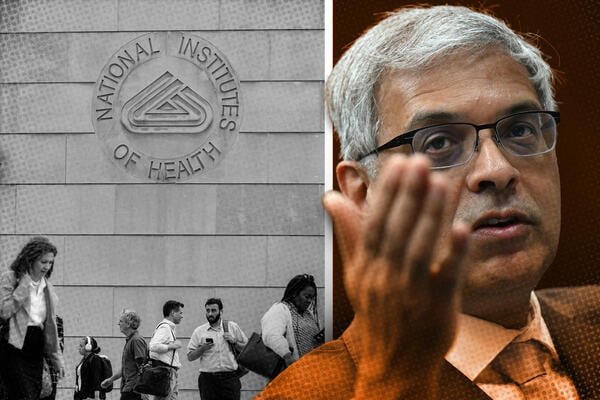
Jay Bhattacharya came to prominence arguing that the nation shouldn’t trust the National Institutes of Health’s leaders.
He was one of three authors of the Great Barrington Declaration, which called for lifting most pandemic restrictions in October 2020, before COVID-19 vaccines were available. The declaration said these restrictions, many of which NIH leaders supported, were producing “lower childhood vaccination rates, worsening cardiovascular disease outcomes, fewer cancer screenings and deteriorating mental health,” among other harms. Former NIH Director Francis Collins called the trio “fringe epidemiologists.”
But in his second term, President Trump made Bhattacharya central when he picked the health economics researcher to lead the NIH, starting in April 2025. The critic, lauded by conservative opponents of pandemic policies as a brave truth teller, became the chief.
As director of the NIH, Bhattacharya has said he wants to restore trust in the agency and in public health. In an interview posted last month by the conservative education video website PragerU, Bhattacharya said “press criticisms” that “we made the NIH political” are “missing the big picture, which is that over the last decade and a half, the NIH had entered politics in an explicit, partisan way.”
“What came before was politicization,” he said, “and what we’re doing now is depoliticization.”
Bhattacharya, an emeritus Stanford University health policy professor, says he wants to fund meritorious science, nix ideological decision-making, support new ideas, help younger researchers, aid a broader swath of universities and grant recipients, and promote replication studies that confirm or debunk already published work. But nearly a year and a half since the Senate confirmed him as NIH director, current and former NIH employees say Bhattacharya is actually moving NIH in the opposite direction in most of these areas.
His in-house journal for publishing replication studies has yet to appear. And he makes assertions—such as that there’s no banned words list at NIH—that current and former agency employees have called misleading or outright lies. He also presides over an agency that has terminated or suspended thousands of grants across the country. Court rulings have restored many of them, but more than 1,200 remain disrupted, according to Grant Witness, a group that tracks federal agency grant cuts.
What came before was politicization, and what we’re doing now is depoliticization.”
—Jay Bhattacharya, NIH director
“There is a lot of distance between the things that Jay Bhattacharya says and the things that Jay Bhattacharya does,” said Jenna Norton, an NIH program officer and an author of the Bethesda Declaration—a June 2025 public letter, riffing off the Great Barrington Declaration, that denounced grant terminations and other moves the NIH has made.
“Certainly trust is not being rebuilt in groups that are being affected by these terminations,” Norton told Inside Higher Ed. She stressed she was speaking in her personal capacity.
NIH grants are now harder to win, and the NIH’s own data says early-career researchers have been harmed. The agency is decreasing the role peer-review scores play in deciding who gets grants, and it plans to start hiding the cumulative scores from applicants and from many NIH employees. Staff say grant applications and current grants are being subjected to political reviews that lead to denials or at least delays of valid research. And the agency is also moving some employees into at-will Schedule Policy/Career positions where they’re more at risk of being fired.
“Bhattacharya is like the fireman who ended up being an arsonist,” said Scott Delaney, co-founder of Grant Witness.
“We try to use data to interrogate [leaders’] success or failure in terms of their policies,” Delaney said. “To this point, the data suggests that current NIH leadership has not been successful in implementing any of the policies or priorities for early-career researchers, for greater trust in public health, even for distributing grant dollars geographically.”
Bhattacharya is now back full-time at NIH, after also serving as acting director of the Centers for Disease Control and Prevention since February. Neither he nor NIH spokespeople provided an interview or answered written questions for this article.
Declining Trust
“I think there’s a wide misperception, both among Congress and among the broader scientific community, that Jay Bhattacharya is a person who is trying to do the right thing but is in a difficult position because he has RFK Jr. as his boss,” Norton said, referring to Robert F. Kennedy Jr., who leads the Health and Human Services Department, which oversees the NIH, and has spread false allegations of harms from common vaccines.
But Norton said she doesn’t think Bhattacharya is acting in good faith; even if his bosses are telling him what to do, he’s electing to follow orders, she said.
“He used [the Great Barrington Declaration] as an opportunity to gain political power, and that led him to this position at NIH,” she said. “So this is a path he chose. He has not stood up against very, very problematic directives coming down from this administration.”
Some say Bhattacharya’s communication style gives him at least the appearance of being different from others in the Trump administration. Jennifer Troyer—global genomics director at Genetic Alliance, a former extramural operations division director for NIH and a senior adviser to 27 UNIHTED, an advocacy group comprised of current and former NIH employees supporting the NIH mission—said Bhattacharya doesn’t “come off like a raging lunatic, like some of the other people.”
“He is more reasonable and he’s very—most of the time—mild-mannered and speaks reasonably, in full sentences,” Troyer said. But she said Bhattacharya is “very disingenuous” and “does a lot more to undermine trust than to build it.”
This past June, Norton, Troyer and other current and former NIH employees published a new, lengthy critique of the NIH’s direction titled “The Bethesda Declaration: One Year Later.” They wrote that “NIH policy directed by HHS and the Office of Management and Budget (OMB) and implemented by Director Bhattacharya continues to flout ethical, statutory, and legal standards” and that “Bhattacharya continues to gaslight the scientific community and members of Congress, insisting these challenges are just ‘political noise.’” They said “Bhattacharya’s NIH” has violated “fundamental ethical standards, undermining the credibility of science and breaching trust with research participants and the public.”
There is a lot of distance between the things that Jay Bhattacharya says and the things that Jay Bhattacharya does.”
—Jenna Norton, NIH program officer
“Repairing this trust could take decades,” they wrote, adding that “Despite his stated desire to increase trust in science, Director Bhattacharya’s actions (and inactions) have accomplished the opposite.”
They pointed to a survey conducted last August by the University of Pennsylvania’s Annenberg Public Policy Center, which found that 62 percent of Americans expressed confidence in the NIH’s trustworthiness, down from 74 percent in September 2024, before Trump’s re-election. While Republicans’ already-lower confidence in NIH had remained steady, Democrats’ plummeted, the poll showed.
A follow-up Annenberg survey in February found confidence in NIH still at 62 percent. And data released Aug. 31 show that level of confidence remained the same as of this month.
A spring poll by the de Beaumont Foundation’s Public Health Listening Lab and the Harvard T. H. Chan School of Public Health found that half of Americans said they trust federal public health agencies’ recommendations less since the Trump administration put new people in charge, while a quarter said they trust those recommendations more and a quarter said their trust hasn’t changed. About 85 percent of Democrats and 48 percent of independents said they trust the agencies less, swamping the 52 percent of Republicans who said they trust more.
Over all, 53 percent of Americans said they trusted the NIH specifically. About 68 percent said that, since 2025, federal public health agencies in general have made recommendations that are too influenced by leaders’ personal beliefs, and 60 percent said they cut health and medical research funding too much.
Deprioritizing Peer Review
With an annual budget of more than $47 billion, the NIH calls itself the world’s largest public funder of biomedical research.
During his tenure, Bhattacharya has repeatedly pushed to downplay the role of scientific peer review in determining which grant applications are and aren’t funded while elevating other considerations, such as agency priorities.
This month, his agency announced plans to start hiding peer reviewers’ “final overall impact scores” for applications—plus the applications’ percentile rankings based on those scores—from researchers and from their universities. The NIH is also proposing keeping this information from its own advisory councils, program staff and the leaders of the institutes, centers and offices that comprise the agency.
Instead of a final score, researchers would learn that their application was “most competitive” (top 25 percent overall impact score), “competitive” (the upper 26 to 50 percent) or “not discussed.” This means “making a top-scoring first percentile grant indistinguishable from a grant at the 25th percentile,” wrote the authors of the Bethesda Declaration: One Year Later.
“While data do suggest that scores within tight ranges may not reflect meaningful differences in science quality, binning scores across such broad ranges is not well supported by evidence,” they wrote.

Saul Loeb/Getty Images
“A lot of times what has happened with this administration, including Jay Bhattacharya, is they will take a real problem and sort of twist it to justify a solution that actually makes the situation worse,” Norton said. While she said it’s true that a grant scoring in the 10th percentile isn’t meaningfully different from something scoring one, two or probably even three percentiles away, the categories NIH has proposed are too broad.
She added that the lack of transparency regarding scores could allow political decisions to guide the agency in funding projects that didn’t score well while skipping grants that did.
Troyer, the former NIH extramural operations division director, said, “The idea that you would score something and then not tell what the score was is just crazy.”
“What is the value of the score?” Troyer said.
Joshua Weitz, a chaired biology professor at the University of Maryland at College Park, said it’s become more difficult for even top 10 percent applications to get funded. He said the plan to not reveal the scores—combined with the fact that many NIH institutes and centers are currently led by acting directors, and the OMB’s pending proposal to give political appointees more power over funding decisions—doesn’t “bode well for an NIH that would be supporting the best investigator-initiated research.”
Banned Words
Bhattacharya has repeatedly said there’s no list of words banned from NIH grants or applications.
Media outlets revealed his agency did order staff to use a “computational text analysis tool” to scan grants—including already-awarded ones—for terms that may mean the projects are “misaligned” with NIH priorities. A copy of the order Inside Higher Ed obtained told NIH employees to “pay particular attention to the use in grants of poorly defined, non-scientific or subjective terms and variables,” adding that “frequent examples are ‘health equity’ and ‘structural racism.’” It lays out a process for “renegotiating” such grants.
“Framing around ‘health equity’ might be refocused to emphasize studying and ameliorating a particular health disparity,” the guidance says. “In some cases, however, the entire premise of the grant relies on subjective or poorly defined, non-scientific terms, in which case it might not be possible to renegotiate it.”
Those grants, the document says, must be canceled.
Bhattacharya is like the fireman who ended up being an arsonist.”
—Scott Delaney, Grant Witness co-founder
How does Bhattacharya square that with his pronouncement that there are no banned words? He said in the PragerU interview last month that, “in order to decide whether something is good research or just politicized DEI, you do need to have tools to identify potentially what they are, and so people use tools, which have words in them. Those tools then identify a grant and then you have a human review to decide, ‘Is this good science or not?’”
“Often what ends up happening is you identify a grant that looks like it might be DEI, you read the application and it turns out it’s not DEI, people just put it [in] there because that’s how you used to be able to get a grant,” he said. “In order to get a grant you had to pretend to be doing DEI and then you’d secretly be doing good science underneath, and so we’d just negotiate with the scientists who are relieved to remove the political nonsense.”
A February report from the Democratic minority on the Senate Health, Education, Labor and Pensions Committee included a list of words and phrases, provided by NIH staff, that trigger the review. The list included “African American,” “Asian American,” “China,” “climate change,” “COVID,” “DEI,” “gender,” “HBCU,” “Hispanic,” “structural racism,” “vaccine acceptance” and many more.
Norton, the NIH program officer, said the list has changed, and “African American” and “Asian American” are no longer flagged, for example. Inside Higher Ed requested a list of the currently flagged words from NIH, but spokespeople didn’t provide it.
Younger Researchers Harmed
NIH’s grant terminations and its rapid shift to more “multiyear grants,” also called “forward-funded grants,” have harmed early-career researchers, internal NIH and external studies have concluded.
Multiyear funding, in which NIH obligates money up front for grants that are usually funded over several years, leaves less money in the current fiscal year to fund new studies and to pay researchers, increasing competition among applicants.
NIH’s data shows that last fiscal year, the agency gave significantly fewer R01-equivalent grants—the marquee awards that can make a career—than in 2024.
The agency defines early-stage investigators, or ESIs, as scientists who are within a decade of earning their terminal degree or completing their clinical training and haven’t yet won a “substantial” NIH grant. Their median age in 2025 was 40. In 2024, 5,446 ESIs applied for R01-equivalent grants, and roughly a quarter—1,423—were awarded. In 2025, more ESIs applied for the grants, 6,065, but fewer were awarded, 1,114.
In a blog post, the NIH said the requirement the agency implemented in June 2025 to use half of its competing Research Project Grant funding on multiyear grants—possibly in an attempt to catch up on distributing funding before the fiscal year ended, after significant earlier delays—likely contributed to the career challenges ESIs face. Congress limited how much multiyear funding NIH could issue this fiscal year, but stopped far short of banning the practice.
The Bethesda Declaration: One Year Later writers also said the NIH canceled the Maximizing Opportunities for Scientific and Academic Independent Careers program and the Ruth L. Kirschstein National Research Service Award Individual Predoctoral Fellowship to Promote Diversity in Health-Related Research.
“In 2025, NIH not only ended these programs but also terminated all active grants funded under these programs, regardless of the merit, progress, or scope of the science,” the authors wrote.
Grant Witness data show that the number of F grants, the main fellowships that go to students in training to become researchers, has plummeted.
“He can say that they want to support early-career researchers all day,” said Delaney, of Grant Witness, “but the data don’t line up to the story that he’s telling. And that’s just one example of that dynamic that’s played out time and time again.”
Not Over the Pandemic
Bhattacharya is still fixated on the COVID-19 pandemic, the crisis that expanded his public profile as he denounced its handling.
While interim director of the CDC, he blocked the agency from publishing an internal study that estimated that the 2025–26 COVID-19 vaccines halved emergency department and urgent care visits and hospitalizations among healthy adults. The Washington Post, which broke the news, reported that Bhattacharya had expressed concerns about the methodology. (JAMA Network Open published the study anyway in June.)
His ongoing COVID-19 preoccupation is also reflected in the NIH Scientific Freedom Lecture Series he initiated in March. It has so far featured three speakers: Carole Hooven, a Harvard University scholar whose lecture was titled “The Reality of Human Sex Differences: Why It Matters for Science, Medicine, and Policy, and Why We Need to Talk About It”; Gary Taubes, a science and health journalist who advocates for ketogenic diets; and Matt Ridley, a British science writer who has argued the Chinese lab-leak theory of the pandemic’s origin is likely true.
We still are in the COVID hangover period. Grappling with that is the central question of this age.”
—Jay Bhattacharya
In the PragerU interview, Bhattacharya said, “Most scientists and people in public health, they just want to move on from the pandemic.” But he doesn’t.
“The harm is still continuing,” he said. “The kids that were out of school—some kids were out of school for up to two or three years—they’re way behind. We still have the economic hangover, all the people that suffered from vaccine injuries that were unacknowledged and the collapse in trust in public health that continues to this day.”
“We still are in the COVID hangover period,” he said. “Grappling with that is the central question of this age.”
Anna Culbertson, an NIH probationary employee who was terminated in May and is now 27 UNIHTED’s executive director, said she thinks Bhattacharya was hurt by how he was treated for expressing his views during the pandemic. But he’s now furthering “really harmful talking points” and “dismantling public trust in science,” she said.
Some at NIH dubbed Bhattacharya “Podcast Jay” for the number of streaming programs he’s on. But Culbertson said podcasts are a good way to help the public understand what NIH does.
“He’s doing a good job at communicating,” Culbertson said. “He’s just communicating misinformation.”
You may be interested

House returns with vote expected on Senate bill to prevent government shutdown
new admin - Aug 31, 2026Washington — The House returns Monday from its five-week recess, with approving a short-term funding bill to head off a…

Refining Kevin Carey’s $10K Proposal
new admin - Aug 31, 2026[ad_1] Seasonal cycles can be comforting. Although it’s technically still August, I’ve noticed some leaves starting to change, which heralds…

Bootleg ‘Spider-Man’ swings into Russian cinemas despite Hollywood boycott
new admin - Aug 31, 2026So cinemas illegally obtain digital cinema packages — the standard industry format used to screen films — through third-party distributors…