




MIT AI Report Calls for Alternative Grading, Social Learning

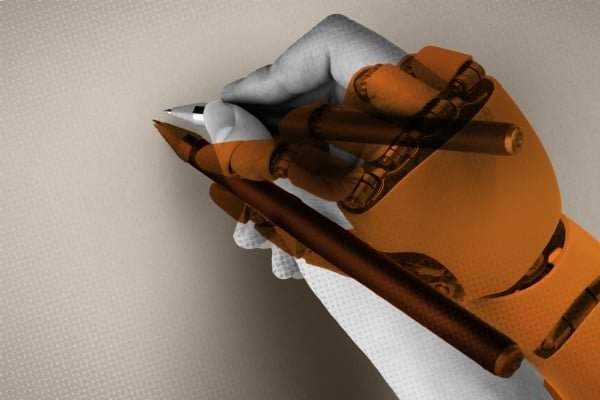
Already, AI can “produce credible solutions and provide reasonable responses to almost any written assignment,” including essays, math problems, proofs and coding assignments, the report states.
Photo illustration by Justin Morrison/Inside Higher Ed | Gazanfer and InspirationGP/iStock/Getty Images
A Massachusetts Institute of Technology student, faculty and staff committee released its report on artificial intelligence earlier this month, declaring that AI is “upending foundational elements of the MIT educational experience” and offering recommendations for how instructors and administrators can overhaul their curricula and teaching practices to respond to the new technology.
“While AI is allowing instructors to develop exciting new learning experiences and enabling students to learn and experiment in innovative ways, there have been a number of concerning effects on the life of the campus,” the committee wrote. These effects include increased difficulty in assessing students’ mastery and progress, increased isolation for students and instructors, and an erosion of the implicit social contract between students and their professors.
Professors feel increasingly pressured to police their students’ AI use with unreliable AI-detection tools, the committee wrote. According to a January survey by the American Association of Colleges and Universities, 73 percent of faculty members report they have personally dealt with academic integrity issues involving their students’ use of AI. Students, on the other hand, are scared of being accused of using AI. (An entire subreddit dedicated to this concern, r/AccusedOfUsingAI, has 2,200 weekly visitors.) Professors using AI on tasks that “demand a human touch,” such as grading, assignment creation and written feedback, also frustrates students, the report states.
“Such an underground river of mutual suspicion is no foundation for a healthy classroom,” the committee wrote, but later on the authors offer a silver lining: “The threat AI poses to familiar ways of teaching and testing may be a blessing in disguise—because the changes are too sudden and severe to ignore.”
The committee stopped short of recommending an institutewide AI use policy, which was one of its initial charges. Instead, MIT should create policy “menus” that departments and instructors can select and build from. In lieu of a policy proposal, the committee put forward a series of recommendations for a near-total overhaul of teaching and learning at the institute.
Assessment and grading changes were a major focus of the report. Already, AI can “produce credible solutions and provide reasonable responses to almost any written assignment,” including essays, math problems, proofs and coding assignments, the report states.
The committee recommended against “grade rationing” policies, such as Harvard University’s recent decision to cap the number of possible A grades in a given course. Instead, it suggested MIT take a step back to “consider what role grades play in our overall system” and explore other grading systems, such as the United Kingdom’s percentage-based system of relative mastery or other competency-based systems.
“The committee discussed the idea that if MIT did not have grades, many of the incentives around AI cheating would disappear,” the report stated. “Already, many employers are less focused on applicants’ grades than on their performance on internal assessments, such as the ability to answer difficult interview questions or demonstrate problem solving and mastery through custom exercises.”
Josh Eyler, senior director of the University of Mississippi’s Center for Excellence in Teaching and Learning, praised the report’s discussion of grades on Bluesky and applauded its advocacy of alternative grading systems.
“I cannot tell you how long I, along with many who study this subject, have waited for a major university to take a stand and make a clear call for a shift in practices of this size,” Eyler wrote. “Remarkable and—to be honest—I’m still a bit shocked, but I am excited to see how it plays out.”
The committee also emphasized the importance of in-person learning and spaces. During committee meetings, students shared that peer study groups have become increasingly rare, and that they are growing more anxious about how AI might impact their job options after college. Some students reported relying on AI for emotional support. Professors now receive fewer visitors during office hours.
The residential experience at MIT is valuable, the authors argue, but incoming students may not appreciate it.
“Learning works when it’s both challenging and social; knowledge is built through cognitive friction, whether that’s disentangling the steps of a mathematical proof with your study group, adjusting an experiment over and over until it works, or having a spirited argument with a peer (rather than getting ‘the’ answer from AI),” the committee wrote. “That’s why it matters for students to go to college!”
In response, the committee recommends more in-person campus celebrations, “tech-free times” focused on personal connection and an emphasis on social learning in class.
Responding to AI’s disruption won’t be fast or easy, the authors state, but it is necessary.
“The work will require thoughtful commitment and focused effort from the entire MIT community—students, instructors, staff and leadership. The goal: to preserve and enhance the distinctive transformative power of an MIT education,” the committee wrote. “It is not too much to say that MIT’s mission depends on it.”
You may be interested

Meghan Markle wears this chic holiday hat on repeat – and UK shoppers can buy it
new admin - Aug 28, 2026The Duchess of Sussex has relied on Cuyana's timeless wide-brimmed hat for years, making it a stylish investment for summer…

Iran war hits 6-month mark with no end in sight
new admin - Aug 28, 2026The head of the U.S. military's Central Command, Adm. Brad Cooper, has echoed President Trump's insistence that the Strait of…
Tennessee Promise Boosts College Enrollment and Attainment
new admin - Aug 28, 2026[ad_1] Tennessee Promise, the first statewide tuition-free community college program in the country, significantly boosted college enrollment and degree attainment…