McMahon Sends Reform ‘Questionnaire’ to Colleges

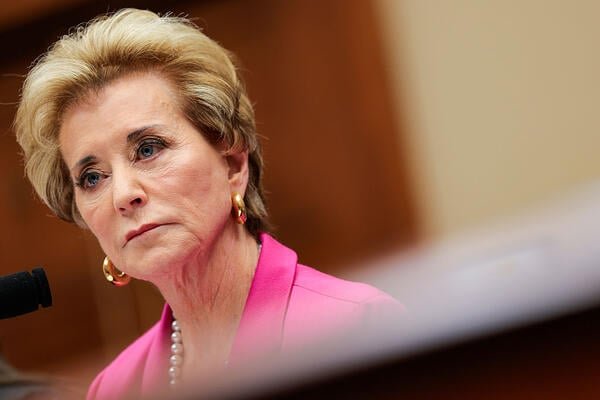
In its latest effort to reform higher ed, the Trump administration called on colleges and universities Monday to publicly answer a set of questions that officials hope will provide more transparency to the American public about how institutions operate and their values.
“This forthright conversation with the American people is long overdue,” Education Secretary Linda McMahon wrote in the letter. “And it is the essential first step toward rebuilding trust in the sector.”
The Trump administration has made no secret of its desire to reshape higher education. Since his first day in office, the president has used funding threats and investigations to demand that universities overhaul admissions, disciplinary processes and academic programs. To enact some reforms, the administration has cut individual deals with institutions..
Monday’s letter appears to stem from the administration’s effort last October to give universities preferential treatment for funding if they agreed to a number of policy changes. Several leading institutions declined to sign on to the proposal known as the Compact for Academic Excellence in Higher Education.
Unlike the compact, the administration is not asking institutions to require standardized college admissions tests, freeze tuition or shut down departments that “punish, belittle” or “spark violence against conservative ideas.”
For its “national call to action,” the department consulted with higher ed leaders, including from the Association of American Universities, and appears to be taking a softer approach. Trump officials want colleges and universities to publicly explain how they’ll make admissions criteria transparent, contain costs and improve pricing transparency, and protect the free exchange of ideas on campuses. McMahon encouraged colleges to respond by the end of year and include any adopted and potential reforms. She asked that responses be concrete.
In another departure from the compact, the document doesn’t spell out any consequences related to whether and how colleges respond; however, a White House official told Bloomberg that institutions that announce reforms “could be more likely to be involved in discussions” about reshaping federal research funding.
Call to Action at a Glance
The letter’s questions focus on a range of topics. They are:
- Transparency and Merit in Admissions
- Free Speech and Open Inquiry
- Intellectual Pluralism and Academic Vitality
- Affordability, Value, and Student Outcomes
- Academic Standards and Rigor in the Age of AI
- Safeguarding Research Integrity from Malign Foreign Influence
- Prioritizing American Interests
Ted Mitchell, president of the American Council on Education who lambasted the compact last fall, said Monday’s letter is “far less belligerent than previous discussions of what higher education ought to be and be doing.”
He added, “I think and I hope that it’s a realization by the administration that universities should not be instruments of the state. I do think that this is a tactical shift. I hope even more it’s a philosophical shift to working together to make institutions as good as they can be.”
McMahon held up as examples recent reports from Yale University, Vanderbilt University and Washington University in St. Louis that looked at why higher ed is losing trust among the American public and political biases in humanities scholarship.
“These courageous documents evince a generational opportunity for self-reflection and institutional renewal,” McMahon wrote. “For the good of the Nation, university leadership must seize this occasion to drive essential reforms—a process some began by adopting positions of institutional neutrality and improving policies related to campus protests.”
PEN America, a free speech organization, criticized the letter as “another blatant attempt by the Trump administration to pressure colleges and universities to abandon principle and hew to the administration’s priorities and ideologies.” The association called on colleges and universities “to stand strong against this latest salvo and for the values of free expression, academic freedom, and institutional autonomy.”
‘We’ve Been Working on This’
For Jenna Silber Storey, a senior fellow at the American Enterprise Institute and co-director of its Center for the Future of the American University, the letter is a “significant improvement” from the department’s original compact. She noted Monday in a statement that the call to action takes a more “measured and constructive” approach, does not “attempt to impose a single approach” on all colleges, and leaves it up to colleges to take initiative, avoiding policies that are “unworkable and perhaps unconstitutional.”
Storey added that though the compact was flawed, she hoped it would spur discussions between higher ed and the government.
“[I] hope that [Monday’s letter] will prove to be a small but important step toward our universities reestablishing the bipartisan relationships and support they need to put themselves on a more stable legal and political footing,” she said.
Storey said she connected the Education Department with the AAU, which provided feedback on the document. The Education Department also consulted with Arizona State University President Michael Crow and WashU President Andrew Martin, Bloomberg reported.
Crow said in a statement Monday that the call to action offers universities “a significant opportunity to respond in ways that will enhance American economic and competitive success, while addressing some of the concerns that have become matters of significant public debate.”
For the AAU, “this questionnaire affords our universities the opportunity to honor” their commitment to the association’s April 30 statement reaffirming the association’s mission to serve the nation, according to a joint statement Monday from AAU President Barbara Snyder, University of Kansas Chancellor Doug Girod, who chairs AAU’s board, and Johns Hopkins University President Ron Daniels, AAU’s vice chair. All three weighed in on the letter and offered suggestions.
Mitchell said it was encouraging that the Trump administration talked to higher education leaders, particularly those from the “the sector they’ve been most upset about— the elite research institutions.” (Several of AAU’s members have faced federal investigations or funding freezes.)
While Mitchell said he took issue with parts of the letter, such as the claim that higher ed has drifted from its principles, he sees the document as an invitation for the sector to have a conversation with the administration. And if that’s all it is, “I’m all for it.”
“But it remains to be seen how this information will be used,” he said.
Not all of the proffered questions will be relevant for many colleges and universities. For instance, McMahon asked colleges to explain how they’ll “ensure admissions decisions are based on merit, achievement, and your university’s educational purpose.” About 40 percent of degree-granting institutions have open admissions policies for their undergraduate programs, according to federal data.
Several higher education lobbying groups that represent institutions didn’t specifically say Monday whether they supported or opposed McMahon’s letter. But they did explain that much of the letter addresses work campuses are already doing.
“For institutions who want to fill out the questionnaire, they’re gonna be able to do so rather easily because these are kind of gimme questions,” Mitchell said. “We’ve been working on this.”
The Association of American Colleges and Universities also said Monday that McMahon’s questions are ones college leaders ask on a regular basis—especially in a time of growing public distrust. But the department’s letter implies that colleges are not properly aware and engaged.
“While there is always room for improvement, it is disappointing that these longstanding commitments are framed in a way that calls into question the dedication of institutions and the millions of faculty, staff, and administrators who have devoted themselves to advancing educational opportunity, research, innovation, and the public good,” AAC&U president Lynn Pasquerella said.
You may be interested
Jocelyn Benson wins Michigan Democratic gubernatorial primary, CBS News projects
new admin - Aug 05, 2026Michigan Secretary of State Jocelyn Benson is projected to be the winner of Tuesday's Democratic gubernatorial primary race, according to CBS News.As…

Bill Belichick’s Hall of Fame snub raises questions about Tom Brady
new admin - Aug 05, 2026[ad_1] NEWYou can now listen to Fox News articles! This week, Bill Belichick won’t be among those inducted into the…
Wesley Bell beats Cori Bush in Missouri Democratic House primary rematch that put party’s rifts on full display
new admin - Aug 05, 2026Rep. Wesley Bell on Tuesday beat former congresswoman Cori Bush in a heated Democratic primary in Missouri's 1st Congressional District,…