



Fired Over Speech, Professors Take Their Employers to Court

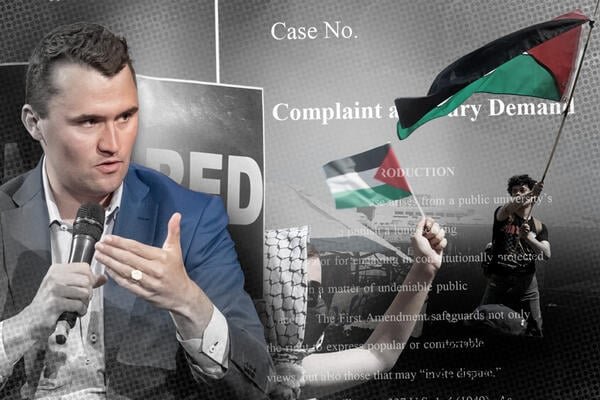
Rima Kapitan is busy. An employment lawyer focused on academia, Kapitan is currently representing more than a dozen faculty members who were terminated or otherwise disciplined for their speech. Her client list includes Savneet Talwar, an art therapy professor at the School of the Art Institute of Chicago who was put on indefinite leave for assigning a case study that featured a woman sympathetic to Palestinians, and Steven Thrasher, who sued Northwestern University earlier this month alleging he was denied tenure because of his pro-Palestinian activism.
“I get way more Palestinian cases than I ever did before,” Kapitan said during a phone call with Inside Higher Ed Tuesday, speaking from the road after presenting oral argument on behalf of one of her professor clients. “It was pretty seldom in the first 10, 15 years of my practicing law that we got a Palestinian case … but now we’re just bombarded.”
Professors are becoming more litigious, and their increasingly censorial institutions are driving them past arbitration and onto the judicial battlefield, experts say. Over the past several years, dozens of faculty and staff members who were disciplined or terminated for something they said on campus or online have sued their institutions, alleging wrongful termination and First Amendment violations.
Others have brought lawsuits to fight curricular censorship, academic freedom violations or tenure decisions that, if allowed to stand, establish dangerous precedent for the faculty body at large. In a May victory for academic freedom, a New York district court judge sided with U.S. Military Academy at West Point professor Tim Bakken and overturned a policy requiring faculty to obtain preapproval for public speech and writing. Bakken’s victory will hold; the academy had until Monday to appeal the ruling, but it did not do so.
Some of the professor plaintiffs have netted high-profile wins in recent months; Tamar Shirinian, an anthropology professor at the University of Tennessee at Knoxville who was fired for speaking ill of the late conservative firebrand Charlie Kirk, bagged a $1.9 million settlement from the university earlier this month.
Her case was part of a wave of litigation that followed a series of terminations over reactions to Kirk’s killing in September, said Zach Greenberg, director of the faculty legal defense fund at the Foundation for Individual Rights and Expression.
“The Charlie Kirk–style litigation is inspiring professors to take their universities to court when it comes to other expression or punishment, such as being punished for classroom expression or other, non-Kirk-related extramural speech,” Greenberg said. “As universities get more recalcitrant and perhaps treat professors more harshly when it comes to this kind of speech, [lawsuits] become the only option for professors to vindicate their free speech rights.”
Inside Higher Ed identified 35 faculty and staff members who were punished or fired for what they said about Kirk, and at least 12 of those employees have sued, seeking reinstatement, financial payouts or admissions of wrongdoing. Among them are Laura Sosh-Lightsy, an associate dean at Middle Tennessee State University who was fired in September for posting on Facebook that she had “ZERO sympathy” for “ol’ Charlie [who] spoke his fate into existence,” and Suzanne Swierc, the former director of health promotion and advocacy at Ball State University, who was also fired in September for her social media posts about Kirk. Swierc settled for $225,000 in May. Sosh-Lightsy’s case is ongoing.
Legal victories will be the most effective way to prevent universities from continuing to censor employees’ speech, said David King, a lawyer based in Tennessee. He recently won a $500,000 settlement and reinstatement for Darren Michael, a theater professor at Austin Peay State University who was terminated in September after simply sharing an old Newsweek headline that read, “Charlie Kirk Says Gun Deaths ‘Unfortunately’ Worth it to Keep 2nd Amendment.”
“I don’t think that we’ve seen anything like this in this country since McCarthy went on the tirade to … try to suppress speech,” King said. It’s “a very dangerous path that we’re going down, and I’m hopeful that we’ll be able to get some results out here that are going to stop it and at least get some help from the courts to say, ‘This is wrong.’”
Opportunities to Win
Most of the employees who faced blowback for their comments about Kirk were disciplined or terminated in the fall, but some of them just filed lawsuits recently. Felicia Branch, a former law professor at the University of Arkansas at Little Rock, sued the university in May, The Arkansas Times reported. Branch was fired in October for calling Kirk “evil” on Facebook, despite a recommendation by a faculty panel that she be reinstated. Oswaldo Nava, a former security guard at Eastern New Mexico University–Roswell, filed a suit against his university in June, alleging he was forced to resign in September after posting about Kirk on Facebook.
Kapitan said that most of the professors she works with try first to settle their disputes outside of court, through their university’s own processes or arbitration. “In employment law, generally, cases tend to settle at some point along the way,” she added.
Greenberg said it’s possible that the professors who sued recently just now finished their disciplinary process, “which can take a long time, perhaps months of appeals and deadlines and hearings.” Or the recent high-profile wins may have inspired them to go to court. “Perhaps the professors are seeing their colleagues get reinstated, getting large settlements—they want to feel the same thing for themselves,” he said.
The specific claims in each complaint are often dictated by the employee’s institution type, Greenberg said. Public universities are clearly bound by the First Amendment and “have to give their faculty free speech rights,” he said. To sue them, you’re “starting a First Amendment retaliation claim.” Private institutions, however, are not beholden to the First Amendment. In those cases, “you’re essentially trying to do a breach of contract lawsuit,” he said.
For example, Anna Kenney, an associate professor at the Emory University School of Medicine, was fired in September after posting on social media that she didn’t feel bad for Kirk and that he “seems like a disgusting individual.” She filed a breach of contract suit against Emory in May, claiming to be a victim of “jawboning,” which FIRE defines as the government using its power to indirectly bully individuals.
Private institutions “can be a bit tricky, because it depends on the exact language of the policies that the college has when it comes to free speech and academic freedom,” Greenberg said. “We have seen some faculty lose cases because their colleges essentially disclaim the free speech policies—[arguing] that they weren’t clear enough, or they were vague.”
Beyond Kirk
In addition to the avalanche of Kirk-related lawsuits, a lot of recent speech cases focus on employees’ advocacy for Palestinians—disputes that Kapitan said make up about half of her current caseload. She attributes institutions’ increased censorship of pro-Palestinian speech to pro-Israel and Zionist organizations that have waged “concerted pressure campaigns to convince universities to silence the dissent about U.S. policy on Palestine,” she said. “Sometimes it’s not even the case that the academic institution has an ideological opposition to what the movement is saying—sometimes they’re just intimidated by these pressure campaigns and intimidated by accusations of antisemitism.”
Idris Robinson, a philosophy professor at Texas State University, was told last summer that his contract would be terminated because he gave an off-campus, unaffiliated talk about Israeli-Palestinian relations the previous year. He sued, and in May, just days before his contract was set to expire, a court ordered the university to reinstate him for at least one year or until his case is resolved. Similarly, an independent arbitrator ruled in June that San José State University must reinstate Sang Hea Kil, a justice studies professor who was fired in 2025 for her pro-Palestinian activism. Still, she’s moving ahead with a lawsuit against the California State University system, alleging it violated her First Amendment rights.
“There’s been a trend of courts understanding and resisting the conflation of antisemitism and anti-Zionism,” Kapitan said. “So we’re seeing that in some of the case law … But we’re still seeing a lot of repression. Universities still seem to be much more intimidated by the government forces seeking to suppress speech.”
The lawsuits will likely keep coming. Earlier this month, a day after South Carolina Sen. Lindsey Graham died, author Tom McAllister posted a tongue-in-cheek warning on Bluesky.
“Remember, be careful what you post on a day like this,” he wrote. “If you do it right, you can get illegally fired for being disrespectful to Lindsay Graham and then win a massive lawsuit about 10 months from now and retire with 2 million in your pocket.”
You may be interested
Grease immersive movie musical review: Aspirational, but still a disaster | Theatre | Entertainment
new admin - Jul 31, 2026Grease the Immersive Movie Musical had a lot of potential (Image: Grease: The Immersive Movie Musical)Initially released in 1978, Grease…

Michigan’s Kyle Whittingham on Ohio State: ‘Hate is a strong word’
new admin - Jul 31, 2026[ad_1] NEWYou can now listen to Fox News articles! Kyle Whittingham may not know it yet, but despite being on…

Man speaks out after peptide vendor’s sentencing: “I wanted to die”
new admin - Jul 31, 2026Man speaks out after peptide vendor's sentencing: "I wanted to die" - CBS News Watch CBS News A federal judge…