



ED Scraps Tool to Investigate Discrimination

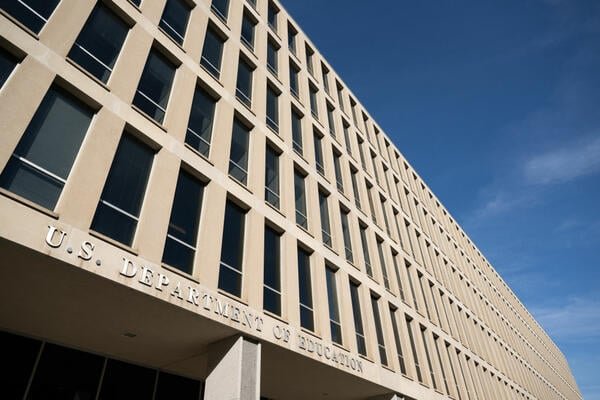
The U.S. Department of Education announced Thursday that it’s abandoning provisions of civil rights law that protect students against institutional policies that disparately impact minority groups. Now only intentional discrimination violates the law, according to the department’s final rule.
ED officials say that the decades-old provisions under Title VI of the Civil Rights Act of 1964 “allow demographic data alone to establish that a school violated federal civil rights laws, even if there is no facially discriminatory policy, practice, or discriminatory intent involved,” forcing educational institutions to consider race in their decision-making.
“These regulatory changes will help ensure fair enforcement of Title VI, as intended by Congress,” Assistant Secretary for Civil Rights Kimberly Richey said in a news release. “The Trump administration will always hold schools accountable for discrimination and ensure all students in America receive the equal educational opportunities and equal treatment to which they are entitled by law.”
Other federal agencies have made similar moves in response to an April 2025 executive order by President Donald Trump that called for eliminating the consideration of disparate impact “in all contexts to the maximum degree possible.” In June, the Department of Justice issued an opinion declaring the Equal Employment Opportunity Commission’s disparate-impact guidelines unconstitutional. The Department of Transportation scrapped the legal concept that same month in its own final rule.
Against that backdrop, the Education Department’s shift may not be surprising, but it’s still “astonishing,” said Catherine Lhamon, who led the Office for Civil Rights during the Obama and Biden administrations.
“For the federal government to announce that it will no longer consider particular kinds of discrimination to violate the law, that guarantees that no person will experience that discrimination, is an incredible diminution of the long-standing protection that Congress has guaranteed to all of us,” she said.
Lhamon argued that ED mischaracterizes disparate impact as condemning practices as discriminatory purely based on demographic data when, in reality, it’s an “investigative tool” that’s used as part of a larger analysis process. During Lhamon’s tenure, OCR investigators sometimes concluded that a school or college’s practice did disparately affect different groups, but the institution had a justified or lawful reason for it that didn’t amount to discrimination, she said.
In contrast, the Trump administration regularly uses universities’ admissions data, disaggregated by race, to accuse institutions of violating civil rights law, which seems to take the approach that ED says it’s against. Lhamon called it “the height of irony” that “the Trump administration tells other people not to do what it is lawlessly doing.”
“Done right, the law is a nuanced inquiry,” she added, “and it’s important to evaluate whether people experience discrimination that can be corrected, and if so, to work with school communities to correct it. But this new regulation takes away that tool as if that particular kind of discrimination is not harmful for people.”
Facing Pushback
A group of 60 civil rights and education organizations—including EdTrust, the NAACP Legal Defense Fund and the Center for Racial and Economic Justice at University of California College of the Law, San Francisco—argued in a joint statement that the policy shift will leave students of color without federal protection from policies that disproportionately harm or disadvantage them. The group urged the department to reverse course.
“For decades, courts have acknowledged that discrimination is not always explicit or overt,” the statement read. “The disparate impact tool is designed to remove unjustified barriers in education and ensure that all students have an equal opportunity to learn and succeed.”
Amalea Smirniotopoulos, senior policy counsel at the Legal Defense Fund, said disparate impact has historically been used to challenge “a variety of unfair barriers” in higher ed.
The policy change is “going to unfortunately make it easier for higher education institutions to engage in discriminatory practices,” she said. “Removing this tool is going to mean that it is more likely that students will experience discrimination that will go unchecked.”
For example, disparate impact has been used to bring civil rights complaints against legacy admissions policies, based on the argument that such practices disadvantage minority students, because minorities have been admitted to these universities for less time and are therefore less likely to have alumni in their families. Some have also argued in the past that by requiring standardized tests, universities disproportionately curtail admissions for students of color.
Smirniotopoulos said the disparate-impact tool gives an institution room to defend such a policy and explain its rationale while also allowing a challenger to argue that there are less discriminatory ways to achieve the same ends. It’s a “balanced standard that allows for consideration of the interests of the institution and the interests of the people who are experiencing those barriers,” she said.
Some experts also say ED went about changing the policy in the wrong way.
The department made its final rule without any prior public notice or the typically required comment period—similar to other policy changes the Trump administration rushed through. ED officials claimed the new rule falls under an Administrative Procedure Act exemption for issues related to “agency management or personnel or to public property, loans, grants, benefits, or contracts” because the policy shift concerns nondiscrimination criteria for institutions to receive federal funding.
Amanda Fuchs Miller, president of the higher ed consultancy Seventh Street Strategies and former deputy assistant secretary for higher ed programs under the Biden administration, said she’s seen other federal agencies use that reasoning to forgo public comment. But the exemption doesn’t apply to the Education Department, according to the General Education Provisions Act, except for in two circumstances: rules related to new grant competitions or in situations where the delay would cause “extreme hardship” to beneficiaries of a program.
“They don’t address that at all in this final rule,” Miller said. “I believe that they didn’t follow the right procedures to get to final rule for a Department of Education regulation. Hopefully it will be challenged, because they shouldn’t be able to just skip these legal processes.”
Lhamon agreed the public should be allowed to formally weigh in.
“It’s a massive change in law for the first time in decades,” she said. “It’s certainly not something that one would, before this administration, have expected the federal government to do with the stroke of a pen. This is the kind of thing that our laws promise that people will have an opportunity for comment and the federal government will consider those comments.”
You may be interested

Full list of hosepipe ban exemptions as rules extended in England
new admin - Jul 24, 2026The Met Office has confirmed that some parts of England are seeing the longest unbroken spell of no recorded rainfall.…

Cyclosporiasis outbreak expands to 9 states
new admin - Jul 24, 2026[ad_1] The massive, multistate outbreak of cyclosporiasis has expanded to nine states, the Centers for Disease Control and Prevention said…

3 Programmatic Accreditors Withdraw From Federal Recognition
new admin - Jul 24, 2026[ad_1] Three programmatic accreditors have voluntarily withdrawn their petitions to continue being recognized by the federal government, Education Under Secretary…