




Financial Aid Offices Contend With AI-Written Appeals

Since the launch of ChatGPT and other generative artificial intelligence platforms in late 2022, students have adopted the tools to facilitate the admissions process, from researching colleges to writing admissions essays.
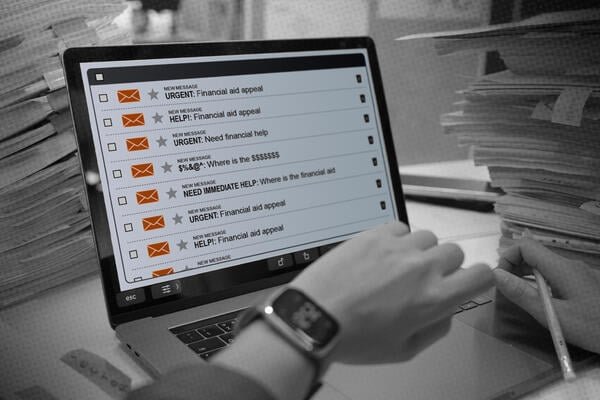
Now, financial aid officers are seeing students and families use AI in a new way: to try to get more financial aid.
Every institution of higher ed is required by law to allow admitted students to request changes to their financial aid package due to changes in their life circumstances, such as a parent losing a job; these requests are called “professional judgment” appeals and usually involve reaching out to the financial aid office, explaining the change in circumstances and providing some documentation.
But financial aid administrators say they’ve begun to receive appeals that appear to be written by AI, based on the generic language they use and the vagueness of the requests.
An April survey of financial aid administrators showed that some are finding it challenging to respond to AI-written letters because they “lack the specificity, personal context, and genuine situational detail that staff rely on to make professional judgment decisions,” according to the National Association of Student Financial Aid Administrators’ report on the survey. “Several respondents noted the difficult position this creates: they cannot assume AI use is fraudulent, but they also cannot make accurate eligibility determinations from submissions that may not reflect a student’s actual circumstances.”
The rise in AI-written appeals highlights the ways the chatbots represent a double-edged sword for financial aid offices. For students, especially those whose parents didn’t attend college, financial aid can be difficult to understand, so tools like ChatGPT can help answer certain questions and, yes, assist in crafting complex financial aid appeals.
“For many families, when you’re about to make this very big, complicated decision that is very much tied to money, sometimes they can feel [more] comfortable asking an outsider who can bring all those different financial aid packages together and create kind of an apples-to-apples comparison,” said Jeff Schiffman, senior strategic leader for EAB’s enrollment management platform, Enroll360. “And in this day and age, what better third party to use than AI? So, I think I understand it for families that want to make this major decision without just doing it on their own, shooting blind.”
At the same time, when the letters produced by AI tools do not contain the information the financial aid office needs to make a decision, it can create more back-and-forth with the student—and more work for the office. The use of bots could also increase the volume of appeals by making them easier to write and submit, Schiffman noted, although Jill Desjean, NASFAA’s director of policy analysis, said her organization has not heard widespread reports of increased appeals.
‘Throw Some Additional Funding’
Two financial aid directors told Inside Higher Ed that they are seeing increased use of AI among students crafting financial aid appeals—although they differed in their descriptions of its impact on their office.
Charles Harper, director of financial aid at Belmont University, a midsize Christian college in Tennessee, said he has noticed that some appeal letters contain very similar content.
“Some of the instances in which they are referencing their need for aid [seem] very across-the-board—anyone could write this,” he said.
But Belmont requires students filing appeals to do so through a secure portal—in contrast to some other institutions, which allow students to appeal via email—so those submitting AI-written letters still have to answer specific questions about their circumstances and upload related documents. Because of this, the AI letters haven’t proved particularly burdensome for Belmont’s financial aid office, Harper said.
At the College of Saint Benedict and Saint John’s University, connected men’s and women’s colleges, respectively, in Minnesota, however, the AI-written letters are causing some difficulty. Robert Piechota, executive director of financial aid, said that the AI-written letters, which he’s noticed are typically submitted by incoming rather than returning students, require significantly more back-and-forth with families to determine whether they qualify for more aid.
Additionally, he said, AI-written letters are more likely to be arbitrary—that is, the student doesn’t cite a concrete reason why they need increased funding, such as a loss of income, but instead appear to be blindly asking for more aid.
“You could just tell by some of the AI letters, they’re probably just sending it to every school that [they were admitted to] and seeing who … just by getting that, is maybe going to just throw some additional funding at them,” he said.
Piechota has noticed an increase in appeals, although he attributed it to the decline in state financial aid available to Minnesota students this year—not AI.
According to College Aid Pro, a consulting firm that provides guidance on financial aid, the letters produced by AI are also less likely to be effective than more carefully tailored letters. Kevin Murphy, a consultant with College Aid Pro, conducted an experiment in which he asked ChatGPT to create an appeal letter based on a real student’s situation: Their family income dropped by three-quarters from what they had entered into the FAFSA.
ChatGPT prompted the “student” to share what changed about their circumstances to warrant the appeal; it also noted in the letter that the school was the student’s top choice, which Murphy said was a good move. But the letter Murphy personally crafted for the family was far more detailed, taking into account an error they made filling out the FAFSA, new credit card and medical debts, and siblings in college and private high school, among other factors. Murphy’s letter was also about three times longer than the ChatGPT letter, although he noted it was one of the longest he’s ever written.
In the end, Murphy’s letter earned the student tens of thousands more in financial aid, including a $40,000 need-based scholarship.
“I just don’t think this would’ve been possible with [ChatGPT’s] appeal letter. It just isn’t detailed enough,” he said. “[It’s] super cool to see, as a high school student putting a simple prompt in, not knowing the federal methodology or the institution methodology … what it spits out. Is it terrible? No. Is it going to get them a huge grant increase? No.”
You may be interested

Can creditors renew a judgment against you if you still owe money?
new admin - Jul 23, 2026The clock may be ticking on your court judgment — but perhaps not in the way you may expect. FREDERICA…

Amazon’s best 4K streaming sticks are up to 40 percent off
new admin - Jul 23, 2026There’s no shortage of great shows and movies to watch, but discovering something new isn’t always easy. Amazon’s Fire TV…

Grieving woman issues alert to anyone walking dogs in July
new admin - Jul 23, 2026A grieving woman has issued a health warning to all dog owners in the UK after her pet passed away…