


How Afroman Went From Comedic Rapper to Free-Speech Hero

I
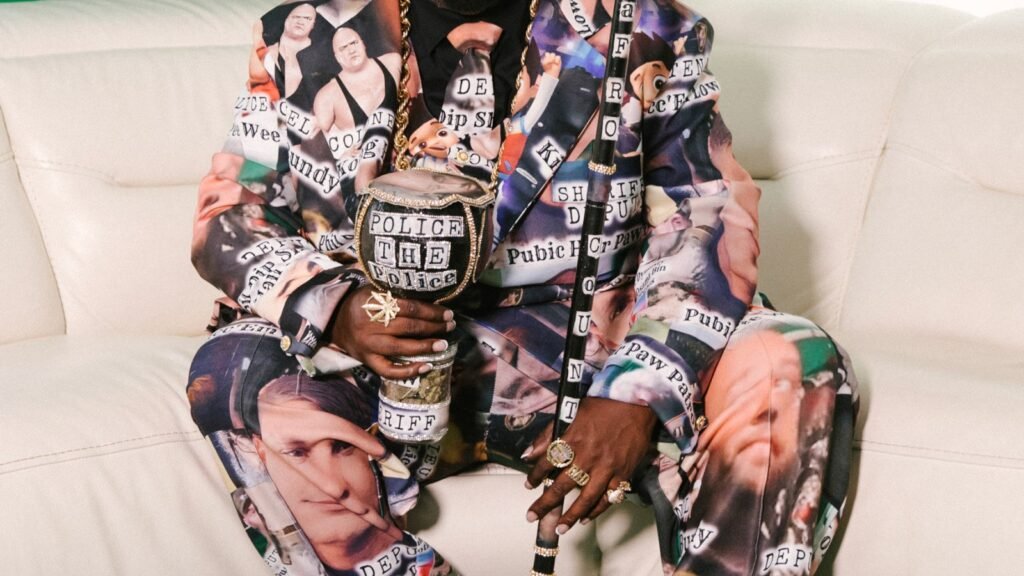
t’s close to showtime, and Afroman is sitting alone on a purple velour couch in the green room of the MegaCorp Pavilion in Newport, Kentucky. In 30 minutes, he’ll be onstage performing the songs that made him famous — “Palmdale,” “Crazy Rap,” and, of course, his breakout 2001 hit, “Because I Got High” — before a crowd of around 1,000 people. He’s dressed in his new signature look: a bespoke American-flag-print suit with matching sunglasses (the flag motif covers the lenses). His French-manicured fingers, sporting multiple gold rings, hold a chalice also emblazoned with the flag and filled with Colt 45 malt liquor. Two assistants, clad in tight red dresses, film his every move while his go-to hype song, Lynyrd Skynyrd’s “Simple Man,” plays on repeat. As Ronnie Van Zant sings, “Don’t you worry, you’ll find yourself/Follow your heart and nothing else,” he rises from the couch and looks up to the ceiling, raising his hands as if in prayer.
Joseph Edgar Foreman, 51, is in a good mood. In recent months, he’s made the unlikely journey from beloved novelty rapper to American folk hero after winning a highly publicized defamation lawsuit brought against him by officers at his local sheriff’s office. Tonight is the homecoming show of his Freedom of Speech tour, a victory lap of sorts that has seen him celebrate his new status as a civil rights champion in cities from Tallahassee, Florida, to Honolulu. Newport is only about an hour from Foreman’s rural Ohio home, so on this early-May evening, he’s greeting a wildly enthusiastic hometown crowd. Onstage, Foreman pulls from old hits and new songs that, as he tells the audience, “almost cost me $4 million.” The crowd roars.
Those new songs chart the strange saga that has brought Afroman back to headlines. In the summer of 2022, at least nine officers from the Adams County Sheriff’s Office busted open Foreman’s front gate and raided his home on suspicion of drug trafficking and kidnapping. They rifled through Foreman’s clothing and possessions and confiscated around $5,000 in cash, “green leafy vegetation,” and some marijuana paraphernalia, according to police documents filed following a search warrant. Foreman was never arrested, and no charges were ever filed.
And that might have been it — a local story about a raid on a rapper from 25 years ago — had Foreman not launched a barrage of insults against the officers on social media, alongside a series of mocking music videos utilizing footage of the raid taken from his home-security cameras. In the song “Lemon Pound Cake,” for example, Foreman pounced on footage that shows one officer in his kitchen appearing to glance, mid-raid, at Foreman’s mother’s homemade confection. (Sample lyrics: “Lemon pound cake/He wanna put down his Glock/Lemon pound cake/Trending on TikTok.”)
Foreman was out of town that night, but his ex-wife, Angie, heard about the commotion and drove over with their two kids. She is convinced that given the amount of officers and weaponry used, had Foreman been home, the outcome would’ve been grave. “I have zero doubts,” she says, “that if [Joseph] was in the house, he would be dead.”

The new front gate to Foreman’s Winchester, Ohio, property depicts two officers from the raid.
Madeleine Hordinski for Rolling Stone
In 2023, seven of the officers sued Foreman for $3.9 million for invasion of privacy and defamation, among other claims. Three years later, a livestream of the relatively brief trial brought its colorful cast of characters to the world, and Foreman went viral. (“I was just trying to go Cincinnati internet,” he says, laughing.) The Daily Show covered the ordeal, and everyone from progressive news outlet Mother Jones to manosphere misogynist Andrew Tate voiced support for Foreman.
To many who followed the case, its absurdities counterintuitively laid bare serious issues of police accountability and governmental transparency. Foreman’s supporters, including some who may not have heard of him before, have embraced the comedy rapper as a First Amendment crusader who feels as culturally relevant now, if not more so, as he did at the peak of his early-2000s fame. If nothing else, he’s mastered the mercurial art of virality and emerged as one of the decade’s most potent political satirists.
“If there’s anybody you don’t want to mess with,” he says, “it’s a comedic rapper.”
‘A Hustling Spirit’
The morning after the show, Mother’s Day, we meet at Mama’s Coffee House in Winchester, Ohio, a village of around 1,000 people about an hour’s drive east of Cincinnati. Foreman visits the shop nearly every day. “We got two buildings in our town,” he says. “The gas station across the street and Mama’s.” The bakery started regularly selling lemon pound cake the weekend after the verdict, and the first batch sold out within an hour. Soon after, people started coming from hours away to buy one. A sign advertising “The Afroman Lemon Pound Cake Combo” — a 20-ounce “lemon pound cake latte” and a slice of the dessert with whipped cream for eight dollars — is displayed on the counter.
Foreman, once again clad in one of his custom flag suits, nestles into a corner booth next to a sign that reads “Sit long, talk much, laugh often.” Over the next several hours, looking back on how in the hell he got to this point, he will do all three.
Born in South Central Los Angeles, Foreman moved to Mobile, Alabama, with his family when he was five, learning to play drums, guitar, and keyboard in his grandfather’s church. They moved back to L.A. at age 11, which was educational in a whole new way. “I picked up an impeccable hustling spirit,” he says, but at the same time, the city exposed him to “things I’d never seen before,” like homelessness and cops being racist toward Black people. “It mentally toughened me up.”
If every superhero has an origin story, Foreman’s begins at South Central’s Raymond Avenue Elementary School. In the sixth grade, he wrote his first rap: a diss track against a rich classmate he says was “beautiful but mean.”
Inspired by his father’s and uncle’s gifts for ragging on rich relatives, he wrote a parody rap about the girl’s “slight little mustache” to the tune of Slick Rick’s “La Di Da Di.” “The whole school went crazy,” he says.
‘They live in this little fantasy world where they bully people and get away with it.’
Two years later, he started selling mixtapes that leaned heavy on storytelling raps but only hinted at the humor that would become his trademark. After a girl derisively called him “Afroman” at L.A. Southwest College in the mid-1990s, Foreman reclaimed the insult, showing an early penchant for turning a negative into a positive. “I watched a Too $hort documentary, and he was saying how they was telling him he was too short,” Foreman says. “And he started putting it on tapes and hats and on jackets. He named himself that, and he said it worked.”
Still, his first mixtapes weren’t catching on. In 1999, broke and with his house in foreclosure, Foreman, then 25, relocated from L.A. to Mississippi. He started looking less to his hip-hop peers as career models and more toward comics like Rodney Dangerfield: When in doubt, clown yourself. “It was magic,” he says of rapping about his own troubles and humiliations.
That’s when, in a “raggedy house with a dirty sock over a preacher mic and a hairband holding it all together,” stoner-rap history was made. Foreman produced and recorded all of the voices for “Because I Got High,” a celebration-slash-cautionary tale about weed.
“What made Afroman different wasn’t the weed. It was the perspective,” says High Times Editor-in-Chief Javier Hasse. “Most cannabis music at the time treated weed as cool, rebellious, or aspirational. Afroman played a guy who blamed weed for everything wrong in his life. The joke was the narrator.” Adds famed marijuana activist Tommy Chong: “The perception before, at least what the authorities were trying to put on, is how evil people are when they’re high. When [the song] came out, it was so simple and honest. He showed how ridiculous [the panic] was.”
Dan McCarron was working in the A&R department at Universal Records in late 2000 when he heard about the “wildfire reaction” the song and album were earning. “It was the biggest demand we had ever seen,” he recalls.
The label signed Foreman, and according to McCarron, the song “quickly went from a couple of [radio] spins to ubiquitous. Every hour, every station was playing it.” Howard Stern became an early proponent, and director Kevin Smith placed “Because I Got High” over the end credits to his fifth film, Jay and Silent Bob Strike Back.
“There were multiple stories within Afroman’s song with a moral and a lesson, and it was funny, and relatable,” Smith says. “And how often is there a song that makes you laugh to the point where you’re like, ‘I gotta play this for somebody else’? It was a phenomenon.” (To wit, in 2001, a judge sentenced a Massachusetts teenager busted with beer and a weed pipe to write three paragraphs on the track’s morals. The boy said he already knew the song and found it funny.)

“The world would have you think I’m stupid, and I play into stupid,” Foreman says.
Madeleine Hordinski for Rolling Stone
“Because I Got High” went Number One in nearly a dozen countries, earned Foreman a Grammy nomination for Best Rap Solo Performance, and the album it was on peaked at Number 13 on the Billboard 200. The response was so universal, Foreman recalls, that two uniformed New York cops once lit a joint and offered to smoke with him. (“This is a crooked-cop prank on me,” he thought. Nevertheless, he accepted.)
Universal quickly repackaged Foreman’s biggest songs to that point for the album The Good Times and released it on Aug. 28, 2001. “I remember feeling, ‘This is the summer of Afroman,’” McCarron says. “He was everywhere.” Two weeks later, on Sept. 11, the national mood transformed overnight.
If irony was dead, what luck did wanton, weed-fueled silliness have? As quick as he seemed to arrive, Afroman was gone. “By the next morning, his radio spins had gone literally to zero,” McCarron says.
“‘Killed’ is a big word,” Foreman says, laughing, when asked if he felt 9/11 killed his career. “It hospitalized it. My career was on the bed with all the hoses and IVs and shit and the foot was in the air.”
Foreman never released a major-label album again, but never stopped recording and touring. He formed his own record label, occasionally revisited “Because I Got High” for remixes, and released independent comedy-rap albums with titles like Frobama: Head of State, Save a Cadillac, Ride a Homeboy and Waiting to Inhale. Did he ever think about giving up after a brief, yet meteoric, taste of superstardom? “I didn’t quit when I was less. You think I’m gonna quit when I’m more? How does a cowboy stop being a cowboy? How does a rapper stop being a rapper?” he says, adding, “You got to have a bad part of the movie to help you wipe tears and love it at the end. Dude, I wouldn’t change nothing in my life, because my truthful story is unbelievable.”
Turning Bad Times Good
From Mama’s, we take Foreman’s Rolls-Royce Phantom he calls “Nighttrain” — with a custom lemon-pound-cake license plate — to the modest farmhouse he’s dubbed Fro-ever-ever Land. Nighttrain, Foreman’s “normal, everyday rich-man car,” has many friends: a 1992 Cadillac Fleetwood Brougham, a 1962 Chevy Impala, a 1983 Coupe de Ville, a black Escalade, and, finally, a Rolls-Royce Ghost bought shortly after the raid. “I wanted to put this car in the sheriff’s face a little bit,” Foreman says, smiling. “It was the first little slice of success after the raid and the album.”
“Most people wronged by the police just have to take it. Afroman didn’t take it.”
Foreman moved here in the mid-2000s, when he was “chasing a girl and discovered some cheap land.” The three-bedroom home, situated on five acres, holds a makeshift recording studio for preproduction and an upper level that highlights Foreman’s near-pathological love of collecting. There’s the cane collection. The fedora collection. The sunglasses collection. The pandemic-mask collection. The suit collection numbering well over 100. The shoe collection (all wing tips, flamboyantly embellished with marijuana leaves, leopard print, stars, and other flair). The DVD collection (with The People vs. Larry Flynt on top). And a chalice collection not seen since the Holy Grail scene of Indiana Jones and the Last Crusade.
We walk downstairs to the kitchen, which, like most of the rooms in the house, is painted bright green. The walls are plastered with framed records and plaques touting Foreman’s streaming numbers. There’s a sign that reads “Drink some coffee, put on some gangster rap & handle it.”
You may have seen this kitchen in one of Foreman’s many videos posted following the raid. On Aug. 21, 2022, officers with the Adams County Sheriff’s Office visited a woman in Winchester they suspected of marijuana possession, according to court documents obtained by Rolling Stone. After finding more than four pounds of weed in her home, the woman, identified in the search warrant as Foreman’s former personal assistant and ex-girlfriend, told the officers that she was “holding” the weed for him, according to the search warrant authorizing the raid on his home. She also claimed that Foreman’s house contained a basement “dungeon,” where, according to the warrant, “he keeps women locked in, forcing them to urinate and defecate in a bucket for punishment for upsetting or disobeying him.” (Property records obtained by Rolling Stone show that Foreman’s house has no basement.)
Later that evening, officers executed the raid with weapons drawn. Angie, with whom Foreman is still close, says she told the cops before they entered his home that she would give them a key. “They didn’t have to destroy anything,” she says. “They could’ve just let me open the damn door. They thought that they was going to catch this big-league [criminal]. Joseph has lived here for years. They’ve never had any issue to ever think ill of him.”
In a statement, Robert Klingler, the officers’ lawyer, says that “the door had already been breached” before Angie arrived. “There was no offer to provide a key to the house.… The accusation that they unnecessarily caused damage to the door, or to any other property, is not true.” Adds Brian Newland, one of the officers, “Ms. Foreman was addressed in a calm and courteous manner.”
“I can’t get them to come out here when I get my house broken into,” the rapper says — a situation he claims has occurred multiple times, prompting him to install the very security cameras that famously captured the cops in his kitchen. “But that same day they came with a Full Metal Jacket, Beetle Bailey infantry, Marine Corps battalion. You could have looked at the floor plan [of my house] at City Hall and realized there was no Dungeons & Dragons and secret Scooby-Doo passages.” (“The officers are unaware of any reports of break-ins by Mr. Foreman that were not followed up on, and do not believe there were any,” Klingler says.)
Six weeks after the raid, Foreman released the song “Why You Disconnecting My Video Camera,” later dropping an accompanying video to his social media accounts. The lyrics called out the officers by name, labeled them “white supremacists,” and claimed that a female officer “ate my ex-wife jus’ like pizza.”
That December, Foreman released “Lemon Pound Cake” and the laconic “Will You Help Me Repair My Door.” (“Why are you stealing my money?” Foreman raps in the latter, which ridicules the officers for busting down his gate and front door.) The videos racked up millions of views and pioneered a new form of modern satire, one that used the officers as unwitting actors in content made to entertain — and monetize. (Foreman’s new gate is adorned with cartoonish cutouts of raid officers Shawn Cooley and Lisa Phillips.)
Talking about the past four years, Foreman whipsaws between blunt-induced joviality and trenchant seriousness. To Winchester residents, the imposing Foreman, who stands six feet three (not counting the Afro), is a gentle giant, an affable staple at pee-wee basketball games and events who never refuses an autograph or photo request. “Two wrongs don’t make a right” seems to be the worst anyone in town has to say about this whole situation. He can be loquacious: A question on the ex who claimed he had a dungeon yields a 20-minute story that wouldn’t be out of place at a Moth reading.
The rage he has against the officers who invaded his home is genuine; but in general, Foreman is charismatic, easygoing, and ball-busting by nature, a student of Richard Pryor and Redd Foxx as much as E-40 and Too $hort. His viral testimony at trial that he could “turn my bad times into a good time” could double as a life mantra.
“The world would have you think I’m stupid, and I play into stupid,” he tells me at one point. When I note that he doesn’t have a publicist, he smiles and quickly shoots back, “My publicist is the Adams County Sheriff Department. Boy, they get me all kind of interviews, man!”

Foreman at his local spot, Mama’s, which sells an “Afroman Lemon Pound Cake Combo” — a “lemon pound cake latte” and a slice of the dessert for eight dollars.
Madeleine Hordinski for Rolling Stone
‘Make Lemon Pound Cake’
At first, Foreman’s priorities following the raid were more practical than idealistic. “Step one: I need my house repaired,” he says. “Step two: I don’t want to pay for what these strangers did. Step three: Make money off of the strangers to pay for the destruction they brought to my home. Step four: Try to make as much money as possible to the point where I’m happy this happened.” But the case quickly took on a greater significance.
In March 2023, seven of the officers who participated in the raid brought, among other claims, an invasion of privacy lawsuit against Foreman, adding a defamation claim in an amended complaint two months later. (Foreman countersued primarily for destruction of property, but a judge dismissed his claims, noting the officers “had privilege to enter pursuant to a court order.”)
In the amended complaint, Klingler pointed to statements made by Foreman on social media that he alleged were defamatory: The officers were “white supremacists” and “criminals” who “stole my money”; Newland “used to do hard drugs” and was a “snitch”; Phillips “is not a female and is trans or lesbian”; and the officers “came to kill me in front of my children.” Foreman would later call Newland a “pedophile” in song and on social media, with Klingler highlighting Foreman’s posts about Newland at trial. (Newland vehemently denied the claim in court.) “As a result of [Foreman’s] actions,” the officers’ lawsuit stated, “they have suffered humiliation, ridicule, emotional distress, embarrassment, and loss of reputation.”
“I’m a little high, so help me,” Foreman says when I read this to him. “Say the first thing they accused me of and then stop.”
“Humiliation.”
“What do I feel as a human being that happens to be Black with the history of injustice and slavery? How do I feel when a group of dudes with guns kick down my door, steal my money, disconnect my cameras, and laugh at me when I ask them to help me fix it? What do I feel? The audacity.” (When reached for comment, Phillips says she was “instructed to disconnect the surveillance-camera system because it was being collected as evidence. I did so professionally, treating the property with respect throughout the process.”)
The American Civil Liberties Union of Ohio filed an amicus brief calling the suit a “meritless effort to use a lawsuit to silence criticism … of government actors.… There is nothing the First Amendment protects more jealously than criticism of public officials on a matter of public concern.”
“Law enforcement doesn’t get to silence or arrest people who are documenting the truth about what law enforcement looks like in this country,” says ACLU senior staff attorney Vera Eidelman, who co-wrote the brief. To her and other Foreman supporters, he was trying to “highlight police abuses [and] talk about the trauma that was caused to him and his family through an invasive raid, and to be able to discuss why that should not be happening, and he did that through expressing himself.”
The dismissal of his counterclaims in February of this year prompted Foreman to continue releasing new songs and videos about the cops in the lead-up to the trial, with titles incorporating their names, like “Shawn Grooming Grooms” and “Brian Newland Is a Flag.” As Foreman saw it, officers like Grooms and Newland were no different from his classmate at Raymond Elementary. “I wrote [that parody in sixth grade]. Well, damn. Fast-forward whatever years. What do we have on the menu for today?”
The three-day trial in March at the Adams County Common Pleas Court highlighted both the deadly serious and the comically absurd. For the officers to prevail, they had to convince the jury that Foreman’s statements would be understood as factual assertions capable of being proven false — and not just Foreman’s opinions or exaggeration, which are typically protected by the First Amendment. If the jury considered his statements and actions as parody or satire, Foreman would win.
This led to some unusual (and viral) moments. Cross-examining officer Randy Walters regarding the song “Randy Walters Is a Son of a Bitch,” Foreman’s lawyer, David Osborne Jr., argued, “There’s no way we can prove whether you’re a son of a bitch or not.” Walters replied, apparently referring to his mother, “Nah, she’s been dead for years.”
All seven deputies testified to the harm they claim Foreman inflicted through his statements. Multiple officers testified that the sheriff’s department received death threats. Cooley, who’d been with the force for more than 30 years and who Foreman dubbed “Officer Pound Cake,” testified that it “just went from being a nice, quiet community — a job you felt safe in — to a place where you had to look over your shoulder every second,” before adding that he received “hundreds of pound cakes at work.” Cooley’s son, Justin, another deputy who sued Foreman, testified he had a mental breakdown and that the “handling of this case” led to his resignation: “I just could not escape the hate that it brought and just tore through this community. I lost family members that are now estranged over this. I lost friends over this.”

Afroman and his lawyer, David Osborne Jr., at Osborne’s office in West Union, Ohio.
Madeleine Hordinski for Rolling Stone
He spoke directly to the musician from the stand. “You enraged the community, and you put me and my family in danger,” he said, as Foreman shook his head. “Every bit of this was a lie, and you knew it.”
“Shouldn’t have threw a fake raid,” Foreman replied.
One of the most contentious assertions at trial was Foreman’s repeated accusation that the officers stole money from him. When Foreman went to pick up the seized cash three months after the raid, the returned amount was $400 less than what was recorded in sealed evidence bags. (A third-party investigation by a nearby sheriff’s office concluded that Newland had miscounted the money. Newland testified that he miscounted and denied stealing any money.)
The defense only called one witness: Rhonda Huffman-Grooms, the ex-wife of Grooms. Grooms had claimed in a deposition that the ordeal with Foreman contributed to his recent divorce. Huffman-Grooms testified to the contrary, adding that in 2022, she attended a Halloween party with at least four of the officers in which “somebody brought a lemon pound cake to the party and everybody laughed about it and then it got thrown into the fire.”
But it was Foreman himself who provided the most explosive testimony. Dressed in his signature suit and sunglasses, he wavered between polite defiance and righteous indignation. “All of this is their fault,” he testified. “If they hadn’t wrongly raided my house, there would be no lawsuit, I would not know their names … there would be no songs, nothing.… They’re suing me for their mistake.”
In his closing argument, Osborne noted that public officials are held to a higher standard under the law and referenced other explicit hip-hop songs, arguing they were entertainment and social commentary not to be taken seriously. “Nobody looks at Lil Wayne’s song ‘Pussy Monster,’” he said, “and says, ‘There’s a monster in that song.’” Klingler, for his side, told a jury that “the case isn’t about lemon pound cake. It’s about intentional lies designed to hurt people and they hurt people.”
After around six and a half hours of deliberations, the eight-person jury ruled in favor of Foreman on all counts. (The judge still ordered Foreman to pay half the court costs, which Foreman is appealing alongside his dismissed counterclaims.) “I did not expect us to prevail on all counts,” Osborne says. “I think it shocked everybody in the courtroom, because I don’t think the plaintiffs had ever considered losing.”
Klingler says he “knew we had a difficult case because of Mr. Foreman’s celebrity and anti-police bias in the culture. The evidence had been so overwhelmingly in favor of the [officers’] claims. Mr. Foreman published lies about the plaintiffs that he knew were lies, and that caused great harm to the plaintiffs.”
One juror tells Rolling Stone that it wasn’t a difficult decision. “It really seemed trivial to me that we were in there,” says Missy, a 45-year-old crystal-shop owner. (She declined to use her last name, citing fear of retribution.) “The [Afroman] songs just seemed like the silliest little songs. The more I watched [the trial], I just couldn’t believe that [the cops] were doing this.… Their lives hadn’t really changed. They suffered some embarrassment, sure. [But] there was nothing there.”
Jurors were more swayed by Newland and Phillips, who cried on the stand as Foreman’s explicit “Licc’em Low Lisa” video, which critics have called misogynistic, homophobic, and transphobic, played in the courtroom.
“I was called to perform my duties as a law-enforcement officer, and I carried out those duties in accordance with my responsibilities and training,” Phillips tells Rolling Stone. “Despite that, I have found myself the subject of ongoing public attacks, false narratives, AI-generated sexual content, and degrading portrayals that have been circulated online. These portrayals do not reflect reality, and they do not represent who I am.… When a community starts defending cruelty instead of condemning it, something is deeply broken.”
“She was the only one that showed a lot of emotion,” Missy says of Phillips. “I was praying for her when she was on the stand and crying. I felt really bad for her.”
But in the end, the jury was unanimous on all counts. “When we found out how much money they were asking for, that was excessive,” Missy says. “I don’t know any cop that has a million-dollar reputation.”
As the judge read the verdict, Foreman stood up and raised his hands to thank God. At one point, tears rolled down his face. “I didn’t win. America won,” he told reporters right after the proceedings concluded. “America still has freedom of speech. It’s still for the people, by the people … When life gives you lemons, make lemon pound cake.”

“I wouldn’t change nothing in my life,” Foreman says, “because my truthful story is unbelievable.”
Madeleine Hordinski for Rolling Stone
“He has my undying respect for being the guy we would all love to be in the face of an oppressive legal system that was out to get him,” Kevin Smith says. “Instead of crying about it or licking wounds, he made art out of it, and it was funny as fuck.”
“They get to live in this little fantasy world and this little county where they are in the habit of doing wrong and getting away with it and bullying people,” Foreman says of the cops. “Now, the world is watching. And thanks for making me rich in the meantime, you assholes.”
Asked why he thinks the story went viral, Foreman says, “The more powerless human being has been violated by these types of governments, not necessarily having a solution. This was a case in time when a powerless man won against powerful government officials.”
“It’s key that this case is happening right now, when we’re seeing law-enforcement officers, ICE agents, and federal officials claim that talking about law-enforcement activity … is harassment or violence,” Eidelman, the ACLU lawyer, adds. “This lawsuit enabled people to think about those things while also having a little bit of fun.”
Missy, the juror, feels the case vindicates more people than just Foreman. “Anyone who has ever been wronged by the police took it as a win,” she says. “Most people just have to take it. And Afroman didn’t take it.”
Foreman has been reaping rewards for his willingness to fight. His streaming catalog increased more than 500 percent in the week following the verdict, according to music-data company Luminate. “Lemon Pound Cake” alone went from fewer than 20,000 streams the day before the trial to more than 1.5 million following the verdict. It hit Number Two on Billboard’s Rap Digital Song Sales chart, with “Because I Got High” at Number Three. Lemon Pound Cake, the album, peaked at Number Two on Billboard’s Comedy Albums chart.
Shortly after the trial, Foreman released his album Freedom of Speech, which compiles many of the raid-themed songs, and saw his show bookings go “nuclear,” he says. “More money for less shows,” he adds. “I need a break.” He is hoping to develop an animated TV series about his experience. At an age when most veteran rappers find themselves struggling for relevance, Foreman has become hip-hop’s Benjamin Button, his career rejuvenated bigger than ever before. “‘Because I Got High’ is a penny in my dollar right now,” he says.
Yet the toll of the raid persists. Angie says both of their children went to therapy, and she’s doubled her home security. “This isn’t something that’s just went away,” she says. “We have cameras everywhere. I can’t tell you how many times that I wake up in the middle of the night looking to see if there’s anybody out there. I don’t have a night’s sleep.”
Toward the end of our time together, I ask Foreman if he’s concerned about any local ramifications. It’s a small town; everyone will still see one another at Walmart and Family Dollar. He’s invoked the Bible several times throughout the day, and now sounds more like his preacher grandfather than the laconic stoner everyone knew in the 2000s.
“I can’t live a scared life,” he says. “I can’t hide from evil. It’s going to come to me. But when it comes to me, it’s going to get dealt with. When you done all you can do to stand, you stand.”
JASON NEWMAN is Rolling Stone’s investigations director who covers the intersection of music, entertainment, and crime. He was not high while writing this story, but strongly considered it.
You may be interested

Wisconsin Congressman Tom Tiffany suffers minor injuries after emergency landing in a lake
new admin - Sep 13, 2026Wisconsin Congressman Tom Tiffany said Sunday he sustained minor injuries after the plane he was traveling in made an emergency…
The 20 murders that shaped modern Britain
new admin - Sep 13, 2026Top criminologist Professor David Wilson has examined the crimes that gripped the nation from Victorian times to the modern day…

Clarks' £89 trainers with 'soft cushioning' have price drop in six colours with deal
new admin - Sep 13, 2026A money-saving offer means shoppers can save on the Clarks Code C Lace trainers Source link