


Noah Kahan Manager Drew Simmons on Building a Slow-Burn Success Story

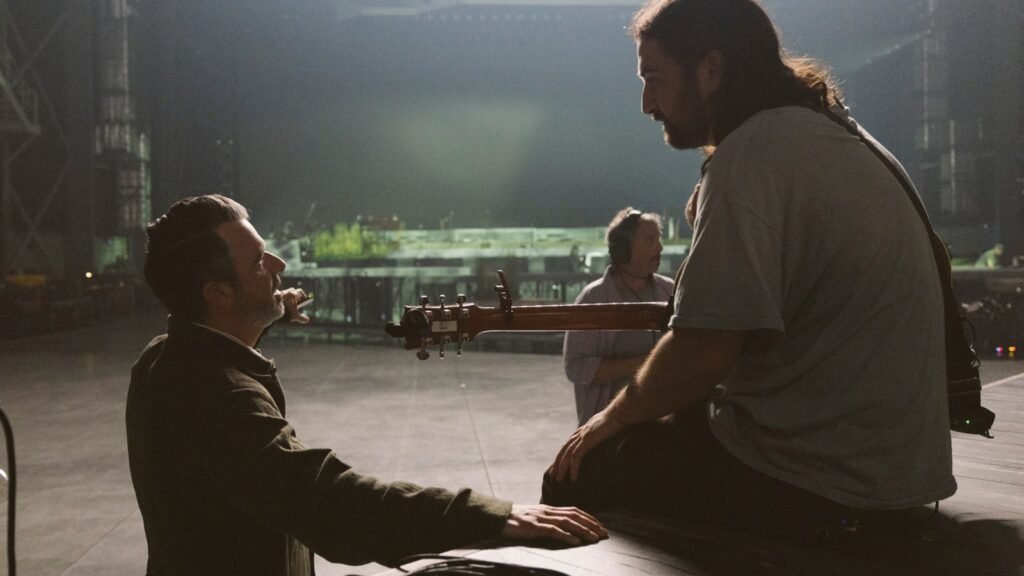
It’s hard to think of Noah Kahan as an independent artist. After all, the 29-year-old Vermont-bred singer-songwriter recently notched three weeks at Number One on the Billboard 200 with his new album, The Great Divide, and is currently on a sold-out stadium tour. But to hear his manager Drew Simmons recount his own path to success, it becomes clear that indie roots run deep in the organization.
Simmons, a native of Buffalo, New York, got his start interning for Ani DiFranco, whose Righteous Babe Records was based in town. The singer built her career outside of the major-label system, becoming a model of the DIY movement in the early Nineties by owning her recordings and connecting directly with fans. It was there that Simmons “realized what a manager did,” he tells Rolling Stone. “And I was like, ‘That seems like something I want to do.’”
Today, Simmons’ roster at Foundations Artist Management also includes Chappell Roan, landing him on industry power lists and thought-leadership panels. His is a circuitous journey that began when he moved to Boston and got hired by Don Law, an influential New England concert promoter whose company would later be acquired by Live Nation. Simmons was attending Northeastern University at the time, but his real education came from working area venues.
Some 25 years later, Simmons found himself on the grounds of Fenway Park with Kahan. “It was emotional,” he says of the 2024 run. “I find that working in music, particularly as a manager, you have so much coming at you constantly. You’re having to navigate information and you’re managing your own team, the artist’s team, the global infrastructure, so you don’t often have time to pick up your head and enjoy the moment. And Fenway was one of the situations where it was such a monumental experience for me, and for my wife, who went to Boston University and had an apartment in the shadows of Fenway Park. To come back, and bring our kids to Fenway, and watch Noah headline it, that full-circle [moment] is so rewarding, it’s hard to comprehend.”
Simmons met Kahan when the singer was 17. “He was from a town of 1,000 people in Vermont, and looked like he was 14,” he says. “People didn’t know what to make of it in the beginning.”
The manager describes his approach as “very old-school” — Kahan with a guitar was his own best promoter. “I’d bring him to A&Rs’ offices and he played a couple songs. I think everyone saw his raw talent, but it was like, who was down to be on the journey along with him? Because artist development is not for the weak; it takes time, patience.”

Patrick McCormack*
Republic raised its hand. Specifically, Avery and Monte Lipman (chief executives of the Universal Music Group label collective), who were, by Simmons’ account, “blown away, and we had an offer the next day.”
From there began “a slow marathon until Stick Season,” Simmons adds, referencing Kahan’s breakout 2022 album. (The album was released on Mercury Records, where Kahan moved when the label relaunched in 2022.) “From 2018 to 2022, it was gradual growth. He was just touring and touring and touring; supporting James Bay and George Ezra and Leon Bridges. He really refined his live show. He wasn’t natural onstage at first, and he became better at it through the reps of doing it over and over again.”
There’s a trust between manager and artist that is often tested in such long-term business relationships. Certainly, Kahan had faith in Simmons’ guidance, which led to signing with a major label and building his fanbase, but Simmons also deferred to his client on matters of artistry.
“When the pandemic hit, Noah had just finished making I Was, I Am, his second full-length release, but he wasn’t believing in it. And the pandemic forced him to live at home for the better part of a year. He realized, ‘I don’t really want to be making this music anymore.’ So he pivoted what’s more reflective of his influences: Paul Simon, Cat Stevens, he grew up listening to Counting Crows. He wanted it to be a bit more songwriter-driven and folk-sounding. And then we had a conversation.”
That talk was one of many as Kahan found his sound. Says Simmons: “He didn’t really fit in any one genre. Even in the Grammy categorization, we’re like, ‘No one knows what the hell to do with him — he’s not folk enough to be in folk; he’s not pop enough to be in pop; he’s not rock enough to be in rock.’ There wasn’t a natural scene for him to get buoyed by. It required us to forcefully push him forward as his own thing.”
Another manager-artist moment of reflection: when Kahan, long before he released Stick Season, wanted to add the title track to his live set list. As Simmons recalls: “I was like, ‘You have a new album to promote. You gotta focus on that.’ But he really was intentional about it. And by the third and fourth show, that was a favorite of the fans on tour. And we knew we had something.”
It wasn’t the first time Simmons had experienced that sensation. Before taking on Kahan, he worked for Red Light Management, where his roster included Young the Giant and O.A.R. Of the former, Simmons says, “I like to call it the era of the ‘blank the blank’ bands: Portugal the Man, Cage the Elephant, Foster the People …” Young the Giant was Roadrunner Records’ attempt at pop-rock, following what Simmons characterizes as “the Nickelback high.” The strategy worked, as the band formerly known as the Jakes landed an alternative hit with “My Body” in 2011.
As for O.A.R., they fit the bill for an “independent grassroots band — they even had their own festival,” he adds. “They had just signed their first record deal with Elektra and had a huge radio hit. It marked a different chapter of that band’s career that was just beginning.”
Back when his own career was just beginning, Simmons took a leap of faith, leaving Boston for New York. “I got a job working for James Brown, which was kind of a no-brainer,” he says free of affectation. “I had to go do it.”
Yes, that James Brown. Simmons was on Mr. Brown’s day-to-day management team up until the Godfather of Soul’s death in 2006. “He was incredibly old-school,” says Simmons, whose responsibilities included planning Brown’s funeral at the Apollo Theatre, for which he bought his first suit. “I think he had over 100 shows booked still for the following year when he passed away. He was still out there — the hardest working man in music.… It was pretty wild.”
Noah Kahan performing at Fenway Park in Netflix‘s Noah Kahan: Out of Body
Netflix
He made another major life change when he left Red Light to join his friend from college Steve Bursky at Foundations. In 2025, Roan signed with the company. “I’ve been working with her for a little over a year and experiencing how a female pop artist is treated, as opposed to a male artist,” Simmons shares. “The expectations, and the realities, and the invasion of privacy. Allowing time for an artist to be an artist, to live and have something to write about, is not always afforded to them.”
Kahan has been open and vocal about mental health — an issue Roan is also passionate about — partnering with Simmons to establish the Busyhead Project. For the Netflix documentary Noah Kahan: Out of Body, which premiered at South by Southwest this year, its namesake put it all on display, revealing feelings of body dysmorphia and anxiety. Simmons credits Kahan for his vulnerability. “You see his self-doubt, and that’s a human feeling, right? But it’s multiplied and amplified when you are so publicly available, as artists are. The career is the audience relationship. That realization, for a lot of artists, is difficult. So therapy, and access to therapy, is something that is a career-long endeavor for Noah, myself, and my team.”
Kahan headlines Rolling Stone’s inaugural Stateside Festival on July 4, just ahead of his return to Fenway on July 18 and 19, where 70,000 people will get to see a guy with his guitar absolutely captivate. And they keep coming back for more.
“Attention spans and trends and genres fluctuate, so you try to focus on picking the clients that have a sound or a perspective that will endure that,” says Simmons. “Sometimes you’re wrong, sometimes you’re right. With Noah, we picked right. He’s such a charismatic and loving person, and [with] the vulnerability in his songwriting … you want to root for him. Even when times were hard, it was always, ‘We got your back. We believe in you as a human. And we see your talent.’”
You may be interested

Duchess Sophie’s 'gorgeous' cowboy boots are an autumn must-have and they're in stock
new admin - Sep 14, 2026[ad_1] Sophie's repeat-wear boots prove a great Western style can carry an autumn wardrobe from casual denim to smarter countryside…
Stocks tumble after AI leaders warn that the industry should slow down
new admin - Sep 14, 2026[ad_1] Stock futures fell sharply Monday morning, led by tech stocks, after leading artificial intelligence CEOs called for a slowdown…

£5 OFF WHEN YOU SPEND £30 AT THE ENTERTAINER TOY SHOP
new admin - Sep 14, 2026Start your Christmas shopping early with this exclusive offer Source link