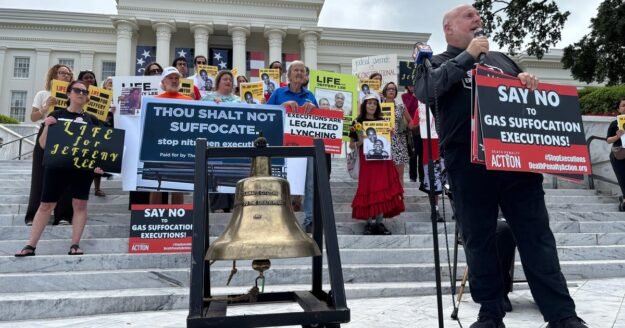


Alabama inmate’s nitrogen gas execution tonight hinges on last-minute appeal to Supreme Court

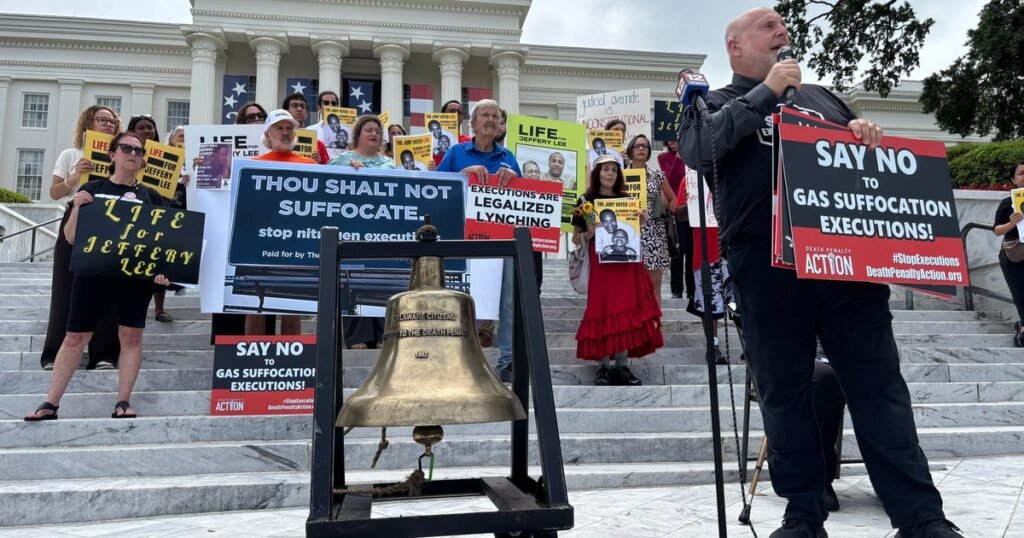
A death row inmate in Alabama is waiting on a ruling from the U.S. Supreme Court to see if the state will be allowed to carry out his scheduled execution Thursday night using nitrogen hypoxia.
The Alabama Attorney General’s Office petitioned the high court to reverse a federal judge’s decision to permanently ban the state from putting Jeffrey Lee to death using the controversial and relatively new execution method that Alabama first introduced in 2024.
Although critics often note the intentional secrecy around nitrogen hypoxia that keeps inmates and the public from understanding how it works, the known parameters of the procedure involve a gas mask being strapped to the face of a condemned inmate, who is then forced to inhale pure nitrogen through it. The lack of oxygen eventually causes death from asphyxiation.
Lee, 49, had been scheduled to die by nitrogen hypoxia at 6 p.m. CT on Thursday, according to court filings. With the justices’ decision still pending hours before the scheduled time, a spokesperson for Alabama Gov. Kay Ivey’s office told CBS News in a statement that “the governor remains prepared to move forward with the planned execution” while the state “continues to defend its execution protocol in the courts.”
But whether and how the execution would proceed was not clear after a federal judge ruled Alabama’s method unconstitutional this week, and an appeals court subsequently rejected the state’s request for a stay.
The application, from Alabama Attorney General Steve Marshall and his associates, then made its way to the Supreme Court. Marshall traveled to Washington, D.C., on Thursday to ask justices to vacate a Tuesday ruling by U.S. District Judge Emily Marks, which barred Alabama from executing Lee using its nitrogen hypoxia protocol. In an unprecedented decision, Marks found the protocol unconstitutionally cruel and in violation of Lee’s constitutional rights under the Eighth Amendment.
Alabama’s appeal argued that executing Lee by firing squad instead of nitrogen gas, as his legal team proposed and Marks accepted in her ruling, was “not feasible or readily implemented” because Alabama does not currently have a protocol in place for it. It also insisted the state’s nitrogen protocol was incorrectly characterized as barbaric in the court proceedings that led to Marks’ decision, saying inmates quickly lose consciousness.
Marks had said in her decision that “Lee has shown by a preponderance of evidence that the Protocol constitutes cruel and unusual punishment,” on the heels of an appeals court ruling Monday that reversed an earlier decision from Marks, in which she found the method constitutional.
The Monday ruling determined that Alabama’s nitrogen protocol poses “a substantial risk of serious harm” to inmates who likely experience “severe air hunger and corresponding emotional distress, anxiety, physiological stress, and physical discomfort” for at least one to three minutes before suffocating.
Lee has been incarcerated on the state’s death row for well over two decades, since his conviction in a 1998 double murder and store robbery. The jury that presided over his criminal case voted 7-2 for Lee to receive a lifetime prison sentence rather than face the death penalty, but the trial judge overruled them. That practice, called “judicial override,” landed many inmates on Alabama’s death row before it was outlawed in 2017.
International human rights leaders have condemned nitrogen hypoxia as experimental, violent and potentially torturous. It had never in known history been used to execute someone before Alabama in 2024 tested it on an inmate who had previously survived multiple botched attempts to execute him by lethal injection. Now, eight inmates have been put to death using nitrogen gas in the U.S., including seven in Alabama and one in Louisiana.
Witnesses who observed those executions later shared unnerving, and, at times, horrific, accounts of inmates thrashing, moaning, or otherwise appearing to show signs of suffering after the nitrogen gas began to flow. Several of them recalled that the inmates’ distress went on for at least several minutes before they seemed to lose consciousness on the gurney. During the most recent nitrogen gas execution in Alabama, witnesses said inmate Anthony Boyd gasped, shook and heaved for some 15 minutes before he stopped moving.
But Alabama has consistently defended its nitrogen gas protocol as an effective and humane alternative to lethal injection, the default execution method that also faced heavy scrutiny in Alabama after multiple bungled execution attempts. An upcoming series of legal claims challenging the nitrogen method is set to go to trial in 2027.
You may be interested

She confided in ChatGPT the night of her suicide. Now, her mother is suing OpenAI.
new admin - Jun 11, 2026About 18 months before Alice Carrier's death in July 2025, the 24-year-old had been confiding in ChatGPT about her relationship problems and…

U.K. defense secretary resigns, saying the government isn’t willing to spend enough on the military
new admin - Jun 11, 2026LONDON — U.K. Defense Secretary John Healey unexpectedly quit on Thursday, saying the government is unwilling to spend enough on…

Mexico beats South Africa in 2026 World Cup opening match at home
new admin - Jun 11, 2026[ad_1] 2026 FIFA World Cup kicks off: Simon Jordan discusses US soccer growth Talksport presenter Simon Jordan discusses the 2026…