


$50M TRIO Grants? ED Gives States Leg Up in Access Program

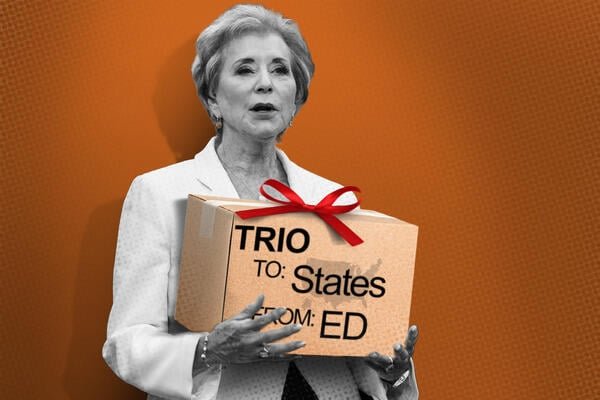
The Trump administration is giving states a significant leg up over higher ed institutions and other nonprofits in grant competitions for long-standing college-access efforts—a move that some advocates worry could fundamentally change the programs.
However, it’s not yet clear how many states took the Education Department up on its offer, though several told Inside Higher Ed they applied. Applications were due last month, and decisions are expected later this year.
Historically, colleges and universities have directly received grant funding for the programs, which are part of TRIO, and then used that money to help low-income middle and high school students and some adults attend and complete college. But recent solicitations for grant applications show the administration wants to give states the funding.
States—or rather, any organization “designated by their governor as the state-level applicant,” or Native American tribes—that applied this year for the Talent Search grant, which is the second-oldest part of TRIO, are eligible to receive up to $10 million a year for five years, while all other recipients are limited to $1 million annually. (The Talent Search grants are awarded on a five-year cycle, with annual payments to the winners.)
The Education Department said it gave out more than 500 Talent Search grants last year, with an average annual payment of roughly $350,000. The highest award was still under $1 million—$900,000 went to ASPIRA Inc. of Puerto Rico, to serve 1,700 students.
Over all, Talent Search served 322,000 students last year, ED said.
The shift is aimed at taking advantage of how “states are uniquely situated to serve more participants with fidelity and administer higher award amounts with appropriate fiscal oversight,” the grant competition states. Projects from one or more state education agencies, state workforce development agencies or Native American tribal organizations can receive up to five extra points above the 100-point regular application grading scale as part of the administration’s push to “return education to the states,” a mantra of Education Secretary Linda McMahon.
While some advocates worry the boost for states could mean fewer options for students, state officials have said they can use this opportunity to secure funding and better help their communities through offering unified approaches to providing tutoring, college advising, grant monitoring and more.
Bigger Grants, Fewer Dollars
But the Trump administration hasn’t increased total funding for Talent Search grants, and it’s planning to give out only 175 awards, compared to 500 grants last year. (In budget proposals, it has repeatedly tried to eliminate TRIO programs completely, though Congress hasn’t followed suit.)
Further, ED also shifted the TRIO grant competition for the Educational Opportunity Centers to preference states, raising expectations that it will also give states a boost in other TRIO programs, such as Upward Bound.
Kimberly Jones, president of the Council for Opportunity in Education, which trains and otherwise supports staff at institutions running TRIO grants, said in March that the changes to the Talent Search competition meant ED was “essentially proposing to obliterate a program that has opened doors of higher education for generations of students.” More recently, she told Inside Higher Ed, “We very well could see TRIO disappear from entire communities across the country.”
“It could be consolidated in a handful of places,” Jones said. “It particularly could be absent in a lot of rural communities. And in a lot of rural communities, TRIO is the only college-access support available.”
By law, previous grant winners can win up to 15 “prior-experience” points, more than the five-point preference ED is giving state applicants. But Mason Bishop, the owner of WorkEd Consulting, who worked with West Virginia to write its state application, said he believes ED will fund state-level applicants first before seeing what money is left for others.
Bishop, a former Labor Department official during the George W. Bush administration, said the state preference is a good thing. With state applications, he said, there are consistent policies and approaches, and “it really brings accountability back to the states,” rather than continuing a situation in which nobody but ED knows what’s going on with many individual grantees. He said he’s seen this state focus echoed in other federal education grant competitions in the last two months.
“Rather than funding a lot of individual institutional programs, they want to have a larger impact by funding systemwide projects,” he said. “And they’re doing that by really incentivizing states to develop consortium applications essentially amongst the institutions within their state.”
Zachary Jenkins, director of a current Talent Search program at Marshall University, which is in West Virginia but not part of its state-level application, compared the $10 million for state applicants to the administration dangling carrots in front of them. Highlighting the extra points for those applicants as well, he said, “In TRIO, we’re kind of referring to it as a state block grant.”
Winning state-level Talent Search applicants could still give much of the funding to universities that used to run TRIO programs themselves. But Jones, of the Council for Opportunity in Education, said that would add “an additional layer of bureaucracy.” She said state entities don’t necessarily have the experience “of promoting college access for this population,” and shifting control to them could remove “the opportunity from folks who have been doing this work and have been doing it successfully for many, many years.”
Asked by Inside Higher Ed why ED is appearing to transition Talent Search away from giving smaller individual grants to many nonstate organizations, a department spokesperson responded via email by criticizing TRIO and focusing on another change in this year’s competition: a push for applicants to focus on getting students into apprenticeships and other direct workforce training, rather than prioritizing college-going.
“Despite pouring nearly $1.2 billion into TRIO, the programs continue to miss the overwhelming majority of their performance measures, and studies of program effectiveness indicate that it has not increased college enrollment,” Ellen Keast, ED’s press secretary for higher education, said in a statement. Citing her department’s data, she said a majority of high schoolers “enroll in postsecondary education without any federal intervention.” (The Brookings Institution has said “the evidence on TRIO is mixed, but mostly it is limited.”)
“TRIO does not generate an adequate return on investment of American taxpayer dollars,” she said. “That is exactly why the Trump Administration is working to make TRIO an impactful program by allowing grants to support all postsecondary pathways, like apprenticeships and short-term, industry-recognized credentials, to support student success.”
To what extent state agencies are actually taking up ED’s invitation to apply for these grants is an open question. Bishop said he thinks only a few states applied. For one thing, they had only a little more than a month to get their applications in.
How States Plan to Use TRIO Funds
ED didn’t provide a list of the applications, so Inside Higher Ed reached out to dozens of state higher ed and/or workforce agencies about whether they applied. Some said they did, and a few shared their applications.
The Ohio Department of Higher Education applied for the full $50 million over five years, to serve 20,000 students annually across 54 of the state’s more than 600 school districts. Its approach is “built on a model of high-dosage tutoring, pre-apprenticeship/apprenticeship, high demand credentials, and learning and employment records,” its application says.
If it wins, the department will partner with six organizations to provide these services to different regions: College Now, Educational Service Center of Central Ohio, Sinclair Community College, Toledo Tomorrow, The GRIT Project and Cincinnati Youth Collaborative.
“This approach eliminates duplication across six regional [Talent Search Ohio] Project sites, reduces per-participant costs, and ensures consistent program delivery,” the application says. “At the same time, project partners leverage their established school relationships, community trust, and local wraparound services to efficiently provide direct support within their regions.”
The Nebraska Department of Education said it requested $10 million annually. “Because the US Departments of Labor and Education have not completed their scoring reviews, we prefer not to provide the grant application at this time,” an administrator said in an email. (ED has outsourced work on soliciting Talent Search grants to Labor.)
The Michigan Department of Labor and Economic Opportunity said it applied for $10 million, but didn’t specify whether that was annually. A spokesperson said, “A copy of our application will not be available while it is still in review by the U.S. Department of Labor.”
The Iowa Department of Education applied for $7.8 million annually to serve 15,700 students per year, according to a one-page project abstract. A spokesperson said the project “focuses on refining a high-need, geographically representative service area and structuring a coordinated model that leverages existing TRIO expertise through strategic subawards to current grantees and institutional partners.”
The abstract says the partners “include Iowa Workforce Development, ICAN, iJAG, the Iowa Board of Regents, Iowa’s Independent Colleges and Universities, Community Colleges, and eight Tier 2 partner colleges.”
The West Virginia Higher Education Policy Commission—which is in a poor state of roughly 1.8 million people, a little more than half of Iowa’s population—applied for only $1.8 million annually for five years.
It plans to provide 3,600 students annually with “high-impact tutoring, course advising, family workshops, disconnected student programming, college admissions advising and coaching (including all application and enrollment activities), career exploration, financial literacy activities, and more,” according to its application. Its proposed partners are regional higher ed institutions: Bluefield, Concord, Fairmont, Shepherd, West Liberty and West Virginia State Universities.
Bishop, the consultant who helped write West Virginia’s application, noted that Talent Search limits the annual per-participant cost to no more than $500. “We had to work with all of the six universities to say, realistically, how many students can you serve?” Bishop said. (West Virginia did apply for the maximum annual amount, $3 million, for this year’s Educational Opportunity Centers TRIO program, in which all nine community colleges are participating, Bishop said.)
Jenkins, the Talent Search director at Marshall, said his university is applying for $625,000 in annual Talent Search funding on its own.
“At Marshall I was happy that we were able to submit our individual grants to serve our target areas and surrounding communities,” he said, adding that the university’s program has existed for more than 20 years and has built relationships with K–12 school district superintendents, principals, teachers and guardians and is able to help local students.
He said many TRIO workers were concerned that even if fewer than half of the states submitted applications for $10 million annual grants, that could eat up the money—but he thinks that once states understood the details, such as how many verified first-generation, low-income students they would have to serve, they realized trying to get such large grants was unrealistic.
One TRIO program leader, who wished to remain anonymous and to not reveal their state so as not to risk funding, said a state agency asked for grantees’ prior grant applications—and for them to sign letters of support in favor of the state-level application. The program leader said they don’t know of any institution that won’t sign a support letter in hopes of receiving funding from the state as part of its grant.
Jones, of the Council for Opportunity in Education, said the stakes in the grant competition’s outcome are high. “We are talking about hundreds of thousands of students,” Jones said, adding that “students … are coming from limited-income backgrounds who do not have someone in their families who can guide them toward higher education.”
Bishop, though, noted West Virginia only had two Talent Search programs before, and one EOC program. He said, “The current program is very flawed in that it locks out any new applicants.”
“This is an opportunity for one of the poorest states and one of the most challenged economically states to actually expand these services to the entire state and get an infusion of resources they’ve never been able to get,” he said.
You may be interested

On Keeping Sanity and Purpose (opinion)
new admin - Jul 24, 2026[ad_1] Summer break is supposed to be a time to rest, recover and remember that we are human beings before…
Will the Federal Reserve raise interest rates? Here is what experts predict for July’s meeting.
new admin - Jul 24, 2026The Federal Reserve is expected to leave interest rates unchanged at its July meeting next week, but rising oil prices…

NVIDIA CEO Donates $75M to Vanderbilt San Francisco
new admin - Jul 24, 2026[ad_1] Vanderbilt University has received a $75 million gift from NVIDIA President and CEO Jensen Huang and his wife, Lori,…