

How Challengers Are Trying to Block ED’s New Loan Limits

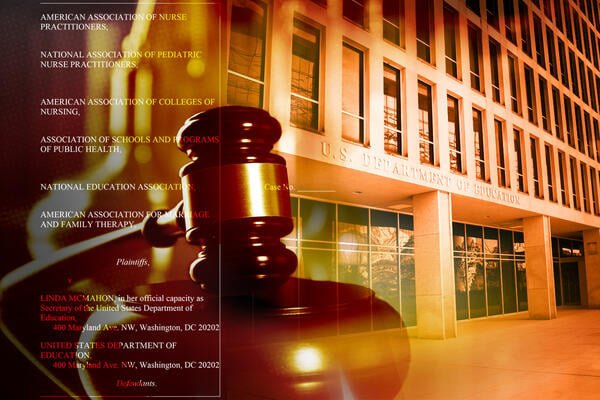
Two lawsuits, filed, respectively, by a swath of Democratic state attorneys general and professional associations, will take center stage this summer as federal district courts weigh the legality of the Education Department’s plan to limit postbaccalaureate student loans.
The regulations facing scrutiny stem from a section of Congress’s One Big Beautiful Bill Act that caps the amount graduate and professional students can borrow from the federal government; if they take effect, the regulations would define which degree programs fall into which category and what level of aid they receive. As of now, only students pursuing one of 11 qualifying degrees would count as professional, allowing them to borrow up to $200,000. All other graduate students would be capped at $20,500 per year or $100,000 total.
Challengers argue that in addition to going beyond congressional intent and therefore breaking the law, the narrow definition could significantly limit college access and weaken pipelines for several high-demand health-care professions.
University leaders, bipartisan members of Congress and even taxpayer advocates who generally push for limiting federal loans have been raising concerns about the legality of the department’s definition for months, so a legal challenge was expected. But now that two complaints have been filed, the exact reasoning behind the concerns is more clear.
So far, attorneys general from 25 states and the District of Columbia have sued, as has a collection of professional associations, including the American Association of Nurse Practitioners, which was one of the more vocal opponents of the definition. More lawsuits challenging the regulations—including one from the American Academy of Physician Associates—are likely.
“The Department’s decision to substantially narrow the programs subject to higher loan caps puts entrance to essential nursing, healthcare, therapy, and education professions out of reach for thousands of would-be students and undermines the professional programs themselves,” Lynn Eisenberg, an attorney representing the associations, said in a news release about the suit. “We are proud to support this broad coalition of associations standing up for their members and for the future of these important professions.”
A Contested Definition
Both complaints, filed late last month, are largely the same. They argue that under the One Big Beautiful Bill Act, in order to be deemed professional, programs must meet three key requirements. According to the legislation, a degree must:
- Signify completion of the academic requirements for beginning practice in a given profession,
- Signify a level of professional skill beyond a bachelor’s degree and
- Generally require professional licensure.
The law also references a list of 10 programs as stated in the Higher Education Act, noting that professional degree programs “include but are not limited to” the examples given.
The Education Department’s definition, however, adds further criteria, effectively narrowing the definition of professional to the 10 example degrees plus clinical psychology. In doing so, the plaintiffs argue, ED effectively rewrote the statute and made a nonexhaustive list exhaustive, exceeding the agency’s statutory authority. They also note that because the department added one high-demand health-care degree to the list and not others, the regulations were arbitrary and capricious, or unfair and unjustified.
Programs Considered Professional Under the Rule
- Pharmacy
- Dentistry
- Veterinary medicine
- Chiropractic
- Law
- Medicine
- Optometry
- Osteopathic medicine
- Podiatry
- Theology
- Clinical psychology
Some of the additional requirements in the regulations include: that the degree must take at least six academic years to complete (including undergraduate studies), is generally a doctoral-level program and does not lead to a career “supervised by another professional” who has “more education, training, and qualifications.”
Further, the list of eligible programs is limited to those within the same four-digit CIP code as the degrees cited in HEA. CIP codes are a six-digit labeling system used by the department to classify fields of study; the more digits in the code, the more specific the degree type. If ED capped the programs at the first two digits, many other health-care fields, like nursing, would be included.
“The final rule narrows the definition incorporated into [the One Big Beautiful Bill Act] and effectively makes [an] illustrative list of degrees exclusive,” the complaint from the attorneys general reads. “Congress never intended anything of the sort.”
(The associations’ complaint also argues that ED violated a procedural law concept called the Master Calendar based on quick turnaround from when the regulations were finalized and slated to take effect. That compressed timeline makes it nearly impossible for colleges to properly comply, they argue.)
Some conservative policy experts, however, are backing the administration’s policy, saying Congress was crystal clear about how quickly they wanted the policy to take effect and that the intent of the law was to limit loan access. In their view, ED was simply complying with Congress’s orders. So they believe the regulations will hold up in court.
But other higher ed legal experts say the plaintiffs in both cases have a sound argument. And a recent Supreme Court ruling that says judges should not defer to an agency’s interpretation of the law could strengthen their cases, they add.
“I have been wrong many times in [predicting] what courts will do, and I’m sure I’ll be wrong in the future, but I would be surprised if there was not some type of injunction that would limit this rule coming into effect,” said Tres Cleveland, a partner at Thompson Coburn LLP and co-chair of the firm’s higher education practice group.
Still, with the policy set to take effect next month and its legality up in the air, experts warn that the situation leaves many students and staff in limbo.
“The Education Department created a mess where there didn’t need to be one,” said Emily Merolli, a founding partner at Sligo Law Group, a firm staffed by former attorneys from the Department of Education. “I’m really grateful that I’m not a financial aid administrator, because this is incredibly stressful for them, as … it just creates an insane amount of chaos and expense for universities as they’re trying to figure out how to navigate this.”
Confusion Looms
While the lawsuits make similar arguments, the two groups of plaintiffs are taking different approaches when it comes to how to block the rule and the speed at which they are asking the court to act.
The first case from the 25 states, which was filed May 19 in Washington, D.C., seeks a more long-term solution in the form of a permanent injunction, which would block the challenged provisions. But such a ruling is unlikely to be handed down before the policy takes effect July 1. Meanwhile, the professional associations have asked a district judge in Maryland to put a temporary hold on the regulations while the case plays out in order to prevent irreparable harm. In the motion for a preliminary injunction, the plaintiffs ask the court to hold its hearing within 21 days, which could make a ruling likely before or shortly after the policy takes effect.
That said, each approach has its own pros and cons.
One aspect in particular to consider about the associations’ complaint, Cleveland explained, is that if the judge does block the definition of graduate versus professional before or shortly after July 1, it is unclear which postbaccalaureate students would still be able to borrow for the fall term and how much.
In the motion for a preliminary injunction, the plaintiffs urge the court to “prohibit the Department from applying the new student loan caps until the Department issues a replacement rule that is consistent with the statute.” But one thing that is not up for debate is that access to the current Grad PLUS loan program, which allows any postbaccalaureate student to borrow up to the cost of attendance, ends July 1. So if the courts rule in favor of the plaintiffs, it could put certain programs and students at risk of temporarily losing access to aid depending on the technicalities of the ruling.
It seems unlikely that federal loan access for graduate students will be cut off entirely, Cleveland said. But it’s also unclear if a judge would simply leave the decision of who qualifies for what amount of loans up to individual colleges, if they would temporarily limit professional loan access to the 10 degree programs Congress listed in the legislation, or if they would keep the current definition and add on the professions represented by the plaintiffs’ associations.
“That is likely the reason why the states did not seek emergency relief. There is a big question about being careful what you ask for,” Cleveland said. “We’ve definitely talked about, and have already started preparing institutions,” for these potential circumstances, he added.
And even if the injunction becomes permanent, the situation remains murky, as the Supreme Court has largely blocked federal district courts from issuing national injunctions. That means any potential district court ruling would only apply to the listed plaintiffs, which could cause more confusion for students and institutions.
You may be interested
House passes short-term bill to punt government funding fight past midterm elections
new admin - Jul 22, 2026Washington — The House on Tuesday approved a short-term extension to fund the government until Dec. 4, hoping to punt…

Belgium Parts Ways With Rudi Garcia Following World Cup Quarterfinal Appearance
new admin - Jul 22, 2026[ad_1] NEWYou can now listen to Fox News articles! The Royal Belgian Football Association (RBFA) has confirmed that head coach…

Severe labor shortage could emerge in the U.S. over the next 10-15 years, population scientist says
new admin - Jul 22, 2026The U.S. is set to face a severe labor shortage in the next 10 to 15 years, a leading population…