

From Chicago Classrooms to Debt-Free Degrees


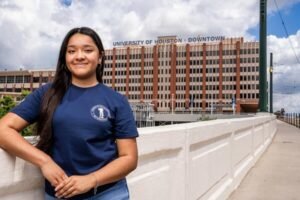
Journey Short graduated from a South Side Chicago high school in 2022 with a 2.34 GPA. At the time, college felt more like a distant hope than a realistic option—especially since it would place a financial burden on her single mother.
“I knew that I wanted to go to college, but I didn’t quite understand how the lack of work I’d been doing up until then would affect my college journey,” Short said. “My list of colleges that were open and ready to accept me wasn’t high, and I knew that college would be expensive.”
Then Short discovered Hope Chicago, the nation’s largest two-generation scholarship program. Launched in 2022, the program provides debt-free college and career pathways, along with wraparound support services, to students at five South and West Side Chicago high schools—and one parent or guardian from each household. The program gave Short and her mother the chance to attend college, easing financial pressure on the family as they sought to pursue their degrees at the same time.
This spring, Short was part of the program’s first cohort of graduates, earning her bachelor’s degree in journalism from Southern Illinois University Carbondale with a 3.7 GPA. She will pursue a master’s degree in political science this fall.
Short is one of about 400 Hope Scholars and Parent Scholars across Illinois who will complete college degrees or workforce credential programs by the end of the summer, all graduating completely debt-free. She noted the program gave her an opportunity she might not have received if the scholarship was awarded solely on academic performance.
“I know there’s a lot of talk about making scholarships only merit-based, but if it was merit-based, I wouldn’t have been able to receive this scholarship,” Short said. “Sometimes students just need the space to thrive, and I think Hope Chicago does exactly that.”

Hope Chicago’s first cohort of about 400 scholars and parents is completing college degrees and workforce credentials across Illinois.
Two-generation scholarship: Aaron Kuecker, chief executive officer of Hope Chicago, said the organization’s two-generation model is designed to strengthen families’ financial position by supporting both students and parents within the same household.
“We see this as an opportunity to more quickly catalyze economic mobility in our neighborhoods,” Kuecker said. “Our families, as they come out with the extra earning power and stability that a college or postsecondary credential can provide, have durability in the face of the sort of storms of life.”
“There’s this in-it-together–ness of the family that yields higher education success, even in demographics, neighborhoods and socioeconomic strata that have not always found the higher ed systems working well on their behalf,” he added.
Hope Chicago’s two-generation model relies on partnerships with nearly 30 Illinois colleges and universities, including every public university in the state and eight private institutions. Partner institutions include Chicago State University, the City Colleges of Chicago system and Loyola University Chicago.
Students receive financial assistance, access to dedicated campus staff, emergency funding, stipends and workforce-exposure opportunities designed to help them persist from high school through graduation and into careers.
With students’ financial barriers removed, their enrollment in college and career pathway programs across Hope Chicago’s five partner high schools has risen from 51 percent before the program launched to 83 percent in the 2025–26 school year.
Kuecker said lifting financial barriers not only expanded access to college, but also changed how families imagined their futures.
“Debt-free access was certainly not just the door opener but also the imagination cultivator,” Kuecker said. “Lifting that economic constraint, and then really coming with a posture that says, ‘We believe in the capacity of every single student,’ began to help our families believe their way forward into that future.”
Short said she noticed a shift in college-going culture among her classmates and younger students at her high school after the program launched.
“College is now like an expectation,” Short said. “Before, I would say it was like, ‘Yeah, if you want to go, but at least make sure you do something.’ But right now it’s like, ‘OK, you’re going to college, you’re going to sit in a seminar and ask all the questions you need to know.’”

Hope Chicago provides financial assistance, dedicated campus staff and other support services to help students persist from high school through college and into careers.
Why this matters: Hope Chicago is supported by a network of corporate, foundation and individual donors, including several Chicago-based companies and philanthropic organizations. Kuecker said it costs approximately $20 million to fully support a cohort of Hope Scholars and Parent Scholars through a four-year degree. The projected social and economic return for the program’s first cohort alone is $143 million, according to a 2023 study.
“The college degree doesn’t address the racial wealth gap in America in part because debt erodes the ability of people to save,” Kuecker said. The two-generation model “gives families the ability to begin to plan and prepare for generational economic mobility.”
Kuecker said Hope Chicago’s model could also contribute to Illinois’s long-term workforce development by encouraging graduates to remain in the state and helping employers meet talent needs.
“Debt-free employees are more durable employees,” Kuecker said. “They have more company loyalty, they’re less apt to be looking for a job, and we know that debt-free grads are more apt to buy a home, which leads to community stability.”
“If you were to think about hundreds of those families in the same neighborhood—what that means for employers in our city, for state revenue, for social service spending—that’s where higher education, when it’s free of debt, can really be an economic driver and disprove some of the narratives about whether or not higher ed is worth it,” he added.
Get more content like this directly to your inbox. Subscribe here.
You may be interested

Altana CEO: Tariffs didn’t restore US manufacturing jobs
new admin - Jul 27, 2026Today, I’m talking with Evan Smith, who is cofounder and CEO of Altana, a company that develops software tools to…

Keke Palmer Talks Viral Oprah Moment, New Audio Series, More
new admin - Jul 27, 2026[ad_1] IE 11 is not supported. For an optimal experience visit our site on another browser.UP NEXTCan I Tell a…

American family trapped in France as wildfires rage on in Western Europe
new admin - Jul 27, 2026American family trapped in France as wildfires rage on in Western Europe - CBS News Watch CBS News An American…