



Georgetown Accused of Failing to Register as Foreign Agent

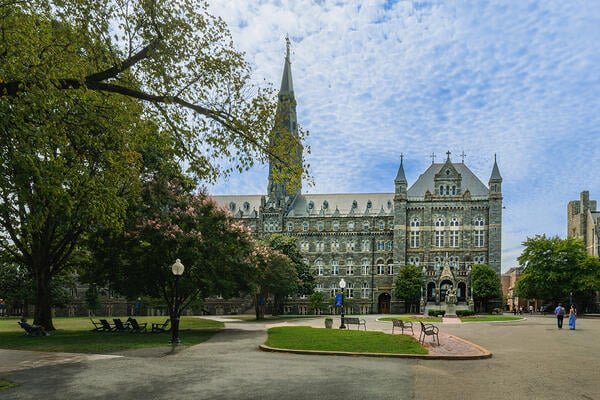
About two years ago, Georgetown University and the Qatari Foreign Ministry signed a deal: Qatar promised the institution $630,000 for research on Islamophobia and related programming.
In return, Georgetown pledged to follow some stipulations. The university agreed that its Islamophobia-focused Bridge Initiative would “consult with the Islam and Muslims Initiative,” another Qatar-supported program, and consider its session, theme and speaker recommendations. The contract also said the university must “organize and host these events and activities in Washington, D.C.”
Conservatives are now criticizing the university for the contract, arguing it allows Qatar to improperly influence the university’s programming. And the Louis D. Brandeis Center for Human Rights Under Law, a pro-Israel group whose stated mission is to combat antisemitism, is urging the Justice Department to investigate Georgetown, alleging that it’s clearly violating the Foreign Agents Registration Act (FARA), a complex law that generally requires what it defines as “agents of a foreign principal” to register with the attorney general. The Brandeis Center contends Georgetown should’ve registered as a foreign agent of Qatar.
“The citizens of the United States are entitled to understand when an ostensibly academic institution is, instead, simply peddling the point of view of a foreign government,” wrote Evan Slavitt, the center’s general counsel, in an email to Inside Higher Ed. “The Brandeis Center, concerned about such influence being used in a way that could further facilitate anti-Semitism in the United States, simply wants Georgetown to be more open about its relationship to the government of Qatar.”
Georgetown didn’t provide Inside Higher Ed an interview about the agreement and didn’t answer multiple written questions, including about whether it has ever rejected speaker recommendations under the contract. The university did, however, point to other parts of the contract, unmentioned by the Brandeis Center, that protect the university and the Bridge Initiative’s academic freedom and autonomy.
The agreement isn’t Georgetown’s only tie to Qatar—it has operated a campus in the country for 20 years.
When Inside Higher Ed reached out to Qatar’s embassy for comment on the accusations about the contract, a Qatari official responded with an emailed statement, calling the allegations “baseless.” The official wrote that they “follow a familiar pattern of smear campaigns mischaracterizing academic and cultural partnerships involving Qatari institutions,” adding that they seek “to drive a wedge between Qatar and the United States.”
“They will not succeed,” the statement said. “The partnership with Georgetown University’s Bridge Initiative is an academic collaboration focused on promoting interfaith dialogue and addressing the documented rise in Islamophobia. Qatar does not direct or control the academic content of the Bridge Initiative. Decisions regarding research, programming, and speaker selection are made independently by its faculty.”
The Bridge Initiative says on its website that it “has produced over 235 pieces of research” in the last six years. It publishes the Today in Islamophobia newsletter, a daily list of headlines about Islamophobia worldwide, among other resources. Its latest report is on the rise in anti-Muslim bigotry amid Zohran Mamdani’s successful campaign to become mayor of New York City.
It’s unclear whether the Justice Department has started a probe into Georgetown. A spokesperson told Inside Higher Ed Wednesday that “the Department does not comment on the existence of or provide status updates on investigations.”
But this use of FARA allegations by the Brandeis Center could present a new threat to universities that receive foreign funding. Congressional Republicans continue criticizing institutions’ ties to China and Middle Eastern nations other than Israel, and President Trump has directed the Education Department to ensure that universities report foreign gifts and contracts in accordance with other federal laws.
“The Department of Justice is looking into more novel concerns regarding foreign influence in the United States, and individuals involved in the FARA bar, people who practice [law] in this area, are aware that think tanks, research institutions and universities—more than ever now—are a potential focus of enforcement,” said Daniel Pickard, chair of the international trade and national security practice at Buchanan, Ingersoll & Rooney.
Pickard said registering as a foreign agent requires public reporting and carries a stigma in many people’s minds. While he didn’t comment specifically on Georgetown’s case, he said, “Independent research agents and universities are understandably reluctant to register under FARA if it’s not required under the law.”
U.S. colleges and universities received $5.2 billion total in large foreign gifts and contracts in 2025, according to the Education Department. Including state and nonstate entities in these countries, Qatar gave the most—more than $1.1 billion.
A Report, an Article and a Letter
Criticism of the Georgetown–Qatar contract has been growing. A March staff report from the Republican-controlled House Education and Workforce Committee, entitled “How Campuses Became Hotbeds: The Rise of Radical Antisemitism on College Campuses,” briefly mentioned the contract and included it in the appendix.
Last week, the conservative Washington Free Beacon published an article focused on the contract. The subheadline said the Bridge Initiative “has promoted terror-tied imams featured in Qatar’s ‘educational videos,’” and the article’s first sentence referred to the country as “Hamas-allied Qatar.” (The article did not mention that Qatar is also a major U.S. ally; it hosts the largest U.S. military base in the Middle East, and it gave Trump a jet he plans to turn into an Air Force One plane.)
The Brandeis Center cited the Free Beacon article in its letter to acting U.S. attorney general Todd Blanche.
“These so-called conferences and events are simply the presentation of speakers deemed acceptable to Qatar to promote Qatar’s point of view in the United States,” Slavitt wrote in the Brandeis Center letter. “Indeed, by running the money through an ostensibly objective institution, it goes to the heart of what the law was originally intended to address—the secret creation of propaganda under the direction of a foreign nation.”
Slavitt said the Justice Department’s FARA Unit should investigate “and ensure that the American public be fully informed of Georgetown[‘s] role not as a neutral presenter of information but the creature of the Qatar government promoting its point of view.”
In its emailed statement to Inside Higher Ed, Georgetown pointed to parts of the short contract that the Brandeis Center didn’t quote. Those provisions include a bullet following the mandate for consultation, saying the university “shall, within its discretion, select and formulate the topics of the sessions and its participants.”
Georgetown also pointed to a bullet that the center and the Free Beacon didn’t quote saying the Qatari Ministry can’t “direct the Bridge Initiative’s research, scholarship, or teaching, or receive the benefits thereof,” and the contract shouldn’t be “construed to restrict the academic freedom of the University, or the Bridge Initiative,” or of employees or students. Another contract provision says the ministry “exercises no role relating to governance, administration or operation in relation to the work of the University.”
“The allegations contained in previous reporting and in the letter to the Justice Department cherrypick individual lines from the contract to create a false impression, and exclude critical context,” Georgetown said in its statement. Free Beacon editor in chief Eliana Johnson told Inside Higher Ed in an email, “We stand by our reporting.”
Slavitt told Inside Higher Ed in an email that “given the factors listed in the letter together with the stunningly large amounts of money that Qatar is providing, the notion that Georgetown University is not substantially guided by Qatar is not tenable.”
The Brandeis Center, a nonprofit, doesn’t disclose its own donors.
“Our donors are Americans who are deeply and rightly concerned about the rise of anti-Semitism in the United States,” Slavitt said. “The blatant, shameful abuse, and frankly egregious dereliction of duty, at Georgetown University is entirely distinct. The university signed a $630,000 contract with a foreign government’s ministry and agreed in writing to let that government quietly shape who speaks and what gets said at events in our nation’s capital.”
You may be interested

Degree Attainment Gaps Persist for Latino Students
new admin - Jul 22, 2026[ad_1] A new analysis by Excelencia in Education finds degree-attainment rates are improving among Latino adults, but stubborn disparities remain.…

Lung cancer in non-smoking women: “A women’s health crisis”
new admin - Jul 22, 2026Lung cancer is the leading cause of cancer death in American women — and a growing share of new cases…
Two thirds of travellers are pamper tourists seeking beauty treatments abroad for savings
new admin - Jul 22, 2026There is a growing trend of booking beauty treatments while travelling (Image: PinPep)Two thirds of travellers are ‘pamper tourists’ and…