

2026 Graduation Season Sees Speaker Cancellations

Graduation season is here again, and it has already sparked a spate of controversies. Several institutions have canceled commencement speeches after students, alumni or community members dug up the speaker’s past comments or social media posts.
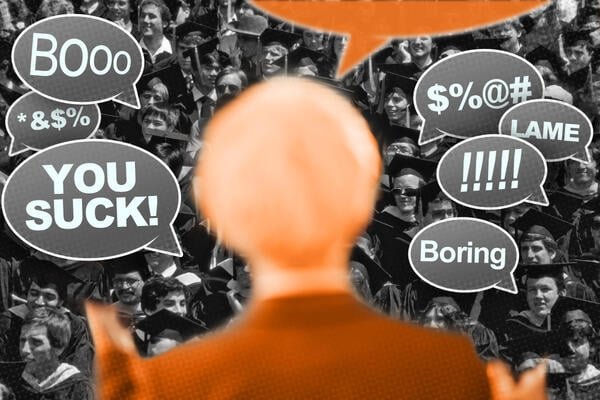
Those comments have centered on issues that have become particularly divisive on college campuses in recent years: Israel’s war in Gaza and the shooting death of political commentator Charlie Kirk last year. Artificial intelligence also turned out to be fraught fodder for a graduation speech this year: Students at the University of Central Florida’s commencement last Friday booed an investment executive for calling artificial intelligence the “next industrial revolution”—a moment that has since gone viral.
Angus Johnston, a professor at Hostos Community College and a scholar of student activism, said the reason graduations are so prone to controversy is because students feel a sense of ownership over the event, more than they would for another speaking event on campus.
“Graduation is a celebration for the graduates. It is a day when their families are there; it is a day when they’re being honored for their success. Even on campuses where students have very little institutional influence, I think students have a profound intuition and a profound expectation that graduation day is about them and should center them,” he said. “That is where we see this tension coming from, because if you look at it from the perspective of the institution, they have a bunch of different things they are trying to achieve with graduation,” such as choosing someone donors and alumni will approve of.
Some of the tension over this year’s commencement speakers is rooted in events of the recent past: Two years ago, commencement season coincided with pro-Palestinian protests, and some institutions canceled graduation entirely to avoid disruptions during the ceremonies. Several large walkout protests also took place at universities including Harvard, Princeton and Duke. Those demonstrations continued in spring 2025, and several speeches advocating for the Palestinian cause created discord.
Speaker Cancellations
At least three institutions have disinvited their graduation speakers this year: Rutgers, Utah Valley and South Carolina State Universities.
Rami Elghandour, a biotech CEO, was slated to address graduates of the Rutgers School of Engineering this Friday, but the university recently announced that he would no longer be speaking. A spokesperson told Inside Higher Ed, the “School of Engineering was recently informed that some graduating students would not attend their graduation ceremony due to concerns about the invited speaker’s social media posts, including one that shared an inflammatory claim.”
The spokesperson cited a post in which Elghandour—a vocal supporter of Palestinian rights and executive producer of the film The Voice of Hind Rajab, which tells the true story of a child who was killed by Israeli forces in 2024—said of Israel, “They’ve committed genocide. They’re running dungeons where they train dogs to sexually assault prisoners … Weapons embargo is the absolute minimum. Sanctions and diplomatic isolation are beyond justified. This we’ll sell them weapons won’t fly.”
In a social media post after his invitation was rescinded, Elghandour criticized Rutgers, saying it had specifically wanted him as a speaker because of his social justice work.
South Carolina State University canceled a speech by Pamela Evette, the state’s lieutenant governor and current gubernatorial candidate, after students at the historically Black institution protested her support for President Donald Trump and for anti-DEI policies.
Officials at the institution told Inside Higher Ed that they decided not to proceed with her as commencement speaker due to safety concerns.
Sharon McMahon, an educator, author and podcaster, was scheduled to speak at Utah Valley University’s commencement. But she was removed when students from the institution’s Turning Point USA chapter called out a post she had shared after Charlie Kirk was shot on UVU’s campus last year, calling the commentator’s rhetoric harmful.
The university also cited safety concerns as the reason for the cancellation; in an essay for The Free Press, McMahon wrote that the safety concerns were legitimate—some people had called for her to be shot while delivering the address—but that they came after Turning Point members and Utah legislators campaigned against her online. She also pointed out that numerous Utah legislators called for UVU to disinvite her or risk losing funding.
“Their objection was not that I had threatened anyone. I had not. It was not that I had incited violence. I had not. It was not that my planned remarks were unlawful, obscene, disruptive, or contrary to the educational mission of the university. No one has claimed that, because no one could. The objection was my perceived viewpoint,” she wrote. “At a private event, that might be ordinary backlash. At a public university, after an open funding threat from public officials with power over the institution, it is the government using its power to punish protected speech.”
Kristen Shahverdian, director of higher education and free expression at PEN America, said she finds it worrying that colleges have pre-emptively canceled convocation addresses due to controversial statements the speakers have made in the past. She also finds institutions’ claims that the cancellations are due to safety concerns dubious.
“We need to be very, very careful about the safety claims when it comes to canceling speakers, because that can so easily be weaponized … That bar should be very high. It really should be a very rare occurrence, and it should be based on some pretty clear indications and really high worry that there’s going to be violence,” she said.
Other Speaker Controversies
At Georgetown University, law students petitioned against Morton Schapiro, Northwestern University’s former president, speaking at their graduation, citing Schapiro’s views on Israel and on campus activism. Schapiro did step down as speaker. Meanwhile, students at the University of Arizona are currently pushing for their institution to drop Eric Schmidt, a former CEO of Google, who is scheduled to speak at the university’s May 15 graduation, over allegations of sexual assault.
New York University no longer allows live speeches by students at ceremonies for individual schools; administrators have replaced them with prerecorded addresses after one speaker last year denounced the “genocide currently occurring in Gaza.”
Philip Hauserman, senior vice president of crisis communications at the Castle Group, a public relations firm, said it seems like colleges aren’t doing basic checks of the speakers they invite—if they were, they wouldn’t be so shocked by the backlash.
“We’re not in a room when these selections are made, but it just seems like within minutes, hours, days of when someone is announced, students, alums, whoever, find things,” he said. “It seems like one of two things. Either leaders are reviewing all of that and saying, ‘Yes,’ but then backing down from it when they’re called on it, or—and I hope this is not the case—they’re not taking an opportunity to look.”
You may be interested
Trump’s personnel agency says it will remove some identifying info as it sweeps up medical records
new admin - Jul 22, 2026The Trump administration is forging ahead with a controversial plan to collect the medical records of millions of federal workers…

Teen makes close to $100k after finding Lakers jacket from 1972 NBA Finals at Goodwill
new admin - Jul 22, 2026Quinn Brown, a 19-year-old with a passion for selling items online, hit the jackpot when he purchased an original 1972…
Takeaways from Hegseth’s Senate hearing over Iran war funding
new admin - Jul 22, 2026Takeaways from Hegseth's Senate hearing over Iran war funding - CBS News Watch CBS News Defense Secretary Pete Hegseth and…