


Why the Red Sea could be the next choke point for the global economy

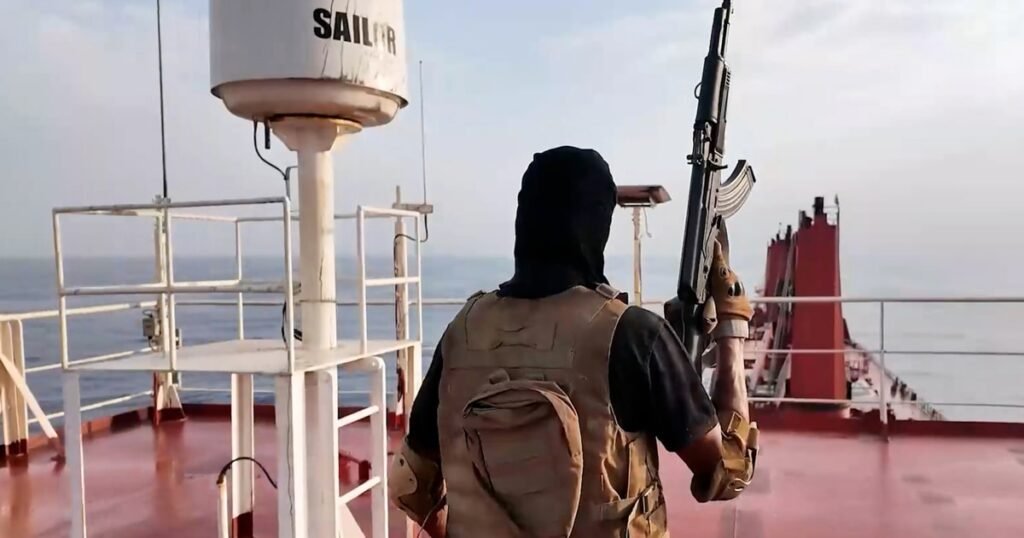
With the Strait of Hormuz blocked after the assault by the United States and Israel, Iran has threatened another vital maritime trade choke point: the Red Sea.
The Islamic Republic said this week that the 1,400-mile inlet dividing Africa and Asia was fair game for retaliatory attacks because of the presence of the American aircraft carrier USS Gerald R. Ford.
“Therefore,” any facilities supporting the carrier group “will be regarded as potential targets by Iran’s armed forces,” its military said Monday, according to the semiofficial Fars News Agency.
Whether Iranian forces would assault Red Sea shipping themselves remains unclear, but in recent years the Houthis, Tehran’s proxy militia based in Yemen, have vastly reduced traffic through the waterway with attacks on vessels there.
Abdul Malik al-Houthi, the militant group’s leader, said March 5 that “our fingers are on the trigger, ready to respond at any moment should developments warrant it.”
So far, however, unlike other members of Iran’s “Axis of Resistance” — Hezbollah in Lebanon and Iraq’s Shiite militias — the Houthis have not yet entered the fight, almost three weeks after the U.S. and Israel began strikes on the Islamic Republic.
“It is too soon to call whether they will ultimately join Iran’s retaliation or not,” said Burcu Ozcelik, a senior research fellow at the Royal United Services Institute, a London-based think tank.

That’s because it’s not as simple as Iran “triggering or commanding the Houthis to enter the fray on its behalf,” she added. “The Houthis are still weighing their options. And so far, they have shown restraint.”
The threat alone has nonetheless upended Red Sea trade.
Global shipping and oil markets are already in chaos after Iran responded to the American-Israeli attack by effectively closing the Strait of Hormuz, prompting the worst disruption in the history of the oil market, according to the International Energy Agency.
In an attempt to limit the damage, Saudi Arabia has increased capacity in its East-West pipeline, which links to the Red Sea on the other side of the Arabian Peninsula, while the United Arab Emirates has juiced the flow on its Habshan-Fujairah pipeline to the Gulf of Oman.
“Yet even at full capacity these routes can only cover about one-quarter of the oil that normally goes through the Strait of Hormuz,” David Butter, an associate fellow at the London-based think tank Chatham House wrote in an analysis this week.
“And they are vulnerable to attack by Iran, and by Yemen’s Houthis,” he wrote. “The Yemeni group has yet to enter the fray, but if it does, it could disrupt Saudi exports.”
Historically, the Red Sea has been invaluable, with around one-tenth of global seaborne oil shipments passing through the Bab el-Mandeb Strait, an even narrower bottleneck of just 16 miles that separates the Arabian Peninsula and the Horn of Africa.
That changed in late 2023, however, when the Houthis started attacking ships using that route in response to Israel’s assault on the Gaza Strip.

Red Sea shipping numbers plummeted, with traffic crossing the Suez Canal (which connects it to the Mediterranean Sea) down 70% by the middle of 2024, according to a yearly review by United Nations Trade and Development. Meanwhile, oil flows through Bab el-Mandeb were cut in half, the U.S. Energy Information Administration said in an analysis.
Ships were forced to take the arduous and often more perilous trip around Cape Agulhas, the southern tip of Africa. Arrivals at the Cape of Good Hope, the region’s major port, were up 89% that year, UNCTAD said at the time. That has only contributed to the spiraling prices for goods that consumers have felt worldwide.
Last year, President Donald Trump launched a weekslong intensive bombing campaign against the Houthis that cost $1 billion before he announced a ceasefire — only for the group to go on and sink two more ships later that year.
It was only in December that oil tankers and cargo vessels had been “gradually making a return” to the Red Sea, according to the maritime intelligence company Lloyd’s List.
Then came the war with Iran.
Though the Houthis have not reignited their missile campaign, the threat of their doing so has coincided with Bab el-Mandeb traffic being “sharply reduced,” according to an update from Windward, another maritime intelligence company, published Monday.
“The Red Sea corridor is a space where African, Gulf, Middle Eastern, Asian and global powers converge,” Ahmed Soliman, a senior research fellow at Chatham House, who specializes in the Horn of Africa, told NBC News in an email. So “escalation in this arena would be hugely destabilizing for shipping.”
That the Houthis have not yet done so likely hints at “the pace and sequencing of Iran’s retaliatory response,” according to Ozcelik at RUSI. Tehran “may judge that the Houthi card is better held in reserve for later.”
The pause also speaks to the “internal factionalism” within the movement, Ozcelik added, with hard-liners “spoiling for a fight” while others argue that “tightening control over Yemeni territory should take priority.”
Ultimately, the Houthis “will look to outlast the current war,” she said.
You may be interested

ChatGPT did not cure a dog’s cancer
new admin - Mar 18, 2026When an Australian tech entrepreneur with no background in biology or medicine said ChatGPT helped save his dog from cancer,…

Zara Tindall’s £35 ‘gorgeous’ jumper is from Next | Royal | News
new admin - Mar 18, 2026[ad_1] The first hints of spring sunshine make now the perfect time to invest in those easy, throw-on layers that…

Travel woes mount for Philadelphia flyers as TSA closes more security checkpoints
new admin - Mar 18, 2026[ad_1] Philadelphia International Airport announced it was temporarily closing two more Transportation Security Administration checkpoints starting Wednesday due to ongoing…