


Why retirees may want to reassess gold after recent market uncertainty


Creativ Studio Heinemann/Getty Images 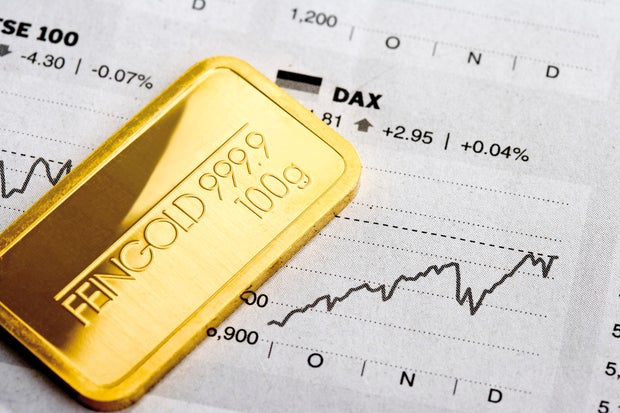
Most retirement portfolios were never really built for today’s economic landscape. The classic 60/40 split — stocks for growth, bonds for stability — made perfect sense in a world where those two assets reliably moved in opposite directions. But that relationship has grown to be unreliable. In recent years, issues with inflation, high interest rates and geopolitical turbulence have managed to drag both equities and fixed income down at the same time, leaving retirees with fewer places to hide.
The stock market’s recent volatility has only sharpened that anxiety. Tariff threats, shifting Federal Reserve signals and global instability have kept investors on edge over the last year, and retirees, who don’t have the luxury of waiting out a decade-long recovery, are feeling that pressure more acutely than most people. After all, when you’re drawing down a portfolio rather than building one, a sharp correction at the wrong moment can permanently alter your financial trajectory.
Gold, meanwhile, has done something remarkable: It crossed $5,000 an ounce and kept climbing. The price of gold is now sitting around $5,166 per ounce, nearly double its price from the start of 2025. That trajectory is hard to ignore, but does that mean it deserves a more deliberate role in a retirement portfolio? It could. Below, we’ll explain why.
Start protecting your retirement portfolio with gold today.
Why retirees may want to reassess gold after recent market uncertainty
Here’s what retirees specifically stand to gain from taking a closer look at gold following the recent market uncertainty:
It tends to rise when markets fall
Gold and equities generally have a well-documented inverse relationship during periods of acute market stress. When investors panic and sell stocks, they often rotate into safe-haven assets, and gold is at the top of that list. That dynamic played out clearly during the 2008 financial crisis, the pandemic market dips and again during the recent volatility spikes. For retirees, that counter-movement is precisely what a defensive allocation is supposed to do.
Diversify your retirement investments with gold now.
It doesn’t crater from earnings misses or rate surprises
Stock volatility is often triggered by company-specific news, Fed announcements or macro data surprises, none of which directly affect gold’s value. The value of gold isn’t subject to earnings calls, dividend cuts or analyst downgrades. That insulation from the news cycle that rattles equity markets makes it a stabilizing force when the rest of a portfolio is whipsawing as the market shifts.
It reduces sequence-of-returns risk during turbulent stretches
For retirees drawing down a portfolio, the timing of losses matters enormously. A sharp market decline early in retirement can permanently impair a portfolio in ways that the same decline a decade later wouldn’t. But a gold allocation that holds or gains value during a downturn reduces the need to sell depreciated stocks to cover living expenses, protecting the long-term recovery potential of the rest of the portfolio.
It provides stability when correlations break down
Traditional diversification relies on stocks and bonds moving independently. But during periods of elevated volatility, that relationship breaks down. Gold, however, tends to maintain its low or negative correlation to equities even when bond diversification fails, making it one of the few real diversification tools and genuine shock absorbers left in a portfolio under stress.
It doesn’t require predicting what happens next
One of the challenges of navigating market volatility is that it’s nearly impossible to time. Gold doesn’t require a retiree to predict whether the next move is up or down, though. It simply behaves differently than risk assets during uncertainty. That passive protection is especially valuable for retirees who can’t afford to get a directional bet wrong.
The bottom line
Gold at $5,166 an ounce is not cheap, and no single asset is a cure-all. But retirees who last evaluated gold years ago — or dismissed it entirely — may be working with an outdated picture. In an environment defined by market volatility, stubborn inflation and deteriorating correlations between traditional assets, gold’s role has become harder to argue against. A small, deliberate allocation isn’t a bet on fear. It’s a recognition that the retirement portfolio of the past may not be equipped for the conditions of the present.
You may be interested

How could military action in Iran impact Trump politically?
new admin - Feb 26, 2026Democratic lawmakers are demanding President Trump provide justification for U.S. intervention in Iran. Former CIA officer Elliot Ackerman and CBS…

Netflix walks away from its deal to buy Warner Bros. after Paramount came back with a better offer
new admin - Feb 26, 2026The transaction we negotiated would have created shareholder value with a clear path to regulatory approval. However, we’ve always been…

Andrea Pavan hospitalized after falling down elevator shaft in wild accident
new admin - Feb 26, 2026[ad_1] NEWYou can now listen to Fox News articles! Professional golfer Andrea Pavan withdrew from the DP World Tour’s Investec…