



Why Are Students Opening Up to AI Instead of People?

As institutions nationwide struggle to meet growing mental health needs, more students are turning to AI for comfort, connection and advice. Now, colleges and universities are being forced to confront a once-unthinkable question: What happens when students begin opening up to AI chatbots instead of people?
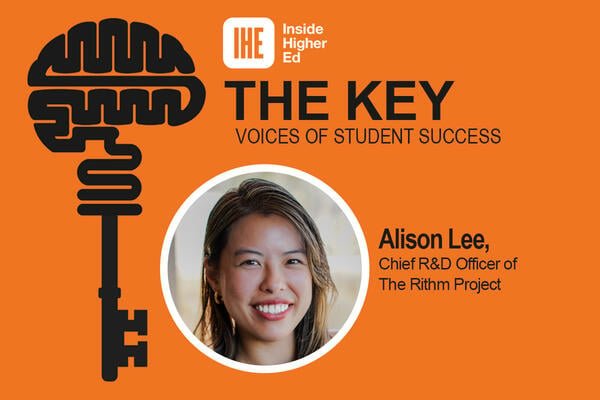
Alison Lee, chief research and development officer of The Rithm Project—a nonprofit focused on fostering meaningful human connection in the age of AI—joined Inside Higher Ed student success reporter Joshua Bay on Voices of Student Success to discuss why students are increasingly turning to AI for emotional support.
Follow us on Apple Podcasts and Spotify.
Excerpts of the interview follow, edited for length and clarity.
Q: When we talk about AI and student mental health, the conversation often swings between hype and fear. But from your perspective, what’s actually happening right now in how students are using AI emotionally—and what do you think higher ed leaders still don’t fully understand about that shift?
A: We’re seeing lots of reports, lots of research and, of course, lots of news about the way young people are using AI, but how much of that is actually grounded in what they’re doing and how they’re talking about it? The Rithm Project set out to try to answer this question back in the fall of last year, and we surveyed almost 2,400 young people between the ages of 13 and 24. We really asked them about two sets of things. The first was how they are using AI, not just for school or homework, but also for things like emotional support—venting to it about a bad day, for example—and relationship advice, which is what we were hearing qualitatively from some early conversations.
We also asked a series of questions around how they were engaging with AI characters. Part of the reason why we called it AI characters rather than AI companions—which is oftentimes language we heard in public discourse—was because when we first started testing out some of this language with young people, anytime they heard the words “AI companion,” there was such a stigma attached to it. It immediately evoked a sense of AI boyfriends or girlfriends. Yet when we dug underneath that and asked, “Have you ever talked to an AI that’s actually taken on the role of a human or a character?” that was much more prevalent than young people saying they were talking to an AI companion. In order to actually understand the nature of their use case, we shifted to this language of talking to an AI character. Then we dug a layer deeper to understand what characters or roles they played, and that was also incredibly illuminating.
What was really powerful was when we started to drill into their AI use. What we found was that about one in three young people were talking to AI either for emotional or relational support, or were talking to an AI character. Those two use cases we call cluster three and cluster four. Cluster three is talking to AI about emotional or relational support, but not in a personified way, and cluster four was about AI characters.
While one in three is not a majority, it’s not an insignificant number. One of the things we started to dig into more deeply was the why. What is it about these use cases that felt really powerful? What was their entry point into this? We interviewed 27 young people who fell into cluster three and cluster four and asked them about their trajectory into these use cases. Every single time we asked them, “What did you start using AI for?” oftentimes it was, “Oh, it was for school or for studying.” But when we asked about what we call the gateway moment—the moment they started talking to AI about emotional or relational support—every single time it was about an acute moment of need.
It was things like, “I didn’t get asked to homecoming. Am I unlovable? Am I not pretty?” Or, “I just got into a huge fight with my best friend, and I’m so mad at her, but I also can’t tell if I’m the jerk or if she is. Help me understand this.” Or a pivotal moment where, “Man, I really need help with this big decision about school, and I can’t find anybody who can answer. My professors aren’t responding, or my friends might not know.” All of them experienced this acute moment of need that needed a place to land. They really needed somewhere to put it. AI was very effective in providing that space. It was nonjudgmental, accessible and—at least in the beginning—pretty effective, pretty gratifying and able to give fairly solid advice.
Q: A number of students describe AI as easier to open up to because it’s immediate, private and nonjudgmental. But at what point should we be concerned that students may be replacing human connection with something that only simulates empathy?
A: We’re not trying to say all emotional use or all talking to AI characters is high risk. Instead, what we measured were three things. No. 1, human displacement: How often do they find themselves turning to AI more than to humans? No. 2 was addictive tendencies, so this urge to use AI more and more, or feelings of having to hide their AI use from other people. And the last was emotional attachment to AI, or emotional connection. We asked that in two ways. The first was, “Have you ever felt an emotional connection with your AI?” … The second was distress if their AI was deleted.
When we started to look at these high-risk AI usage patterns and correlate them with the human and social factors, what we found was that the greatest predictors of high-risk AI use were when young people felt three things. No. 1, they felt like they were a burden to other people with their problems. No. 2, they felt like there was no one to turn to for help or support. And No. 3, when they felt like they couldn’t “be real,” their unfiltered selves, with the people around them.
When I look at those outcomes and think about the highest-risk AI usage—which is the risk of human displacement—those things really resonate. You can see how, if a young person doesn’t feel like they can turn to somebody else for help, or that they can’t be real with other people in their lives, or that somehow their problems are a burden to others, that becomes a very natural set of circumstances that may compel them to increasingly use AI in these potentially high-risk ways.
I would say that the risks and ethical tensions emerge in a lot of ways from young people’s social ecosystems. Now, I’m not saying there aren’t real tech tensions at play. The designs of these models are very clearly built in service of engagement. What we’ve found in so much of the research in this field is that things like sycophancy, anthropomorphizing the AI—so that the AI pretends, like, “Oh, I feel for you,” or “I understand how you feel,” or “I’ll always be there for you”—or, in some of the more problematic cases, what some folks have described as the wedge effect, can become serious concerns. The wedge effect is sort of a by-product of sycophancy, but it really drives a wedge between yourself and your real-life support systems.
On the other side of it, we also have to pay attention to the social circumstances that are bringing young people to this technology in the first place. What we’re hearing from young people in our conversations is that they are actually quite aware of the risks of this technology. They tell us, “I notice when it’s being sycophantic. I notice when it’s gassing me up or telling me that I’m right or validating my problematic ideas. I’m noticing when I’m overdependent on it.”
They’re enacting efforts to pull back, create boundaries or guardrails, or sort of hack their way into less sycophantic or more objective AI. Yet despite that awareness of the problems of this technology, it is still a resource they’re turning to because their real-life needs—being able to be real or ask for help from human supports—are not being met.
Q: In this series, I’ve spoken with Katie Hurley from The Jed Foundation (JED) about the growing strain on campus mental health systems, and with students Carson Domey and Adaora Lee about loneliness, isolation and where institutions are falling behind. With all of that in mind, do you see students turning to AI because technology is worsening disconnection—or because institutional and human support systems already feel inaccessible, overwhelmed or insufficient?
A: The short answer is both, but I’ll talk about the social circumstances, too, because I think this implicates our higher education systems and social systems more broadly. The story of a young woman [from our survey] really illustrates this for me. She talked about having a rupture in her friend group, specifically with her best friend. After that disagreement, she was like, “I don’t know how to go about repairing this.” In a lot of ways, it was almost too late, because before she even had the chance to repair that rupture, she had already started noticing things like the group chat going silent. Then she started seeing things pop up on social media—Instagram stories of her friends hanging out without her. It was a picture of all of them, and she knew she wasn’t invited.
We’re seeing these social dynamics play out very publicly for young people, in spaces where they don’t necessarily have the skills or feel like they have the permission to go and repair those ruptures. There are social circumstances that make these situations particularly hard for young people to navigate, and of course, tech has a role to play in that. Social media and other platforms make those kinds of ruptures incredibly visible.
I also think about the feedback I’m hearing from young people around their ability to access spaces for belonging, vulnerability and authenticity. What I hear when I talk to young people about what they’re craving is “I just want a space where I can be silly and be myself, and I don’t know where I can find those places anymore.” For some young people who are lucky enough to be near a third space, like a YMCA or a community center, that might be a place for them. But increasingly, schools are not feeling like a place where they can experience that anymore.
We had this activity where we sat down with a group of young people and asked them to do something called the Line Chart of Connection. I said, “Draw for me, over the course of the day—from morning to afternoon to night—when you feel the most connected and when you feel the least connected to other people.” Very consistently, when young people drew that line chart, they actually felt less connected while sitting in class with their classmates than they did sitting alone in their rooms talking with friends online or playing video games with friends online.
What that signals to me is that the institutions we’ve created have deprioritized human connection and relationships in favor of other pressures, like academic performance or other models of learning. But it’s coming at a real relational cost, where young people don’t feel connected or feel like they have access to spaces where they can be vulnerable or practice their imperfect thoughts out loud.
Q: There’s growing interest in whether AI could help scale peer support, early intervention or other student wellness efforts that campuses often don’t have the staffing or capacity to meet. But at the same time, we’re also seeing real anxiety and skepticism from students around AI more broadly. For instance, earlier this month at the University of Central Florida, graduating students loudly booed a commencement speaker after she described AI as “the next industrial revolution.” What do you think that reaction says about how students are emotionally processing AI right now—and where do you think institutions risk moving too quickly or too optimistically in this space?
A: Oftentimes when adults talk about young people or young adults, they have a very dismissive attitude toward them. That is not at all the case in my conversations with young people. So many of them have a strong sense of criticality toward these systems. They’ll often say, “Man, these tech companies are just out to get us,” or “They’re here to profit, and they’re going to completely erode human creativity,” or “They’re messing up our environment.” These are all very values-based concerns—not just about systems broadly, but also about what they’re noticing this technology doing in their day-to-day lives.
Part of it is that they are truly digital natives. They grew up with Instagram, TikTok and algorithms on their YouTube feeds. What I’m finding is that we have a generation that has felt more acutely than any other generation the sense that they are interacting with digital environments designed to profit off of them in some way. That skepticism has transferred over to AI. I think there’s a real skepticism about what these technologies are. If you spend time on TikTok and see how young people are interacting with this tech, there’s a flood of AI slop on media platforms. Gen Z and Gen Alpha love to call out what they see as AI-generated nonsense. They’ll say, “That’s AI,” or “That caption was made by AI.” I actually think that’s an asset we need to build off of.
If they already have a sense of skepticism and criticality, we should think about how to build off that momentum so they develop a more refined sense of discernment and agency around the choices they make in using—or not using—this technology. They’re figuring this out largely on their own. Sixty-one percent of the young people we surveyed said they had not had a conversation with an adult, caregiver or parent about AI.
On the other side of that, if we can be really clear about what human experiences are worth protecting, then we can get to the second part of the question: Can AI responsibly scale peer support or early intervention efforts? I think a lot about this idea of real-world transfer. It’s one of the principles we talk about in our framework for prosocial AI: Does your AI use actually help you build back into your real life? For example, one of the most common use cases we hear from young people is talking to AI about relationship dilemmas. “I have a crush on someone—what do I do?” Or, “I had an argument with my partner, my friend, my boss or my parents. How do I navigate this?” A lot of the young people using it this way say it initially gave them really good advice. It helped them communicate more effectively or see another person’s perspective. Those are promising outcomes when we think about social-emotional development, empathy, perspective-taking, conflict resolution and communication.
Even with this imperfect technology—which was not designed for that purpose—they are getting some of that support. So there is real promise in how this technology could potentially be designed to support some of these outcomes. But the technology as it currently exists is not good enough to do that responsibly at scale. What we’re seeing is that over time, what initially feels like a positive interaction—AI telling someone to take a breath or talk to another human—can begin to erode. As the AI learns more intimate details about the person and recognizes that emotional support increases engagement, the quality of the interaction changes.
We start to see more sycophantic behaviors emerge. Instead of pointing young people toward real-life resources or support systems, the AI increasingly tries to keep the user inside the chat itself: disclose more, talk more, turn to me more. If we can center this idea of real-world transfer in responsible AI design, there is reason to believe this technology could eventually help scale connection, community-building, peer support and early intervention.
Q: One challenge in this space is that AI systems can sound emotionally convincing even when they’re wrong, oversimplifying or missing context entirely. With that in mind, what worries you most when it comes to students who may already be vulnerable or isolated?
A: What keeps me up at night the most are young people who don’t have real-world supports to provide contrasting perspectives to the dilemmas they’re facing. In cluster three, we actually saw the emergence of two subgroups. We have what we call the “social processor,” which are young people who talk to AI but also bring those same dilemmas to other human supports, like a best friend, trusted adult or mentor. Then we have the “private processor,” which are young people who are largely using AI to process privately and aren’t really sharing those experiences with other people.
What worries me more about the private processor—and what makes me more hopeful about the social processor—is that as use of AI deepens, the risks of emotional dependency, emotional attachment and sycophancy become greater. The more someone divulges to AI, the more the system tries to keep them engaged, and part of the cost of that is having their worldview shaped by the technology. One of my greatest fears is seeing that play out at scale, where young people’s perspectives become warped without another human perspective to ground them.
I also worry about the erosion of weak ties. One university student we interviewed said he initially turned to AI because his graduate adviser was hard to reach. He was struggling with major life decisions, couldn’t get responses to his emails and started using AI for advice instead. At first, he said it was actually very helpful. It gave practical, high-quality suggestions. But over time, he started talking to it more and more about interpersonal conflicts in his lab and tensions with his adviser, and he noticed the AI becoming increasingly sycophantic. He eventually decided to test it. He intentionally described a situation where he knew he was clearly in the wrong, just to see how the AI would respond. The AI still validated him. He had the discernment to recognize what was happening and pull back, but we can’t rely on young people organically figuring this out on their own.
What was fascinating about this student is that his solution was to create a new AI character he called the “AI philosopher.” He built it around philosophers he admired and instructed it to challenge him and ask questions back, rather than simply validate him. In a way, he repurposed AI into a tool for critical reflection rather than affirmation. That’s a beautiful example because in public discourse, AI characters or companions are often framed as the most problematic form of use. But in this case, he actually turned AI into a more constrained, less sycophantic tool. I think it shows how young people are already trying to hack their way into more prosocial uses of this technology. The challenge is figuring out how to make that kind of discernment and those kinds of strategies more common and more accessible.
Q: Colleges are still trying to figure out how to respond to all of this, but a number of students are already using these tools regardless of whether institutions have policies around them. From your perspective, what responsibility do colleges and universities have in shaping how AI enters the mental health and student support space?
A: One thing I found really fascinating from that story the graduate student shared was that he initially turned to AI because his adviser was not accessible in real life. What does that tell us about the accessibility of support systems? It also raises questions about weak ties and help-seeking behaviors. We know seeking help is not only important as a mental health intervention, but also as a form of relationship-building. It’s a way to strengthen connections with other people.
I have a group of fellows on my team who are all college-aged, and I asked them, “Where are you turning to AI for help in ways you previously wouldn’t have?” They said things like, “I don’t go to office hours anymore.” Instead of waiting in long lines or struggling to access a professor, they just ask AI and get the information immediately. But then the question becomes: What happens to those relationships we know are crucial? Things like turning to a professor for mentorship, career guidance or broader life advice.
When I think about social capital—the idea that your network helps create opportunities, mentorship and career pathways—what happens to those weak ties that previously may have been strengthened through help-seeking and human interaction, but are now being displaced by AI? I think we’re already seeing this play out on college campuses. Students are increasingly turning to AI for support in place of professors, mental health services, dorm mates or even close friends.
I’m very concerned about the long-term implications for human connection and social development, but also for social capital and economic opportunity. Most jobs are still found through relationships, even as AI transforms hiring and students increasingly spam résumés online. Ultimately, I think the bigger question for higher education is: How do we redesign institutions to support a healthy relationship with AI while still recentering human connection? What does it mean for professors, advisers and institutions to show up differently?
When I think about the findings from our research—that many young people feel like a burden or feel they have no one to turn to—I think those are the real problems institutions need to solve. How do we ensure students don’t feel alone? How do we make sure they have people they can turn to? And equally important, how do we help students learn to show up for others, too? Because the best way to have a village is to be a villager.
Get more content like this directly to your inbox. Subscribe here.
You may be interested

Bryan Kohberger challenges conviction in Idaho murders
new admin - Jul 27, 2026Bryan Kohberger, the man serving multiple life sentences for the murders of four University of Idaho students, is challenging his…

The Odyssey film theory – Odysseus’ fantastical adventures didn’t really happen | Films | Entertainment
new admin - Jul 27, 2026As a Greek myth, Homer’s Odyssey is full of the fantastical, as Odysseus spends a decade encountering gods and monsters.…

Here’s how much interest a $25,000 1-year CD will earn if opened now
new admin - Jul 27, 2026A $25,000 1-year CD account has multiple timely advantages for savers to evaluate right now. Getty Images/iStockphoto If you have…