




Western Governors U President on the State of Online Ed

Western Governors University is no longer the new kid on the block.
Founded in 1997, WGU is pushing 30 and for years has consistently been one of the largest institutions in the nation. Its website currently lists more than 190,000 students, and its alumni network has surpassed 500,000 graduates. The private, nonprofit, online university—which has been lauded for embracing competency-based education and serving adult learners—is still growing its footprint.
WGU plans to build a new headquarters in Salt Lake City, where it is based, and recently opened regional offices across the country, including in Washington, D.C., on Monday. Inside Higher Ed stopped by the ribbon cutting to speak with WGU President Scott Pulsipher in a wide-ranging interview that covered online learning, competency-based education and other topics.
This interview has been edited for length and clarity.
Q: You opened regional offices in D.C. and elsewhere recently. Why are you expanding?
A: Some of the offices are to support regional engagement in the Northeast region. And D.C. was absolutely the proper home for us here because of how much engagement we have with partners that represent the industries and the associations of those industries that we engage with. That’s true both in higher education, but also across manufacturing, health care, retail. But it’s also where so much of the policy work that we do happens, which is why D.C. made sense.

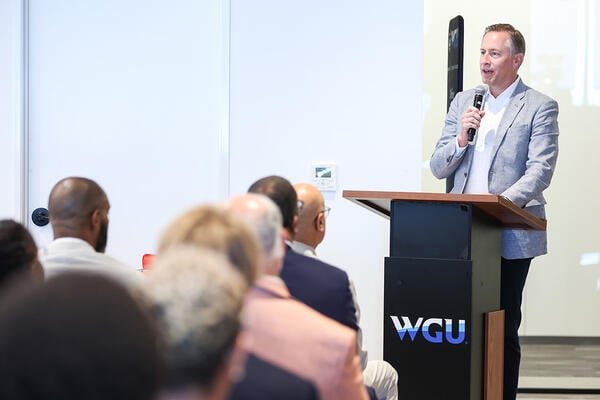
Western Governors University President Scott Pulsipher takes part in a ribbon-cutting ceremony for a regional office in Washington, D.C.
Western Governors University
Q: Big picture, what is the state of online higher education in 2026?
A: I’d say the big picture for us is the demand remains really strong in that field, and you continue to see the increasing percentage of total enrollment taking all or some of their college online. The other thing that we’re seeing—and this comes more from [WGU’s] “Workforce Decoded” report—is that employers are not distinguishing between whether it was this modality or that modality. What they care about is are you ready and prepared for the world of work? For our perspective, in the development of new nondegree credentials or developing new credentials, employers are very engaged in ensuring that their needs—their skill needs—are a key input into the curriculum. Our 1,000-plus employer partners are very engaged with us in helping us design curriculum that then the learning outcomes will be relevant to these skills.
Q: You’ve talked about the need for universities to embrace AI. What does that look like at WGU?
A: From our standpoint, AI is touching everything that we do: how we design and develop curriculum, how we think about the instructional model, how we provide mentoring and support services, how we inform our marketing and enrollment and activate more populations of underrepresented, underserved individuals. To sum it up, what the internet did for us to democratize access to higher ed, we believe artificial intelligence will do for democratizing learning. And democratizing learning means that it’s now accessible and traversable for everyone. It’s not only those who are prepared. Come as you are, and we’ll help you get to where you need to be.
Q: A lot of colleges are struggling with enrollment, while WGU is not. What lessons do you think others in the sector could learn from WGU?
A: It comes back to value. More and more individuals today, when they’re considering whether or not they go to education, they want to know whether it’s worth it. And there’s already ample narratives around how conventional college may not be worth it because it’s either too expensive or it’s not relevant to the job. I think if you were to focus on ensuring that you deliver a value proposition that’s aligned with what the student as a customer wants, [which is value and relevant skills] … growth in enrollment will be an outcome because your value proposition is strong. But if you don’t have a great value proposition, you shouldn’t expect your demand to grow.
Q: There has been some recent controversy about colleges, including WGU, accepting transfer credits from online learning platforms like study.com. At the same time, colleges have historically been stingy about accepting transfer credits. How can the sector strike the right balance?
A: You have to be careful you don’t overindex on access, and increasing access means you accept more transfer credits [and] you make it easier for individuals to complete it. However, if you overindex on that to the detriment of quality and relevancy, you have a problem because all your graduates aren’t prepared for the role of work. They’re not going to be credible with the employers and so it won’t deliver the value proposition. But if you overindex on relevancy and you make it so stringent that no one completes it, then you have access without completion. So you also aren’t actually changing lives for the better. I think we’re always trying to advance both, never to the detriment of the other. If you’re expanding access, you can’t lower quality as a reason to do so. We’re trying to ensure that we are always holding the bar high. As a competency-based [example], are the assessments, even if they occurred somewhere else, sufficient to validate an individual’s proficiency in those specific learning outcomes? If they are, we’ll accept them. If there is evidence that they’re not, then we shouldn’t be accepting them.
Q: Competency-based education has become more mainstream since WGU was founded. Where does that go from here, given rising concerns about costs and return on investment?
A: I think it’s more likely that newly created institutions, or at least completely separate divisions of existing institutions, will be the ones more inclined to adopt and move toward a competency-based pedagogical model. Why? Because the existing ones, their entire business and economic model is built around a credit hour and a semester or a term. The likelihood of disrupting that and shifting to a competency-based one is zero because everything is about that design. But you’ll have those institutions create new divisions or a new entity, that says, “Competency-based is the way to go, and allows us to have a different term structure, a different instructional model. There’s no credit hour or seat time component to it.” The other reason I think [CBE] is going up dramatically is because it’s manifesting itself in the workforce or in the work.
Q: What is the biggest obstacle preventing higher ed from serving working adults more effectively?
A: I think it’s in the structure. Just consider, for a working adult, time is probably the single biggest barrier. Proximity is another huge barrier. In a conventional design of higher education, if you have to be in my classroom at a specific location, at a set time, that immediately constrains the access for a working adult who has a job, who has family commitments, who has other responsibilities. If your model is built around that, you’ve only built for one type: an 18-year-old who’s unencumbered by real-world obligations. So if you’re an unencumbered adult who can do that and is funded by federal student aid or parents, great. But if you want to serve a working adult, that doesn’t fit their model at all. Most of those working adults, they’re not in the top quartile of household income, they’re lower. So affordability is also a big barrier and constraint.
You have to rethink your economic model as an institution if you’re going to serve a working adult; it can’t cost $100,000 [a year]. Federal loan programs don’t cover that. That’s not to mention the time component. If [students] have to stop working, then you have an added cost of lost wages. There’s other dimensions, but those are probably, in my opinion, the biggest ones.
You may be interested

NSF Won’t Fund Research Involving Chinese Scientists
new admin - Jul 14, 2026[ad_1] The policy takes effect Oct. 1. National Science Foundation The National Science Foundation will bar U.S. colleges and universities…

New York enacts country’s first statewide moratorium on data centers
new admin - Jul 14, 2026There will be a one-year pause on building new data centers across New York due to an executive order signed by…

Let’s build a children’s public internet
new admin - Jul 14, 2026An increasing number of people seem to agree the internet is terrible for children — allegedly addictive, destructive to self-esteem,…