


War of Words Over U of Florida’s Presidential Pick

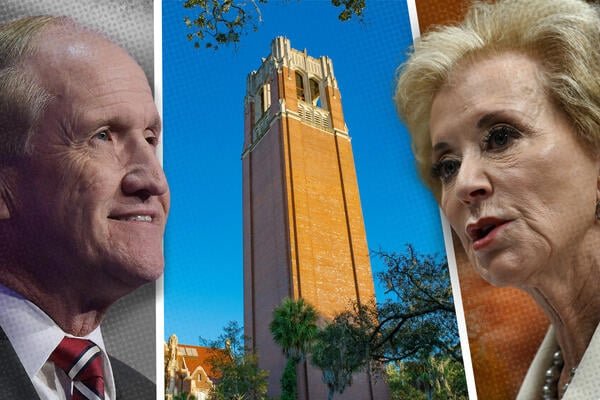
Controversy is once again swirling over the University of Florida’s presidential pick.
When UF announced former University of Alabama president Stuart R. Bell as the sole finalist for its presidency last week, it bucked the prevailing trend in the Sunshine State, where other public institutions have prioritized hiring former Republican lawmakers over seasoned academics.
In the hiring announcement, UF touted various accomplishments from Bell’s 10-year run at Alabama, which ended in 2025. Under his leadership, Alabama saw its rankings and retention rates increase, won multiple college football championships, and achieved R-1 status.
Republican governor Ron DeSantis—who wields significant influence over presidential hires in the state—signaled his support, nodding to Bell’s success during his time at Alabama.
“Dr. Bell did much to elevate the University of Alabama when he was the president in Tuscaloosa and I have no doubt that he will help UF reach new heights during his tenure in Gainesville,” DeSantis wrote on X. “He is a great selection and has my full support!”
But like the previous presidential hiring cycle at UF, Bell’s selection soon sparked controversy. Last June, the Florida Board of Governors rejected former University of Michigan president Santa Ono for the top job at UF due to concerns about his past support of diversity, equity and inclusion practices. Ono’s efforts to distance himself from DEI failed to convince the Florida Board of Governors. Now DEI is once again a central theme in the opposition to Florida’s presidential pick.
What the hiring announcement did not mention is that as Alabama president, Bell oversaw the creation of a DEI office in 2018. He also launched efforts to recruit a more diverse student body, which resulted in significant increases in the enrollment of Black and Latino students. While such recruiting efforts have historically been lauded, the anti-DEI movement of the past few years has emboldened conservative critics, including those who seize on Bell’s past work to argue that he is unfit for the job.
“University of Florida board leadership is breaching protocol to push Stuart Bell, former president of U of Alabama, as the SOLE finalist for the UF Presidency. It’s a blow to UF’s reform record as Bell founded the DEI office at Alabama and refused to fire DEI officers even when the legislature banned it,” John Sailer, a senior fellow at the Manhattan Institute, posted on X.
Criticism of the candidate and the search process also flowed from Washington, D.C.
Florida senator Rick Scott, a Republican, took issue with the search process, arguing in a letter to State University System of Florida chancellor Ray Rodrigues that it “lacked any transparency or public input.” (Scott did not criticize Bell, just the search process.) Scott also blasted UF for agreeing to pay $2 million to interim president Donald Landry if he did not get the permanent presidency. Though his payout will not be supported by taxpayer funds, Scott questioned the appropriateness of Landry’s unusual contract provision, which he called “crazy.”
Education Secretary Linda McMahon also took what appears to be the unprecedented step of inserting herself into a university’s hiring process, noting her own DEI concerns in a social media post.
“We need bold leaders to reorient higher education toward merit, truth-seeking, and academic rigor,” McMahon posted on X. “Florida has led the fight to get discriminatory DEI out of our schools and universities. UF deserves a president who will continue to drive those reforms.”
Asked about the highly unusual move of an education secretary involving herself in an individual institution’s personnel matters, an ED spokesperson defended McMahon’s remarks.
“Several public research universities have taken major steps to recommit to academic rigor, merit, truth-seeking, and viewpoint diversity in recent years,” Ellen Keast, press secretary for higher education, wrote to Inside Higher Ed. “These successes are among the most encouraging developments we have seen in the sector, and they are a roadmap for reforms that will help rebuild trust in higher education. They would not have occurred but for principled and committed leadership—at all levels—and Secretary McMahon is keen to see this progress continue.”
UF both condemned DEI and defended its presidential selection in a social media response.
“@EDSecMcMahon is correct. DEI is discriminatory by design, antithetical to the purpose of a university, and incompatible with the pursuit of truth,” UF posted on X, noting that the Board of Trustees has “embedded an anti-DEI mandate within the presidential contract itself, ensuring that no university funds, public or private, will underwrite DEI at this institution.” UF added, “Dr. Stuart Bell stands with Secretary McMahon, the Board, and the people of Florida on this. He is ready to lead UF forward as a university defined by merit, rigor, and the pursuit of truth.”
UF also noted in its response that the board adopted an institutional neutrality policy in 2025.
Some critics believe that in condemning DEI, the university violated that policy, which restricts university leaders from weighing in on “issues that polarize society.”
Walter Kimbrough, a former college president who now works for the United Negro College Fund, called out the discrepancy over institutional neutrality in several posts on X, noting that UF leaders are “barred from using university resources—such as official email systems, websites, and social media channels—to make proclamations on societal or political issues” like DEI.
(The University of Florida did not respond to emailed questions from Inside Higher Ed asking about the controversy over Bell’s selection or the alleged violation of institutional neutrality.)
Asked if DeSantis stands by Bell amid the wave of conservative criticism over his DEI record, the governor’s office referred Inside Higher Ed to his initial statement of support. A spokesperson for DeSantis did not respond to emailed questions about whether he supports Landry’s $2 million payout.
But as the war of words over Florida’s next president continues, one voice has been conspicuously absent: Bell has not yet commented publicly amid the attacks on his record. His sole public statement so far appeared in the hiring announcement, in which he made a vague statement about ideology—perhaps anticipating the critiques that would emerge.
“I will continue to keep UF focused on the pursuit of truth, knowledge, and excellence while standing strong against ideologies and fads that have no place in the classroom,” Bell said in the announcement.
He will ultimately have the chance to defend—or downplay—his record on DEI in a public interview with UF’s Board of Trustees. The next regularly scheduled board meeting is June 11. While an agenda is not yet available, it is likely Bell will be interviewed then, unless a special meeting is called beforehand.
You may be interested

Hayden Panettiere on ‘Nashville’ Helped Reveal Country Music Dark Side
new admin - Aug 17, 2026[ad_1] When Hayden Panettiere’s character Juliette Barnes stood up against the unwanted advances of a DJ during the second season…

Hegseth to go to Iowa today to campaign for GOP candidates, sources say
new admin - Aug 17, 2026Defense Secretary Pete Hegseth was scheduled to head to Iowa on Monday to give remarks, speak to veterans and campaign,…

King Gizzard and the Lizard Wizard’s Field of Vision Festival
new admin - Aug 17, 2026[ad_1] Folk Bitch Trio Image Credit: Griffin Lotz for Rolling Stone One of Folk Bitch Trio’s earliest “big” gigs was…