



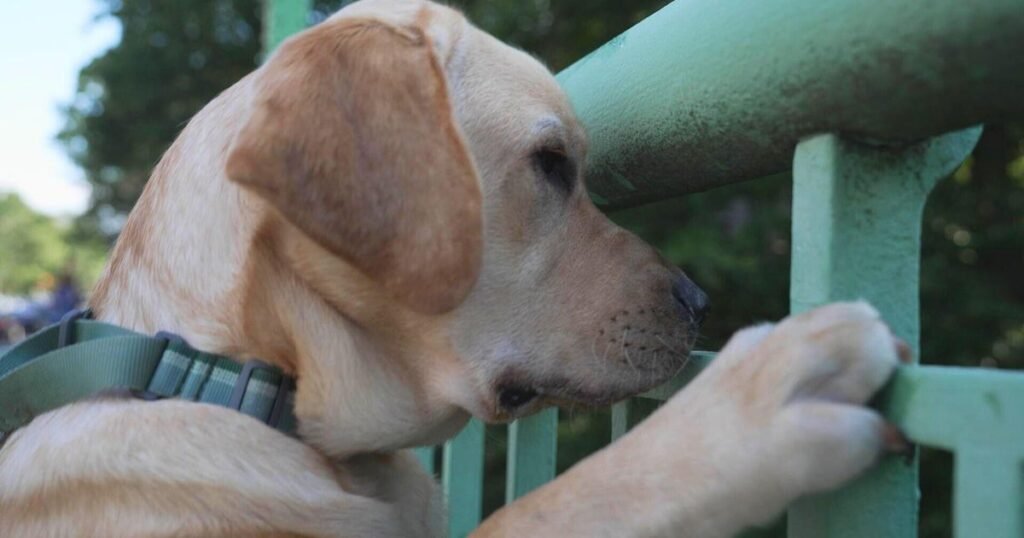
Want to live a longer, healthier human life? Dog brains might hold key information for longevity.

It was personal when Pat Schultz enrolled her German shepherd-poodle mix in the Dog Aging Project. Her husband was suffering from Alzheimer’s at the time, and the project her dog was participating in aimed to advance research into both canine and human aging.
Her dog, 12-year-old Murphy, is one of more than 50,000 in the project. Scientists around the country collect data on dogs’ diets and exercise, analyze blood samples and do MRIs of dogs’ brains. Dogs suffer from many of the same aging-related diseases as humans, and because they age more rapidly than humans, scientists can learn a lot from studying them, veterinary neurologist Stephanie McGrath said.
“We can get a ton of information that would take decades to do in humans,” McGrath said.
What kinds of tests does the Dog Aging Project do?
Matt Kaeberlein, a biologist who has spent decades trying to understand and reverse the causes of aging in both humans and dogs, co-founded the Dog Aging Project in 2014.
“I realized, ‘Oh my God, we know about three or four or five ways to slow aging in laboratory animals. Some of those are going to work in dogs,'” Kaeberlein said.
Much of the biology of aging is similar across the animal kingdom, particularly across species of mammals, Kaeberlein said.
Right now, many treatment trials go from tests on mice directly to human trials, but many drugs that work on mice don’t work on people, according to the latest data. Dogs are seen by some researchers as the species that can fill the gap between mice and people: They live alongside humans and are exposed to the same environments. Dogs exercise with people, drink the same water and even eat our food.
60 Minutes 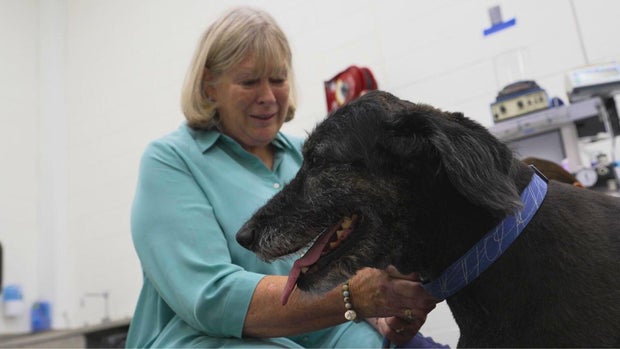
All the information collected in the Dog Aging Project goes into a public database accessible to researchers around the world. It’s been used in more than 50 scientific studies so far, many of which found correlations between lifestyle, environment and disease risk.
The Dog Aging Project has found that dogs that live with other dogs appear to suffer from fewer diseases. And when it comes to cognitive decline, dogs that don’t exercise were found to have a six times greater chance of developing dementia.
As part of the project, dogs undergo tests to assess physical and mental fitness. In one test, dogs are shown where a treat is hidden and seconds later, they’re allowed to go and get it — if they can remember where it is. Murphy has undergone testing for the past three years. When 60 MInutes was there, he showed signs of anxiety during the test, which, McGrath said, is a possible sign of dementia.
Comparing dog and human brains
When some of the dogs in the aging project die, their brains are donated and examined. Dr. Dirk Keene, a neuropathologist who’s studied human brains for 20 years looking for causes of Alzheimer’s, works alongside the vets and researchers in the Dog Aging Project. His motivation for participating in the project was watching his mother suffer from Alzheimer’s and also seeing his dog Spring decline from what looked like, to him, the same disease, which some call “doggy dementia.”
Near the end of her life, his dog Spring would get confused and lost; she’d stare into space and lean against things — something that happens to people, too, Keene said.
“It’s not just memory when we start to have dementia,” Keene said. “Dementia’s a very complex thing that includes confusion, it includes the loss of the ability to remember where you’re supposed to be, sort of spatial references. Very similar to what we’re seeing in dogs, it happens in people.”
60 Minutes 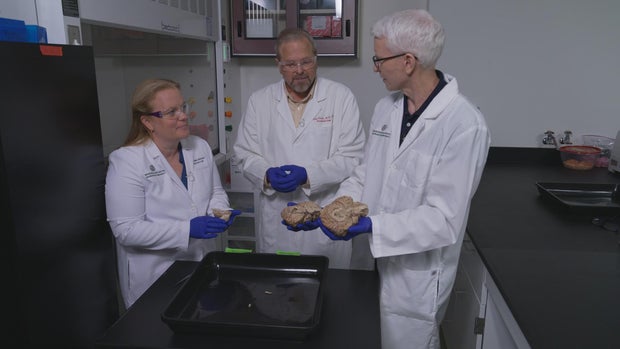
Dog brains, like human brains, have a frontal lobe, temporal lobe and occipital lobe, Keene showed 60 Minutes. It’s the same basic shape as the human brain. And it turns out dementia changes brain size and structure in very similar ways in both species.
Brains of those who suffered from dementia weigh less than healthy brains, Keene said. As the disease kills off neurons, the brain shrinks, and the space in the middle cavity enlarges. Dementia in dogs also results in enlarged spaces and brain shrinkage.
Under a microscope, Spring’s brain, one of the first to be donated to the Dog Aging Project, shows beta amyloid plaques, a hallmark of Alzheimer’s in people, according to Keene.
Extending dogs’ lifespans
The project, in addition to helping dogs live healthier lives as they age, is also looking at increasing life expectancy. Researchers are testing the drug rapamycin. In mice, it’s been shown to slow cognitive decline and increase life expectancy by 60%, leading some longevity researchers and influencers to suggest rapamycin for human use.
Molecular biologist Julie Moreno helped conduct a pilot study of 12 dogs, all with signs of dementia, to see how rapamycin would have an effect on dogs. Qbert, 10, was part of the study. He was given a placebo. And 13-year-old Monkey, who received rapamycin. Moreno studied Qbert’s and Monkey’s brains after they died. She found that Monkey’s brain showed fewer microglial cells, which produce inflammation commonly associated with dementia.
Two other dogs receiving rapamycin have since died. Their brains also showed fewer cells associated with inflammation.
“If it works in a dog, and it’s safe, and it’s helping their cognition, then, maybe, it would help humans,” Moreno said.
60 Minutes 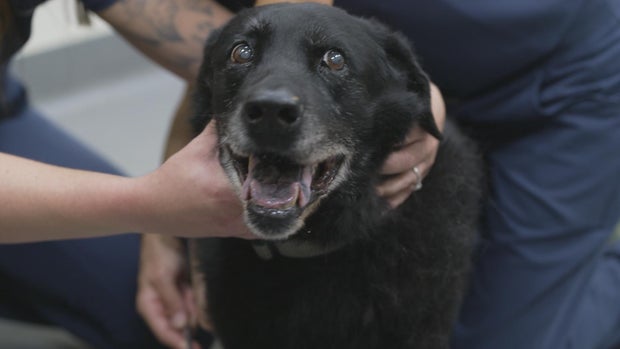
The Dog Aging Project is now conducting a larger clinical trial funded, in part, by the National Institutes of Health, giving hundreds of dogs, including Murphy, either a placebo or rapamycin to see if the drug can extend life.
For-profit biotech startup Loyal, founded in 2019 by Celine Haliou, is testing three drugs.
“My vision is that this is, you know, it’s a daily beef-flavored pill that are given preventatively to keep them healthier longer, similar to a statin, you know, for older Americans,” Haliou said.
Her hope is an estimated “one healthier year of life,” said Haliou.
One of Loyal’s drugs, in a clinical trial, is being given to dogs over the age of 10, who are monitored for signs of aging. The Food and Drug Administration has signed off on the drug’s safety data and says it has a “Reasonable Expectation of Effectiveness,” but final results from the trial won’t be known for several years.
The aging drug is not something to be given to a dog on their deathbed, Haliou said.
Silicon Valley is betting big on longevity. Loyal has raised more than $250 million to bring its drugs to market. Haliou said that if her company is successful with dogs, it may unlock the possibility of working on human longevity.
“I think going dogs first is the fastest way to work on and understand the biology of human aging,” she said.
You may be interested

Jewish volunteer ambulances set on fire in London in apparent antisemitic attack
new admin - Mar 23, 2026Police in London are investigating what appears to be an arson attack on several ambulances from a Jewish volunteer service,…

Dog trainer shares 1 simple tip to stop your dog pulling on lead
new admin - Mar 23, 2026Does your dog pull on the lead? (stock) (Image: Getty)A dog trainer has revealed the 'only tip you need' to…
What swimmer Katie Ledecky learned about America in her time with Team USA | 60 Minutes
new admin - Mar 23, 2026During her years as an Olympic swimmer, Katie Ledecky says what she's seen "is that sport in America is at…