



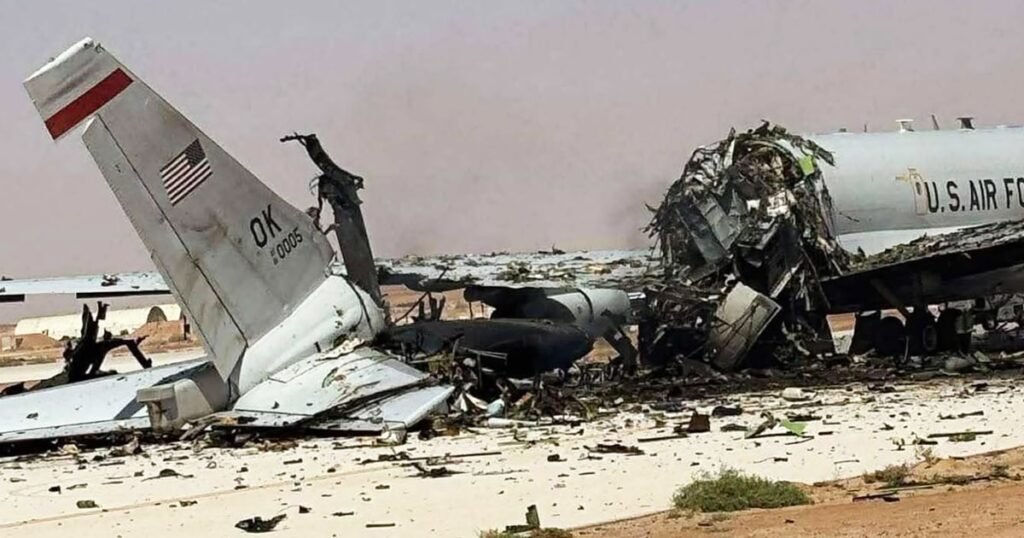
Vital U.S. radar aircraft was destroyed by Iranian strike on U.S. base in Saudi Arabia, photos show

NBC News has reached out to U.S. Central Command for comment.
“Iran is gradually eating away at the network of early warning systems that the US has built over decades in the region,” Andreas Krieg, a senior lecturer at King’s College London’s School of Security Studies, said in written comments to NBC News on Monday.
“Collectively each radar or (Intelligence, Surveillance, and Reconnaissance) platform destroyed further degrades the overall monitoring capability of the U.S.,” he said.
The E-3 Sentry, an airborne warning and control system, or AWACS, jet was one six stationed at Prince Sultan Air Base prior to Friday’s attack, according to Air & Space Forces Magazine, one of the world’s foremost publications on the aerospace industry. Prior to the strike, the U.S. had 16 in total, the magazine reported.
NBC News has reached out to U.S. Central Command for comment on the number of E-3 Sentry planes.
Krieg said the U.S. should have foreseen such an attack and “should have been prepared better for a longer war,” particularly “fighting from permanent installations, especially in a theatre where the other side has large numbers of ballistic missiles, cruise missiles and one-way attack drones.”

Still, he said he believed the U.S. was still doing a “reasonably effective job overall of protecting its assets in a very difficult theatre,” with “most incoming threats” reportedly being intercepted.
Retired U.S. Army Lt. Col. Daniel Davis, a Bronze Star winner who served for 21 years, disagreed.
“We’re not doing OK at all,” he said in a telephone interview Monday. Dennis, a senior fellow and military expert at Defense Priorities, a Washington-based think tank, added that the U.S. was “not militarily prepared for this to be a sustained war.”
“There were too many in the administration that thought this was going to be a quick and easy thing,” he said, adding that the “Iranian side still has plenty of missiles to keep going at a sustained rate.”
“If we’ve had this much trouble with what was considered a militarily inferior Iran, what does anybody think would happen if we had to fight on the ground, in the sea and in the air against a Russia or a China?”
But Burcu Ozcelik, a senior research fellow at the Royal United Services Institute, a London-based think tank, said in a separate interview that there was “a risk of underestimating or understating the nature of the damage inside Iran,” particularly given the communications blackouts in the Islamic Republic.
People should be “cautious at this stage of the war about overstating the extent of damage that the U.S. forces have a sustained,” she said.
Meanwhile, Ukrainian intelligence shared with NBC News by President Volodymyr Zelenskyy in an interview over the weekend suggested that Russia could also be playing a role in aiding Iran in its attacks on U.S. assets in the region.
In an interview in Qatar on Saturday, Zelenskyy said he was “100%” confident Moscow was sharing such intelligence with Tehran to aid in targeting U.S. forces across the Middle East in the war, which began after the U.S. and Israel launched strikes on Iran on Feb. 28.
“Moscow has every incentive to tie down U.S. military resources in the Middle East, raise costs for Washington, and reward Tehran for the military support Iran has given Russia elsewhere,” Krieg said.
Still, he said he would not go so far as to suggest that Russian assistance might be “the reason Iran is succeeding.”
Ultimately, he said, “U.S. protection has been competent” in its war with Iran, “but not optimal.”
“It has been good enough to preserve operations, but not good enough to prevent embarrassing and costly losses.”
You may be interested

3/30: Face the Nation – CBS News
new admin - Mar 30, 2026This week on "Face the Nation with Margaret Brennan," Major Garrett speaks to UAW president Shawn Fain as the Trump…

Iran’s Speaker Ghalibaf takes on Trump on social media
new admin - Mar 30, 2026America's poster-in-chief has a new challenger.While most Iranians are barred from the internet, one of the country’s rising hard-line figures…

Lindsey Buckingham Has Made Peace With Stevie Nicks. What Happens Now?
new admin - Mar 30, 2026[ad_1] Late last week, Lindsey Buckingham dropped a very tantalizing tidbit while speaking to his Instagram followers about his future…