



Ursuline Fights Expulsion From Athletic Conf. After Merger

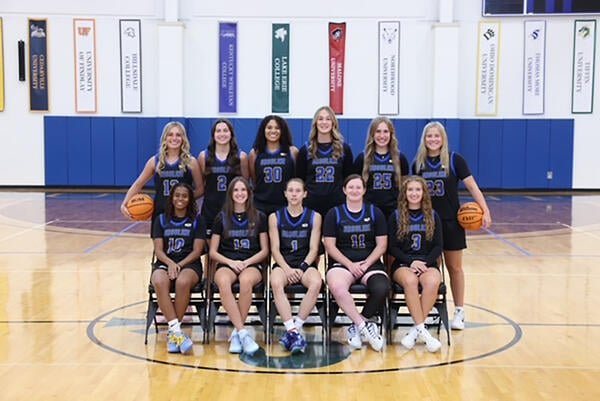
Part of what interested Brooke Haren in playing basketball for Ursuline College—a private, Catholic, majority-women’s institution in Pepper Pike, Ohio—is its membership in the Great Midwest Athletic Conference.
In 2011, the college helped create the conference after struggling to find one interested in accepting its Division II women’s sports teams. Fifteen years later, the conference includes 13 member institutions across Kentucky, Michigan and Ohio.
“Being in GMAC means my family can watch me,” said Haren, a shooting guard from Louisville, Ohio, which is an hour away from Ursuline’s campus. “The majority of my games are in Ohio and within driving distance so my support system can come … My mom’s my biggest fan. You’ll never come to a game and not hear her yell her head off.”
And she was under the impression none of that would change when Ursuline—like so many small colleges across the United States—merged with another institution last year. In a January 2025 memo announcing that Gannon University in Erie, Pa., was acquiring Ursuline, leaders assured students that Ursuline would maintain “distinct academic programs, athletics, and facilities” after the merger.
But neither Ursuline nor Gannon anticipated the GMAC would expel Ursuline from the conference—effective as of the 2027–28 season—on the grounds that it is no longer an “autonomous” institution as a result of the merger; since last year, Gannon has overseen Ursuline’s campus.
“I was shocked and frustrated. I never, ever thought this would happen,” Cindy McKnight, Ursuline’s longtime athletic director and one of the GMAC’s founders, told Inside Higher Ed. “Athletics plays a huge part in the enrollment of the college. And the young women we’re recruiting want to be a part of a conference … We lost two soccer players right after the announcement.”
Without a conference to play in, the college is worried that it won’t be able to maintain the enrollment boost it’s expecting this fall or provide a satisfactory experience for its mostly female athletes. Nearly half the students in its incoming class participate in sports.
Now, both Ursuline and Gannon are asking a court to reverse the decision, arguing that it violated both GMAC’s bylaws and federal legislation that protects women from discrimination in college athletics.
Enrollment on the Line
In a lawsuit filed in the U.S. District Court for the Northern District of Ohio, Eastern Division, earlier this month, the two colleges allege that GMAC breached its contract with Ursuline in the process of terminating the college’s full membership, “seizing upon the merger as a basis” to remove Ursuline despite its good standing.
GMAC declined to comment on active litigation. But Gannon president Walter Iwanenko Jr. told Inside Higher Ed that he’s not completely sure what conflict GMAC sees with Ursuline postmerger. “In the world of higher education there have been multiple acquisitions and mergers,” Iwanenko said. “The idea of a president overseeing multiple athletics programs is not anything new.”
As mergers and acquisitions have become more common over the past several years, numerous colleges have folded into larger institutions, but kept their original sports teams. For example, after six colleges within Pennsylvania’s state higher education system merged into two universities in 2021, both the NCAA and the Pennsylvania State Athletic Conference (of which Gannon University is also a member) allowed all six teams to retain their independence and compete against each other in the same conference.
And as the lawsuit notes, the NCAA has already ruled that Ursuline remains an “independent, standalone institution” postmerger and is eligible to play Division II sports.
Although GMAC granted Ursuline an exemption that allows it to compete against other conference teams during the 2026–27 academic year, Ursuline remains excluded from 2027–28 scheduling activities that are already underway. Meanwhile, GMAC has delayed a vote on its future membership.
“Without clarity regarding its Conference affiliation, Ursuline cannot represent to prospective student-athletes that they will have access to GMAC schedules, Conference championships, or related post-season opportunities for the 2027–28 school year and beyond,” the lawsuit reads. “The uncertainty created by GMAC’s actions has impaired, and continues to impair, Ursuline’s ability to recruit student-athletes, retain current student-athletes, and plan future athletic operations.”
While the college has already started looking for another conference, it has yet to find one willing to take all of its sports teams, which includes 12 women’s teams and, as of last year, three men’s teams.
“It’s really challenging to find another conference that makes sense for our school’s location,” Shannon Sword, head coach of Ursuline’s women’s basketball team, told Inside Higher Ed. Unlike the colleges in GMAC that are in relatively close proximity to each other, joining another conference may burden college athletes with more travel and more missed classes. “Another possibility is becoming one of the handful of schools that is independent and not part of a conference, but that is not a good option,” she added. “It’s very hard to schedule games as an independent team because everyone else is part of the conference, which also gives students a chance to compete for championships.”
Title IX Violation?
For now, Sword said, GMAC’s decision “hinders our female students and their ability to receive the student-athlete experience we promised them.”
And that’s the other sticking point of the lawsuit, which also accuses GMAC of “disproportionately restrict[ing] athletic participation opportunities for women student-athletes at Ursuline by reducing or eliminating access to conference competition, championships, and related pathways” in violation of Title IX of the Education Amendments of 1972, which prohibits sex-based discrimination in collegiate sports. “GMAC’s governance decisions directly control whether women student-athletes at a federally funded institution may participate in intercollegiate athletics within the Conference.”
And Gannon and Ursuline believe the college’s mostly women’s teams may have also played a role in GMAC’s decision to expel it from the conference, which now has 13 women’s teams and 12 men’s teams.
“Conference members have raised concerns regarding scheduling logistics associated with Ursuline’s athletics program structure, including the absence of corresponding men’s programs in certain sports,” the complaint asserted. Meanwhile, it added that GMAC last month announced that the University of Indianapolis, which has both men’s and women’s athletic programs, will join the conference in 2027.
‘Very Bad Precedent’
Whatever the reason behind the decision, it could take months or even years for the courts to decide if GMAC must reinstate Ursuline’s membership.
In the meantime, the situation sends a message to the scores of other small colleges across the United States going through mergers “that you may not have an athletic conference to play in if you’re dealing with an athletic conference that’s not willing to adapt to a changing higher education environment,” Iwanenko, Gannon’s president, said.
“Higher education is under a lot of pressure right now, especially private, four-year institutions. The idea of an athletic conference is to make sure we’re supporting each other and helping our student-athletes succeed,” he added. “By not allowing Ursuline to continue in the athletic conference, it’s providing a negative student experience and will have a negative financial impact.”
Ali R. Malekzadeh, president of Roosevelt University in Chicago, which acquired Robert Morris College in 2019, said he’s “surprised” by GMAC’s decision to boot Ursuline from the conference after the merger.
“I don’t know why GMAC would do this. There must be something else going on,” he said. “Ursuline is being snubbed.”
Beyond that, he added, GMAC is “setting a very bad precedent” in an era of frequent college mergers, acquisitions and closures.
“Most of the colleges in the conference have very small enrollments. And because of the enrollment cliff all small colleges in the Midwest are facing, any of those remaining GMAC colleges could be targeted for a merger or acquisition,” said Malekzadeh, who is also an expert on postmerger integration. “If any two of them were to merge with each other and one of them gets kicked out of the conference as a result, the other option is closing the college. And you really don’t want to do that.”
You may be interested

4 killed in U.S. strike on alleged drug-smuggling boat in Caribbean, Pentagon says
new admin - Sep 20, 2026The U.S. military attacked a boat suspected of being used to smuggle drugs in the Caribbean Sea on Saturday, killing…

Ed Sheeran says situation in Gaza is “catastrophic and unjustifiable” at first concert since Macklemore was dropped from tour
new admin - Sep 20, 2026Ed Sheeran opened his solo concert in Philadelphia on Saturday with comments about Gaza, saying what is happening there is…

Ed Sheeran Breaks Silence on Israel-Gaza Amid Macklemore Tour Drama
new admin - Sep 20, 2026[ad_1] Ed Sheeran took the stage on Saturday night for the first time since Macklemore was removed from his stadium…