

Unprecedented views of largest star-forming region in our galaxy captured by Webb telescope

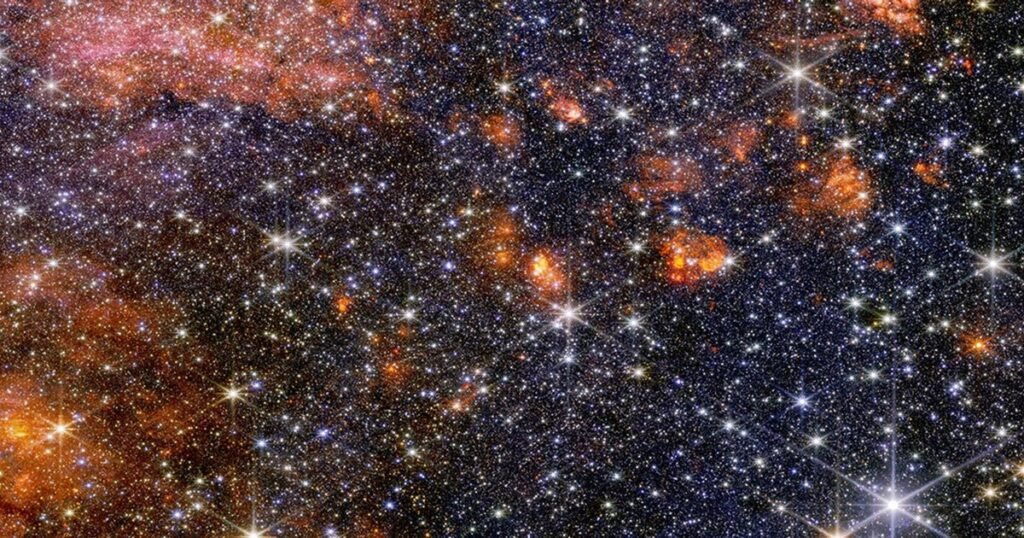
NASA’s powerful James Webb Space telescope has revealed a colorful spread of stars and cosmic dust in the Milky Way’s most active star-forming region.
The telescope was studying Sagittarius B2, a massive molecular cloud, NASA said in a news release. The region is just a few hundred light-years from the supermassive black hole at the center of the Milky Way and is densely packed with stars, star-forming clouds and complex magnetic fields. Sagittarius B holds only 10% of the galactic center’s gas, but produces 50% of its stars.
The Webb telescope’s instruments can examine the infrared light that passes through the region to study what forms there.
NASA, ESA, CSA, STScI, Adam Ginsburg (University of Florida), Nazar Budaiev (University of Florida), Taehwa Yoo (University of Florida); Image Processing: Alyssa Pagan (STScI) 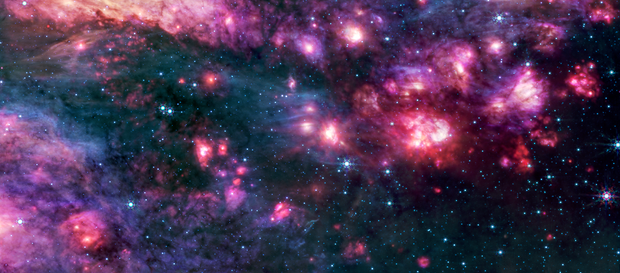
One image from the Mid-Infrared Instrument shows an area known as Sagittarius B2 North, which is one of the most molecularly rich regions known to humans, NASA said. The images taken with Webb’s Mid-Infrared Instrument show gas and dust in the region in “unprecedented detail,” NASA said. In this image, stars appear only as blue pinpoints through the thick clouds.
When using the telescope’s Near-Infrared Camera, astronomers were able to see colorful stars illuminating bright clouds of gas and dust. The astronomers will continue to study these stars to learn more about their size and age, which will inform research into the process of star formation in Sagittarius B2.
NASA, ESA, CSA, STScI, Adam Ginsburg (University of Florida), Nazar Budaiev (University of Florida), Taehwa Yoo (University of Florida); Image Processing: Alyssa Pagan (STScI) 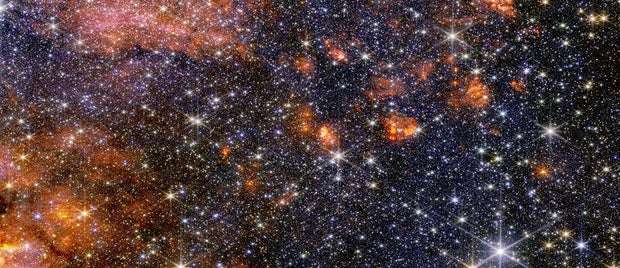
The new images still leave some questions for astronomers. Areas of Sagittarius B2 that look dark and empty are actually “so dense with gas and dust that even Webb cannot see through them,” NASA said. Those clouds of gas and dust will eventually become future stars, NASA said. The clouds also serve as a sort of “cocoon” for young stars.
Researchers also hope the Webb telescope’s instruments can help them learn why star formation in the center of the Milky Way is so low.
“Humans have been studying the stars for thousands of years, and there is still a lot to understand,” said Nazar Budaiev, a graduate student at the University of Florida and the co-principal investigator of the study. “For everything new Webb is showing us, there are also new mysteries to explore, and it’s exciting to be a part of that ongoing discovery.”
You may be interested

'Beautifully executed' horror is 'one of the best' streaming now on BBC
new admin - Oct 12, 2026Sydney Sweeney stars as a young nun uncovering horrifying secrets at an Italian convent in this horror film that 'shocked'…

U.S. embassy urges “extreme caution” using Saudi airports as Houthi attacks escalate
new admin - Oct 12, 202610m ago U.S. embassy in Saudi Arabia urges "extreme caution" in country's airports The U.S. embassy in Saudi Arabia…

Kelly Clarkson Feuds With Brooklyn Store After Bad Experience
new admin - Oct 12, 2026[ad_1] Kelly Clarkson found herself emboiled in an online feud with Brooklyn shop Art of Play over the weekend. On…