




Understanding Noncredit Students’ Goals and Motivations

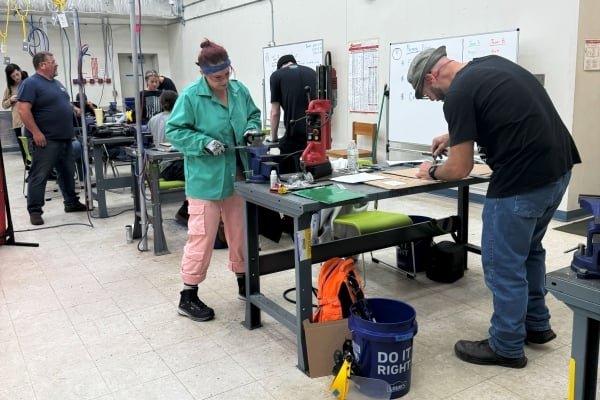
Noncredit programs at community colleges draw millions of adult learners every year, but there’s little research on who they are and what their goals are.
A recent report from Rutgers University’s Education and Employment Research Center, released last week, delves into these questions through qualitative interviews with 83 noncredit students at three community colleges: LaGuardia Community College in New York, Mt. San Antonio College in California and Northern Virginia Community College. These students hadn’t previously earned degrees. Interviewees’ ages ranged from 18 to 60, though the majority were adult learners between the ages of 25 and 49.
“It’s always important to talk to the students,” said Kathy Hughes, senior research consultant at the Education and Employment Research Center and an author of the report, “and researchers really hadn’t done much of that so far” when it comes to students in short-term noncredit workforce programs.
For researchers, a noteworthy finding was that most of the interviewees, 71 percent, had previously attended college. Almost two-thirds of those who enrolled in the past only took credit-bearing courses. Smaller shares enrolled in noncredit courses or a mix of both, 12 percent and 15 percent, respectively. A quarter of interviewees were enrolled in credit or multiple noncredit programs while participating in the study.
Hughes said the reasons college didn’t work out for them in the first go-around varied widely. Many hit financial barriers. Some started college during the COVID-19 pandemic and struggled with online learning. Others became parents. Classes outside their interests deterred some.
“For many of them, [a noncredit program] felt like something that they were finally able to achieve,” Hughes said, “because it was short term, because it was free or low cost. This felt finally feasible, practical, possible.”
Many students were driven to these noncredit programs because of that sense of feasibility in contrast to the longer, more costly degree programs they’d tried before, the report found.
“Some of the decisions are really driven by cost, location, feasibility,” said Michelle Van Noy, director of the Education and Employment Research Center and an author of the report. “Does this program come at a time that it fits in my life? There’s this really high degree of pragmatism at play here that influences their career trajectories.”
The report also found that students had different goals for their noncredit programs.
Some wanted to immediately get a job or a better-paying role, while others saw the programs as a stepping stone to further higher education. Of those students, some had specific plans for how their programs fit into a wider educational path, while others didn’t. For example, one student described doing a pharmacy tech program in hopes of one day becoming a nurse, even though one program doesn’t directly lead to the other.
It’s a sign students need “advising across the range of different options,” said Van Noy, given some students don’t fully understand what programs lead to their intended careers—or don’t even know noncredit programs exist when they first start college.
She also believes it’s important that higher ed leaders consider not only how noncredit programs can stack and lead to degrees but also whether they offer clear pathways to well-paying jobs, since so many noncredit students are looking for immediate career progress.
“A really important consideration … is to listen to the students, to hear the students in terms of what they’re looking for,” Van Noy said. It’s worth “figuring out which programs will lead to those good jobs” and consider “the quality of jobs that are out there that are associated with many of the programs that students are interested in.” She noted that just because a program is popular and attracts students doesn’t mean it’s ultimately getting students the jobs they want.
The research center plans to do further studies on these students, breaking down their employment histories and the costs of their programs, including nontuition expenses such as textbooks and other supplies. The researchers also want to better understand these students’ job outcomes.
The report details students’ “hopes for these programs,” said Van Noy. But the “lingering question” is “what ended up happening? Where did it take them?”
You may be interested

North Korean workers are taking remote U.S. jobs. This company set a trap to expose one.
new admin - Mar 15, 2026FBI officials say laptop farms are a crucial way North Korean IT teams trick U.S. companies into believing their remote…

U.S. intelligence shows Iran’s late supreme leader was wary of his son taking power, sources say
new admin - Mar 15, 2026U.S. intelligence has circulated to President Trump and to a small circle around him that Iran's late supreme leader, Ayatollah…

Trump’s $100,000 fee for H-1Bs, six months later
new admin - Mar 15, 2026Last fall, President Donald Trump’s executive order raising the fee for H-1B visas to $100,000 — like many of his…