


Transcript: Olga Stefanishyna, Ukraine’s ambassador to the U.S., on “Face the Nation with Margaret Brennan,” March 8, 2026

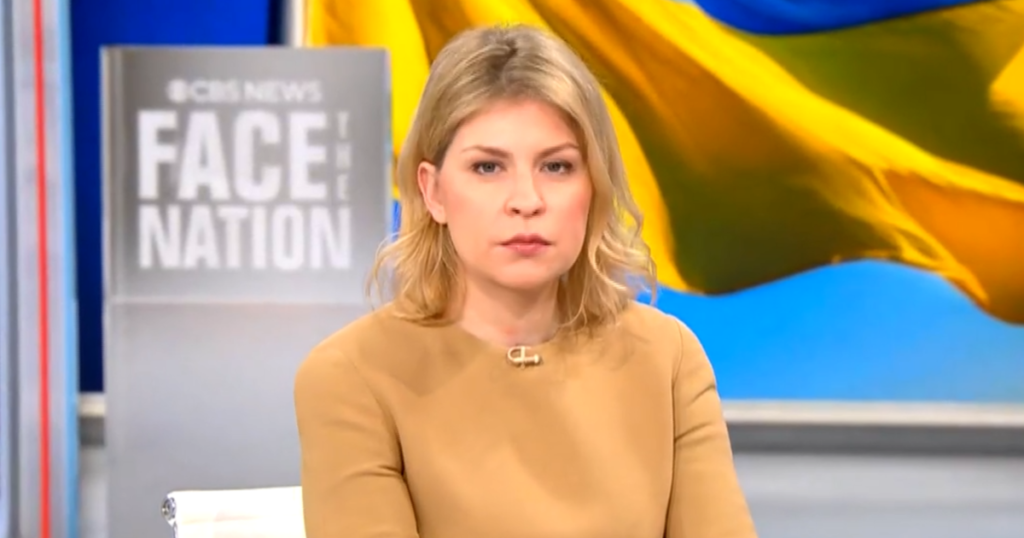
The following is the transcript of the interview with Olga Stefanishyna, Ukraine’s ambassador to the U.S., that aired on “Face the Nation with Margaret Brennan” on March 8, 2026.
MARGARET BRENNAN: We turn now to the war in Ukraine, and Ukraine’s ambassador to the United States, Olga Stefanishyna. Welcome back to Face the Nation.
UKRAINIAN AMBASSADOR OLGA STEFANISHYNA: Well, Margaret, thank you for having me.
MARGARET BRENNAN: So, one of the biggest threats to Ukraine has been Russia’s ballistic missiles that it has been firing into your country for some time. The solution has been the Patriot system, the American interceptors. They are in short supply, as you well know, and now America’s allies in the Gulf tell us that they are also in short-supply there and they need them. Your president said he is concerned America is going to reduce its air defense support for Ukraine. How much of a problem is this for your country?
AMB. STEFANISHYNA: Well, thank you, Margaret, for asking this question. Of course, we have been talking about that publicly as well and have been having non-public discussions. But the most important thing that we see that, you know, the events happening right now with the war in Iran have been so resolute that probably these are the most-important developments on a global arena over a decade. So, no shortages of means should be an issue. And we’re sure that the American defense industry is capable of making sure that all the fronts are covered. Ukraine has the resources and ability to procure more, and we are looking forward for exploring the options, how to do it. But also, you know, we ended up with four 300 Shahed drones over the houses of Ukraine, which was only possible because Iran has been a strategic enabler of the Russian aggression three years ago, and we see what the involvement of cheap technologies is, and we have been ready to contribute.
MARGARET BRENNAN: Well, I asked that earlier in the program of the Energy Secretary, Chris Wright, because Russia and Iran have been allied here. They have been trading resources and technology. They are allied in many ways. He seemed to say they were not really a factor. You say they are directly one.
AMB. STEFANISHYNA: Well, I mean, they are absolutely a factor, because basically the Shahed drone technology was developed to attack people, to demoralize population, to cause the losses among civilians. So, it killed, like, hundreds of Ukrainian kids, so many families, and this was a strategic enabler of war. And Russia has been- Russia were not investing in bilateral relations or development or investments. They were investing in regimes like Iran, Venezuela, and Syria, just because they thought it’s not possible to have the resolute action as it is now taking place with Iran and as it was before in Venezuela. And it was not possible a couple of years ago with Syria. So, they are deprived of means of their influence, they are weaker. But also we should not forget that Ukraine has shown that Russia is no different from all of these countries. It’s just bigger, and we see that, you know, the experience which is being gained right now, and the new reality which is been formed by President Trump also paves the way, the new reality for the Russians, and I’m sure they’re really, really afraid of it.
MARGARET BRENNAN: Well, your president said he was asked by the United States to provide anti-drone technology that Ukraine has to America. When does that arrive? When will that be operational?
AMB. STEFANISHYNA: So, you know, we understand more than anybody in this world what is needed in a moment of crisis. What is needed when you see when your people are dying just across so many cities of the Gulf countries. And what we suggested is the immediate action and immediate reaction. So, we can secure the skies. We can provide the air defense because we have so much knowledge. And these are only Ukrainian people, Ukrainian armed forces who have this knowledge and capability, so we are able to provide it to the United States and the Gulf countries and this is what we did. We are not going to stand aside knowing that people are dying because we know how painful it is and we will do everything we can to make sure that this resolute action is ending up with something that is called positive.
MARGARET BRENNAN: So, sending advisors to help. It sounds like special–
AMB. STEFANISHYNA: And also capabilities. So, it’s the drone capabilities of Ukraine is not only the drone or the people, it’s the whole spectrum of actions you’re taking, because situation is changing every week and you need to have people and the mechanism which allow to react immediately and this is what only Ukraine has at the entire planet.
MARGARET BRENNAN: So just a few days ago, President Trump said he thinks Vladimir Putin is ready to make a deal. And he said that Volodymyr Zelensky, your president, has to get on the ball, and he has to get a deal done. And he referred to him as a P.T. Barnum of Ukraine. It seems like the relationship is still really tense, even though you’re talking about Ukraine helping the United States. What’s going on here?
AMB. STEFANISHYNA: Well, I mean, I think definitely a couple of minutes of this discussion is not enough for that. But I think we’re assessing the situation by actions. And the actions are that there is a mechanism where Ukraine still can get access to American military equipment. President Trump has released significant sanctions to the Russian Federation over the last months. And also we are in dialogue already trilaterally with the United States and Russians on ending the war. All of this is a very important development and we are looking forward for their success. But for us the most important thing is that we are able to defend ourselves and secure our cities and we’re doing that to the extent we can with the American support. And we have never been too tired to give credit to President Trump for so many important things he did. Although the rhetorics we hear sometimes is not something that really very clear or very positive. But we’re a tough country, we’re tough people, we have been through so much that a couple of words is not really something that can distract us, and we know what we know, that Ukraine is a country in the world which really wants the war over more than anybody, and this is where we stand.
MARGARET BRENNAN: What evidence do you have that Russia is helping Iran in its war right now on these American allies?
AMB. STEFANISHYNA: Well, some information has been provided. It’s not something that we would want to share, you know, in a media or go public with. But I can also assure you that it’s not only Ukraine. There are, like, a lot of countries who have a lot information and a disposal and intel community is very well developed across all the NATO formats. So whatever information is there, it’s already at the disposal of, you know, all allies and partners, including the United States. And. I’m sure this is an information which is black and white. It’s nothing which could be called gray.
MARGARET BRENNAN: But it goes beyond sharing targeting information, which CBS has reported?
AMB. STEFANISHYNA: I’m not sure that I could really comment on that, but I think we should look also in the context that Russia has been supporting the regimes of the countries I’ve mentioned, like Venezuela, like Syria, like Iran, for years, and this partnership was possible and evolved in building the productions in the Russian Federation.
MARGARET BRENNAN: Ambassador, thank you for your time today.
You may be interested

U.S., Ecuador carry out joint “lethal kinetic” strikes to combat drug trafficking, video shows
new admin - Mar 09, 2026U.S. and Ecuadoran forces conducted joint strikes inside Ecuador as part of ongoing operations to combat drug trafficking in the…

Students “Doing OK” Can Still Be at Risk
new admin - Mar 09, 2026[ad_1] Colleges have spent years building systems to flag students in academic trouble. But a new report from TimelyCare suggests…

ED Offers Conditional Deadline Extension on ACTS Survey
new admin - Mar 09, 2026[ad_1] The association representing institutional researchers had requested a three-month extension. ojogabonitoo/iStockPhoto.com The Education Department could give some institutional research…