


Texas Systems Review Course Descriptions, Syllabi

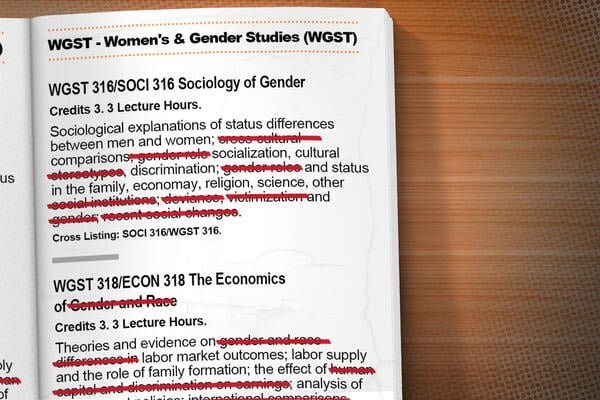
The Texas A&M University system is among the six reviewing their curricula.
Photo illustration by Justin Morrison/Inside Higher Ed | AtipatChantarak/iStock/Getty Images
As conservative Texas politicians identify and target faculty who teach about gender identity, officials at six Texas public university systems have ordered reviews of curriculum, syllabi and course descriptions.
The impetus is clear: Texas A&M University fired a professor, demoted two administrators and pushed out its president after conservative politicians lambasted the institution for a lesson on gender identity in a children’s literature class. Their criticism hinged on the fact that the topic was not reflected in the brief course catalog description for the class. Before he resigned, Texas A&M president Mark Welsh ordered an audit of all courses at the flagship campus, which the system Board of Regents quickly extended to all Texas A&M institutions.
“The Board has called for immediate and decisive steps to ensure that what happened this week will not be repeated,” the regents wrote in a statement posted on X. “To that end, the Regents have asked the Chancellor to audit every course and ensure full compliance with applicable laws.”
Other systems soon followed. On Sept. 29, University of North Texas system chancellor Michael Williams instructed the president of each institution to “conduct an expedited review of their academic courses and programs—including a complete syllabus review to ensure compliance with all current applicable state and federal laws, executive orders, and court orders,” he wrote in a letter. The review is due Jan. 1.
The University of Texas system is reviewing all courses on gender identity to “ensure compliance and alignment with applicable law and state and federal guidance, and to make sure any courses that are taught on a U.T. campus are aligned with the direction and priorities of the Board of Regents,” according to a statement from the system. The review will be discussed at the Board of Regents meeting in November.
System leaders at several public institutions have cited Texas House Bill 229, President Donald Trump’s Jan. 20 executive order and a Jan. 30 letter from Gov. Greg Abbott that said, “All Texas agencies must ensure that agency rules, internal policies, employment practices, and other actions comply with the law and the biological reality that there are only two sexes—male and female.” Yet no current federal or state laws prohibit public university professors from teaching about transgender identity.
A University of Houston system spokesperson told The Texas Tribune that it is completing a review of general education courses in compliance with Texas Senate Bill 37, which took effect this fall. The law requires public universities to complete a curriculum review every five years, but the first reviews aren’t due until 2027. Texas Woman’s University is also conducting a review of all academic courses and programs, the Tribune reported.
Texas Tech University ordered its faculty to ensure that course content complies with Texas and U.S. law, as well as the federal and gubernatorial executive orders that declare the existence of only two genders—male and female. The resulting oral policies—which officials are purposely not writing down—severely limit what faculty can teach about gender identity and effectively erase transgender people and topics from the curriculum.
It’s unclear how each of the six university systems will respond after their reviews are complete, and whether courses will be censored or entirely removed from the catalog.
The conservative politicians who have gone after institutions and faculty for teaching about gender identity have found professors through syllabi and course information posted online. As the risk of doxing grows, faculty are working to keep their information private, but new technology and Texas law are adding complications.
Hundreds of American colleges and universities are now requiring their faculty to upload syllabi to Simple Syllabus, a third-party platform that offers uniform syllabus templates and easy editing; it also allows faculty to embed syllabi into campus learning management systems. According to the company’s website, more than 500 colleges and universities currently use the platform. Institutions may limit who can view the syllabi—for example, Clemson University requires users to log in with university credentials.
But other institutions—including the University of Houston, Texas A&M University and the University of Texas at Austin—allow the general public to view their Simple Syllabus pages. This may be in part due to Texas House Bill 2504, a 15-year-old law that requires public institutions to provide publicly accessible syllabi that include major assignments and exams, required or recommended readings, and a general description of lecture or discussion topics.
Andrew Joseph Pegoda, a lecturer in the Women’s, Gender and Sexuality Studies Department at the University of Houston, experienced the risks of this public access firsthand. In August, a conservative news site published a piece targeting Pegoda for teaching two courses that include queer theory in the curriculum and that, according to the news site, exemplify “indoctrination in women’s and gender studies departments.”
“I realized that they got their information from Simple Syllabus,” Pegoda said. The platform allows users to search posted syllabi at an institution using keywords—for example, searching the word “queer” on the Simple Syllabus page for one Texas university returned four different syllabi that included the term.
The spotlight on Pegoda came and passed quickly, largely because his name wasn’t included in the article’s headline. “I’m glad it wasn’t worse than it was. It could have been more direct or more vicious,” he said.
Simple Syllabus spokesperson Matthew Compton-Clark said the company has not received any reports of targeting via the platform. “We take data privacy extremely seriously, and are a faculty-first organization,” he wrote in a statement to Inside Higher Ed. “We provide multiple privacy features, giving faculty the ability to set not just their entire syllabus private, but individual components as well. This same feature also exists for the institution, allowing the school to set the visibility of the entire syllabus, or individual parts of the document based on their state-specific legislation.”
The Texas law does not require the public syllabi to include class meeting times or locations, though many professors don’t amend the public versions of their materials to exclude that information. Pegoda said he’s been advised to “put minimum detail in the public Simple Syllabus and then to provide a more regular syllabus to students,” he said.
But, in the wake of the incident at Texas A&M, that may not work, he said. “Now professors are being encouraged to very specifically detail everything in the syllabus so as to not potentially get fired or have student complaints.”
You may be interested

Squeezed by inflation, more Americans are falling behind on debt payments
new admin - Oct 12, 2026Rising U.S. prices are squeezing household budgets, causing more Americans to fall behind on their debt payments, recent financial data…

Would access to Russian diesel help drive down prices in the U.S.?
new admin - Oct 12, 2026Russia's commitment to boost global diesel supply, as announced by President Trump on Oct. 9, may do little to ease prices…

Judge chastises Justice Department lawyers after hundreds of trees cut down at D.C. golf course
new admin - Oct 12, 2026Washington — A federal judge on Monday rebuked the Justice Department after hundreds of trees were cut down at East…