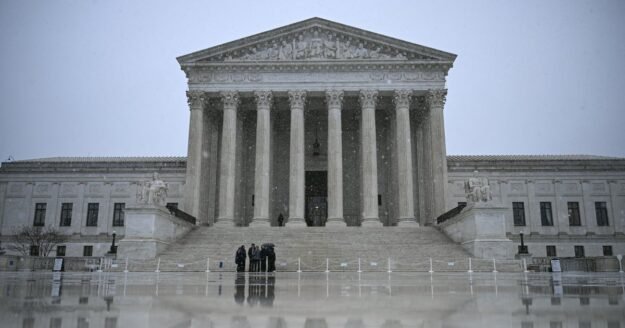



Supreme Court grapples with laws allowing mail ballots that arrive after Election Day to be counted

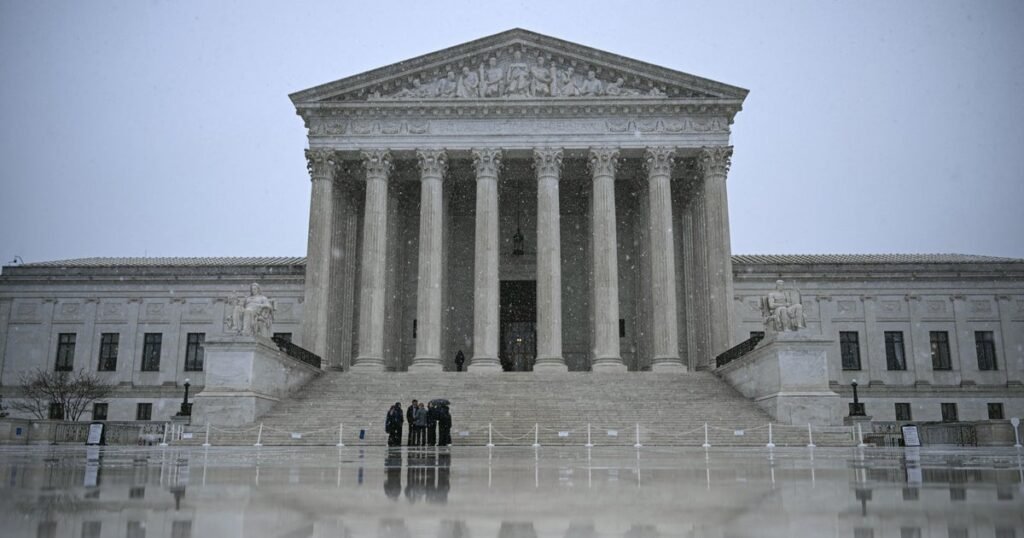
Washington — The Supreme Court on Monday wrestled with a major elections dispute involving whether federal law bars states from counting mail ballots that are postmarked by Election Day but received by election officials later.
The case before the high court, known as Watson v. RNC, involves Mississippi’s deadline for late-arriving mail ballots and whether its law, as well as similar measures from 13 other states, conflicts with federal statutes that set Election Day as the Tuesday after the first Monday in November in certain years.
President Trump has pushed to end mail voting, with some exceptions, and a decision in the case from the Supreme Court is expected to come months before the November midterm elections.
Across roughly two hours of arguments, the justices asked sharp questions of lawyers for both the Republican National Committee, which is challenging the grace periods, and Mississippi officials, who are defending the law. Several of the conservative justices, including Justices Samuel Alito and Clarence Thomas, appeared skeptical of the state laws governing late-arriving ballots.
But the three liberal justices, Elena Kagan, Sonia Sotomayor and Ketanji Brown Jackson, defended the measures as an exercise of states’ authority to set rules for federal elections.
Chief Justice John Roberts and Justice Amy Coney Barrett, meanwhile, each asked questions indicating they were concerned about how a decision invalidating the deadlines for late-arriving ballots could affect other election rules, including those allowing for early voting. The RNC and the Trump administration have argued that under the federal statutes setting a uniform day for the elections for president and Congress, Election Day is the day the ballot box closes.
“Once we go down this road … where are we going to end up?” Kagan asked Solicitor General D. John Sauer, who argued for the Trump administration and urged the justices to strike down the grace periods.
Kagan and Barrett both pressed Sauer and Paul Clement, who argued on behalf of the RNC, about whether a decision in favor of the GOP would require election officials to complete other tasks on Election Day, such as adjudicating voter-qualification issues.
All 50 states require ballots to be marked and submitted by Election Day. But 14 states and the District of Columbia have enacted so-called grace periods, in which ballots that are postmarked by Election Day can be counted if they arrive after that day. Twenty-nine states and the District of Columbia allow at least some military and overseas ballots to be counted if they’re received after Election Day, according to the National Conference of State Legislatures.
Four states — Kansas, North Dakota, Ohio and Utah — passed laws last year eliminating grace periods and now require mail ballots to be received by Election Day in order to be counted.
Before the Supreme Court is Mississippi’s law, which allows mail ballots that are received up to five days after the election to be counted as long as they were postmarked by Election Day. In 2024, the Republican National Committee and the state GOP, as well as Mississippi’s Libertarian Party, filed lawsuits challenging the state’s ballot-receipt deadline.
The plaintiffs argued that federal statutes enacted in the 1800s that set a uniform day for the election for president and Congress require ballots to be received by Election Day. Mississippi’s grace period, the Republicans alleged, conflicts with those federal laws.
A federal district court upheld Mississippi’s law, finding it did not conflict with the federal Election Day statutes because, when Congress enacted those laws, the ordinary meaning of “election” was the final choice of a candidate by the voter.
But the U.S. Court of Appeals for the 5th Circuit reversed that decision and ruled that federal law trumps Mississippi’s deadline, since “election” day is the day by which ballots must be cast by voters and received by state election officials.
“While election officials are still receiving ballots, the election is ongoing: The result is not yet fixed, because live ballots are still being received,” a panel of three judges on the 5th Circuit found.
Mississippi officials appealed the decision to the Supreme Court, which agreed in November to decide whether states can count ballots that are cast by Election Day but received by election officials after that day.
Mississippi Secretary of State Michael Watson, a Republican, is urging the Supreme Court to uphold the law. In filings with the high court, he argued that his state and others with post-Election-Day ballot-receipt deadlines have made a policy choice, which reflects the nation’s system of federalism. The Constitution’s Elections Clause gives states the authority to set the rules for federal elections, and offices at the state and local levels oversee their administration, though Congress can pass election regulations.
Watson and others defending the grace periods have warned that if the Supreme Court adopts the 5th Circuit’s rule, it could jeopardize the laws of the 29 states that accept some ballots after Election Day, including from military and overseas voters. There are nearly 4 million servicemembers and U.S. citizens living abroad who rely on mail ballots to vote, according to a coalition of groups representing troops, military families and overseas voters.
In filings with the Supreme Court, Watson argued that an “election” is the choice of a federal officer, and voters make that choice when they mark and submit their ballots. Under Mississippi law, all voters — whether voting in-person or by mail — must make their “conclusive” choice of candidates for office by Election Day.
“It does not matter — as far as the federal election day statutes are concerned — that election officials in Mississippi may receive some ballots after election day,” he wrote in a Supreme Court brief. “Only ballot casting is essential to an election.”
But lawyers for the Republican National Committee urged the Supreme Court to uphold the 5th Circuit decision that invalidated Mississippi’s law, arguing that the election ends when the ballot box is closed, not when voters make their selection. The term “election,” they argued in a brief, refers to the public process of selecting candidates for federal office.
Election Day encompasses the submission and receipt of ballots, and both must conclude on the date set by Congress, the Republicans and Libertarian Party of Mississippi said. They also argued that a patchwork of different ballot-receipt deadlines only replicates the problems Congress was trying to fix when it set a uniform day for the election in the 19th century.
The GOP also warned that the laws allowing officials to count late-arriving ballots invite fraud and create the appearance of fraud.
“In the eyes of many, they have hampered the efficiency and integrity of elections,” the RNC argued.
Claims about fraud through mail voting have been perpetuated and amplified by Mr. Trump, though instances of mail-voting fraud are rare. There is no evidence of widespread voter fraud, according to elections experts.
The Trump administration is backing the GOP in the case and has argued that under federal law, states cannot count ballots in elections for president, the Senate and House that it receives after Election Day.
“[I]n setting a uniform ‘election day’ for the Nation, Congress mandated what those words have always required: On election day, the ballot box must close, and every vote must have been received,” Solicitor General D. John Sauer wrote in a friend-of-the-court brief.
A decision in the case involving Mississippi’s ballot-receipt deadline is expected to come by the end of June or early July, raising concerns that if the Supreme Court strikes down its grace period, election officials in some states will be left scrambling to inform voters about changed deadlines months before the November midterm elections.
You may be interested

What is Elon Musk’s Terafab chip project? Here are his “most epic” goals for the factory.
new admin - Mar 23, 2026Elon Musk, famously a man with big ideas, is building a semiconductor plant vast enough to power those ambitions.Musk on…

New York Giants valued at $10.8B amid Tisch family equity transfer request
new admin - Mar 23, 2026[ad_1] NEWYou can now listen to Fox News articles! As New York Giants co-owner Steve Tisch and his siblings look…

New Back to Future documentary film coming to streaming this week | Films | Entertainment
new admin - Mar 23, 2026The Back to the Future film trilogy continues to prove incredibly popular over 40 years on.Creators Rob Zemeckis and Bob…