



Skeletons found in well identified as Roman soldiers killed 1,700 years ago

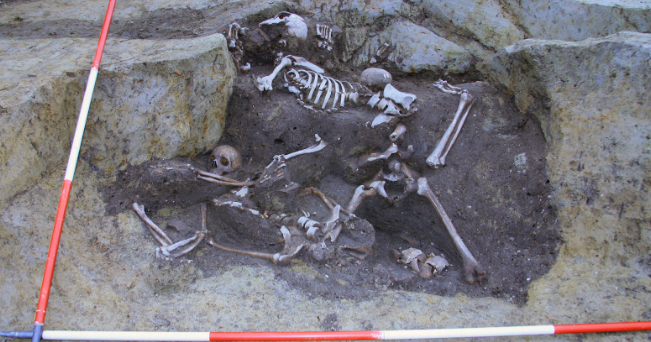
Seven fully preserved skeletons found in an ancient city in Croatia have been identified as Roman soldiers who would have lived 1,700 years ago, scientists said in a new paper.
The skeletal remains were found in 2011 during a dig at the Roman city of Mursa, located in modern-day Croatia, in a water well that had been repurposed as a mass grave, said the researchers, who are from a number of European archaeological institutions. The area was conquered by Romans during the first century B.C., and the city was an “important trade and craft center” that bordered an active military zone, according to the paper published this week.
All seven skeletons were identified as belonging to taller-than-average adult men. Four are younger adults, between 18 and 25, while the other three are middle-aged, between 36 and 50, the researchers found. All were “robust” but showed “indicators of early-life stress” such as wear on the teeth.
The skeletons were placed in different positions and at different depths, the researchers said, but all appear to have been buried at the same time. The remains seem to have been “thrown in” shortly after death, the researchers said. The men were likely soldiers who may have participated in a 260 C.E. battle for the city or died in a skirmish afterward, according to the researchers.
PLOS One 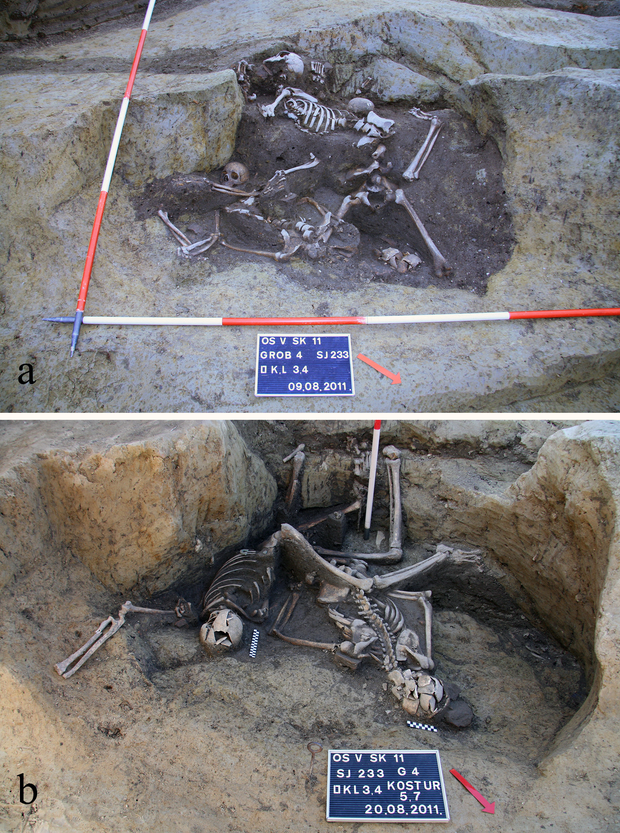
Several of the skeletons had injuries, including blunt-force injuries on the facial bones of one and puncture wounds on the torsos of two others that were likely caused by weapons such as arrows or spear tips, according to the paper. The wounds and their locations were determined by analysis of the skeletal remains.
The researchers were also able to use carbon and nitrogen stable isotope analyses to learn more about the soldiers’ day-to-day lives. They ate lots of grains, including wheat and millet, and vegetables, but little meat, the study found. Four of the skeletons underwent DNA analysis, which found that none appeared to be local to the area. One was likely from northern or Eastern Europe, while another was likely from the Byzantine Empire.
Remains of Mursa have been explored by researchers for decades. Archaeologists have found a number of water wells, small pits and other evidence of civilization.
Mursa was affected by a number of conflicts, the researchers said. Many occurred during the Crisis of the Third Century, an era during which Rome nearly collapsed due to civil wars, foreign invasions and economic issues, according to CBS News’ partner network BBC News. The city eventually “ceased to exist as an urban settlement” after attacks in 441 C.E., the researchers said.
You may be interested

A photo of actress Mia Goth seemingly referencing news of her recent divorce spread across the internet. It was AI-generated, her representatives say, posted by an account she had asked Instagram to remove.
new admin - Oct 13, 2026Earlier this month, news broke that actress Mia Goth had filed for divorce from actor and filmmaker Shia LaBeouf. An…

Bipartisan senators urge Trump to rescind Russian diesel deal, calling it a “betrayal” of Ukraine
new admin - Oct 13, 2026Washington — A bipartisan group of senators on Tuesday urged President Trump to withdraw from his diesel deal with Russian…

UCLA Has ‘Serious Concern’ QB Nico Iamaleava Will Miss The Rest Of The Season
new admin - Oct 13, 2026[ad_1] NEWYou can now listen to Fox News articles! The UCLA Bruins are the biggest story in college football right…