


Seattle U Dismisses Professor Who Criticized Provost

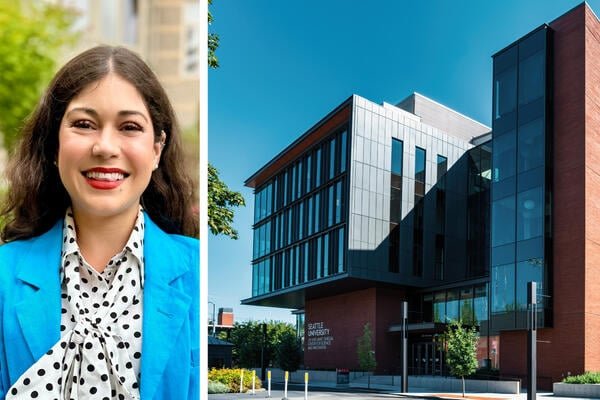
Carmen Rivera’s employment ended on June 30, two months before her contract was set to expire.
Carmen Rivera | benedek/iStock/Getty Images
Seattle University terminated and declined to renew criminal justice professor Carmen Rivera’s contract two weeks after she posted a video to Instagram that showed the provost yanking a Palestinian flag from the hands of a graduating student. University officials told Rivera they would not reappoint her because there weren’t enough classes for her to teach a full course load in the coming academic year, but Rivera suspects the decision had more to do with her public criticism of the provost and the university.
Rivera, who is not tenured and split her time between teaching and an assistant deanship, posted the video on June 14, the day of commencement. She texted her dean before posting it—not for permission, but to “keep her in the loop,” she said. The video shows a graduating student approach provost Shane Martin on stage while unfurling a Palestinian flag. As the student gets closer, Martin grabs the flag and, after a brief struggle, hides it behind his back while the two take a photo together. Martin lets go of the flag and returns it to the student as she walks off the stage.
“I am disturbed by how the provost handled this situation. I believe I’ve seen other flags waved by students and not receive this response,” Rivera wrote alongside the video on Instagram. “I understand I may receive backlash for highlighting anything negative that could damage the institution, and institutions are made of people. They’re not real. People are real and I know too many who are afraid to say anything. I am privileged and fed up enough to not be afraid. I’m sorry this happened. I hope we can do better.”
Martin has since apologized for misunderstanding that the student “wished to avoid physical contact as part of her Muslim faith,” he wrote in a statement. He did not mention the flag.
Overnight, Rivera’s video racked up more than 900,000 views, she told Inside Higher Ed. She debated taking it down. Over the next couple of days, Rivera spoke with College of Arts and Sciences Dean Monica Casper twice on the phone.
Casper suggested “that I was in trouble, unofficially,” Rivera said. “My dean told me that allegedly her job was threatened … because she could not control my social media.”
The Seattle University Faculty Handbook does not contain a specific policy on social media use. It does have a passage on extramural speech, which states that “when faculty speak or write as citizens, they should be free from institutional censorship or discipline,” but they should “remember that the public may judge their profession and Seattle University based on their communication.” It goes on to say that “academic freedom is supported and sustained by robust processes and practices of shared governance, which affirm the right of faculty members to discuss, criticize, and debate university policies and priorities.”
Several of Rivera’s colleagues suggested that she get an employment attorney.
“I was basically told that the president’s office and the provost’s office … all very much want me gone,” she said.
Rivera met one on one with Casper on June 25. During the meeting, Casper said “she didn’t know anything about my contract,” Rivera said. A few days later, officials wrote to say Rivera’s contract would not be renewed because the university was “making adjustments to the dean’s leadership team that includes eliminating the current assistant dean position,” according to a screenshot of the email Rivera shared on Instagram. “Further, we do not have a full-time (7 courses) teaching position available to make up the additional courses with the reduction of the administrative effort. Accordingly, we are not renewing this position.”
‘Discouraging and Demoralizing’
Rivera’s employment ended on June 30, two months before her contract was set to expire. A university spokesperson declined to comment on the decision to end Rivera’s contract, stating that the university “does not comment on individual personnel matters.”
“Faculty appointment and renewal decisions are made through established academic and administrative processes,” the spokesperson told Inside Higher Ed in an email. “As part of those processes, faculty appointment and renewal decisions are routinely communicated following the conclusion of the academic year. The university typically communicates the reasons for those decisions privately to the individuals involved.”
The justification given was confusing, Rivera said, because she’d been told by her department chair in March that she would need to teach a full course load during the 2027–28 academic year, when Seattle University is scheduled to transition from the quarter system to a semester calendar. During the 2026–27 academic year, Rivera planned to teach five courses and continue her assistant deanship.
“I know we don’t have enough instructors. Our department [and the psychology department] are the largest departments in the College of Arts and Sciences. We typically do not have enough instructors for the number of classes that we are required to teach for our accreditation, so for them to just blatantly say … that they don’t have enough classes for me is false.”
Rivera is far from the first faculty member to be fired, sanctioned or otherwise disciplined in response to speech related to Palestinian activism. Most recently, an arbitrator ruled that tenured San José State University professor Sang Hea Kil must be reinstated after she was fired for participating in pro-Palestinian demonstrations. The School of the Art Institute of Chicago put art therapy professor Savneet Talwar on leave in April for giving students a case study that centered on a Muslim woman upset about the violence against Palestinians in Gaza. University of Michigan board members urged the university to put African studies and history professor Derek Peterson on leave after he praised pro-Palestinian protesters during a commencement speech.
The June 14 Instagram post isn’t the first time Rivera ticked off Seattle University leadership, she said. During a December faculty meeting, and then via a collegewide email in January, she spoke out against the university’s decision to allow Customs and Border Protection to attend the Criminal Justice Career Fair. She also butted heads with other criminal justice faculty members when she encouraged students in the Criminal Justice Club and the Student Executive Council to survey other students about their feelings on whether CBP should be invited to the fair.
Rivera plans to fight the decision in court, she said.
“It’s incredibly discouraging and demoralizing,” she said. “I fully believe they are doing this on purpose to scare other faculty members. I believe they are making an example of me.”
You may be interested

Olivia Rodrigo Presents ‘Jeopardy!’ ‘Women in Music’ Category
new admin - Jul 10, 2026[ad_1] There’s nothing Olivia Rodrigo loves more than celebrating her musical inspirations. The popstar brought that fervor to a guest…

Disney Plus is reportedly looking into a free streaming tier
new admin - Jul 10, 2026Disney Plus is considering making some of its content free to watch, according to a report from Business Insider. A…

How to Watch Spain vs. Belgium: TV Channel, Live Stream, Live
new admin - Jul 10, 2026[ad_1] NEWYou can now listen to Fox News articles! Spain and Belgium meet in their 2026 FIFA World Cup quarterfinal…