



Roger Clyne on Refreshments’ Desert Rock

For 30 years, Roger Clyne has been inviting listeners to the dusty cattle ranches, tequila-stocked cantinas, and notorious narcotics pathways where his native Arizona meets the Mexico borderlands. “Everybody can hear the Sonoran Desert in this music,” Clyne tells me. He’s sipping a margarita in his backyard in Tempe, Arizona, a few blocks from the college bars that made him (briefly) famous with the Refreshments, and a hundred miles from his family’s cattle ranch between Tucson and the Mexico line.
Now, a brand new Roger Clyne & the Peacemakers record is dropping at the same time that Clyne is celebrating the album that started it all.
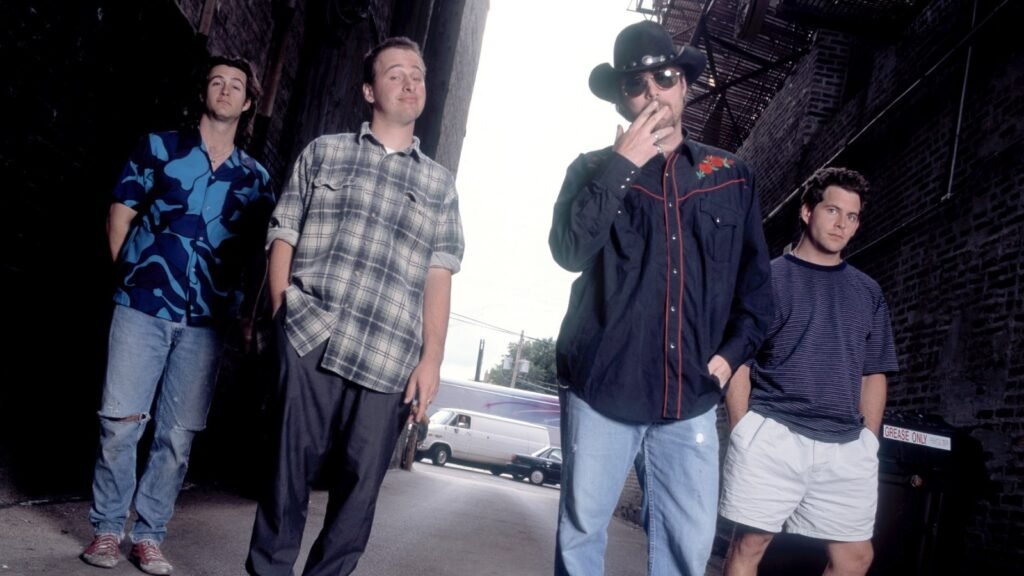
In late 1995, Clyne rose to prominence with the Refreshments, a four-piece college rock band from Tempe — part of a wave of post-grunge acts from the college town including Gin Blossoms and Dead Hot Workshop. They topped the Billboard Heatseekers chart and had a Hot 100 single, “Banditos,” and penned the instrumental “Yahoos and Triangles” — better known as the theme song to King of the Hill. By 1998, the group had disbanded. In its wake, Clyne and Refreshments drummer P.H. Naffah formed Roger Clyne & the Peacemakers. On Friday, the group will release Hell to Breakfast, their ninth studio album and first since 2017’s Native Heart.
The nine-year gap between records, Clyne says, was part purpose and part accident. He struggled to process the impact Covid had on both his music and the world, but he also wanted his melodies and lyrics to cover new ground.
“The world was a rocky place full of chaos and vitriol, and I had already written 10 records,” Clyne tells Rolling Stone. “Not that chaos and vitriol aren’t fertile ground. It was just tough to find where to plant the seeds and figure out what I wanted to grow this time, or how I wanted to say what I wanted to say. Once you already have published close to 120 songs, it’s hard to find how not to be a parody of yourself.”
Hell to Breakfast is Clyne coming to grips with it. The world around us may be hell, but we’re still waking up to coffee in the morning, and there’s still art to be found.
Clyne wrote nine of the album’s 10 tracks and co-wrote one with Miles Nielsen (of Miles Nielsen & the Rusted Hearts). The band self-produced most of the record, with Naffah and Jeff Lusby engineering. Two of the songs, though, were recorded at Yellow Dog Studios in the Texas Hill country and co-produced by Adam Odor and Silverada’s Mike Harmeier. Shelby Stone — who at 26 is currently experiencing the same sort of rise that Clyne did three decades ago — appears on “Getaway,” a duet with Clyne.
The Peacemakers are Clyne, Naffah, bassist Nick Scropos, and lead guitarist Jim Dalton — who is also the frontman of the long-time Denver country outfit the Railbenders. The Peacemakers’ first decade saw several lineup shuffles, but the group has been steady since Dalton joined in 2009.
“He really, really cares about the song,” Dalton says of Clyne. “He works long and hard on the songs. Every lyric has to be perfect. I don’t have that same discipline or patience. I write a bunch of goofball songs, and I’m OK with that, but he is a songwriter’s songwriter.”
A singing cowboy with a heavy respect for the colliding Native American and Mexican cultures that have enveloped him over his 58 years, Clyne is a vanguard of the life that shaped him. “One hundred percent inextricable from any song in the catalog is culture and locus — where we live,” Clyne says of a career that once saw mainstream fame but now brings him a sense of purpose and peace. He shares it with a dedicated fanbase and an inner circle of independent songwriter friends that spans the worlds of Americana and independent country music.
This is evident across Hell to Breakfast, and is most striking on “American Drugs,” the co-write with Nielsen that finds a cowboy in Nogales, Arizona, having his heart broken by a Mexican girl. The first verse came easy to both men, but Nielsen wanted to keep the second verse — and the heartbreak — abstract to allow listeners to project their own heartache on the song. Clyne, on the other hand, wanted to “shatter this man’s heart.”
“You gotta do it in 15 seconds,” he says. “That’s where I really have fun. This fucker is gonna be hurt. But he’s also gonna ride off into the sunset proud of that cowboy shit.”
Stone’s appearance on Hell to Breakfast closes a circle that began with her debut record, Silveryear, released in 2025 on physical platforms and set for an April streaming release. She met Naffah through her friend, manager, and longtime songwriter, Dalton Domino, and Naffah produced Silveryear. “The culture of his camp is insane,” Stone says of Clyne and Naffah. “Everyone is so nice. It’s a family vibe.”
The first track Clyne wrote that made the record, “You Got Lightnin’,” dates to the height of Covid and came from a reckoning with his place as a songwriter.
“I was starting to write again,” he says, “but ran into Covid, which was a shock. I was wanting to want to write again, which is a strange place for a writer to be! I always have a drive to write, but I want the drive to be honest — not like a quota.”
Clyne long ago embraced the native Apache community in southern Arizona. He befriended an Apache he calls Gordon — the native name, he says, does not have an English spelling. Gordon is part of the Apache medicine community, responsible for spiritual and cultural health.
Clyne had learned a spiritual ritual from Gordon involving an animal hide with symbols written on it. The ceremony involved laying the hide flat and collecting various pieces of the surrounding physical world — such as stone, wood, and ash — and assuming a spiritual posture at a certain time of day. During Covid, Clyne called Gordon to review the ceremony while driving in his truck across the desert south of Tucson.
“He was very specific in his instructions for about two minutes, and then pauses,” Clyne recalls. “I thought I lost him. I’m going, ‘Gordon, are you there?’ Then, he said this: ‘Roger, you got lightning.’ That meant permission, and acknowledgment that the divine spark is already there. Do what you’re gonna do. The intention, it already exists that the ceremony is supposed to honor or invoke. Don’t let it hang you up, just get to it.”
Such an anecdote is not just inside baseball for Clyne’s music. It’s a window into his essence. All that has shaped him — people, cultures, histories, dust devils, and panoramic desert vistas — is inseparable from his lyrics and his sounds. Clyne prefers to keep his politics personal, but in this volatile era, he has found himself becoming increasingly, and publicly, protective of the life he has been afforded. Last summer, as Congress, with an endorsement from Utah Rep. Mike Lee, pushed to put public lands up for sale — which would have impacted a large swath of his Arizona homeland — Clyne and his son, Rusty, lobbied fiercely against the move. The proposal died in Congress, and Clyne would like to see it buried for good.
“I believe that this issue is literally common ground,” Clyne says. “People who do or don’t subscribe to a party can get behind and endorse the idea that public lands are a very uniquely American generational wealth. Insert any Theodore Roosevelt quote right here about public lands and preservation and responsibility and stewardship, and everybody agrees. It’s one of the last little pieces of ideological real estate that we have together.”
Another part of Clyne’s livelihood that is inseparable from politics is his bellwether festival, Circus Mexicus. The annual gathering has spanned more than a quarter century along the beach and in the bars of Puerto Penasco, Mexico, 60 miles south of the Arizona border along the Gulf of California. It has showcased artists like Cross Canadian Ragweed, Reckless Kelly, and BJ Barham, and individual members of groups like Gin Blossoms or the Lowdown Drifters playing solo sets.
This year’s festival is planned for the last weekend in May, with the lineup still in progress. Clyne says it’ll happen regardless of the atmosphere surrounding border enforcement and immigration, and that will be the case as long as he has a say. It’s not the only festival Clyne oversees — his annual Clyne Country Campout in mid-fall brings fans to the family ranch still run by his father, Doc Clyne — but it’s the high mark for Clyne and a nod to his roots.
Before he was an artist, Clyne took Spanish immersion courses and studied cultural ethnography in Ensenada, Mexico, while a student at Arizona State University. The music he found in Ensenada has shaped every song either the Peacemakers or Refreshments ever released.
“I chose to hang out with the mariachis,” Clyne says of his time as a student. “That sounds like fun. I’m gonna hang out in the bars with loud music, tubas, and tequila and cigarettes and write about that. That’s where the Sonoran sound and the Mexican culture merged and became an element in my music.”
The world caught on to those elements when “Banditos” was released as a single ahead of the Refreshments’ 1996 album Fizzy Fuzzy Big & Buzzy album. On the surface, it’s a straightforward storytelling song about robbing a bank in Mexico and getting away with it. But Clyne’s spin in the chorus of, “Everybody knows that the world is full of stupid people/Well I got the pistol, so I’ll keep the pesos and that seems fair,” would become one of the anthems of the post-grunge movement and remains the crescendo of Peacemakers concerts, provoking full-throated singalongs. It’s not a stretch to compare Clyne playing “Banditos” in Tucson to, say, Springsteen in Asbury Park. It may be regionalized now, but the fame afforded to Clyne from that song never left him in southern Arizona.
As a result, Clyne has a soft spot for both “Banditos” and Fizzy Fuzzy Big & Buzzy. On March 14, the Peacemakers are throwing a 30th birthday party for the album in the parking lot of Tempe’s Yucca Tap Room — the same parking lot where the Refreshments officially released the LP in 1996. When they hit the road for an extensive 2026 tour on the heels of Hell to Breakfast, they will also honor the song and album that enabled their last three decades.
“The band was great,” Clyne says. “I think the writing was great. And the zeitgeist of the time it came out was ripe. We were labeled as ‘frat rock’ by more than one magazine, but that in itself was almost a rebellion against the homogenization of what was then grunge. It was almost a movement, but we didn’t set out to be iconic. I think it was just who we were. I was writing. The guys were playing. The record company was being a record company. The zeitgeist of the time and place — Matt Pinfield was playing it on MTV — was all happening. So, boom! Fizzy Fuzzy Big & Buzzy got out there, and it was the lighting of the fuse for my career.”
Since forming the Peacemakers, Clyne has been steadfastly independent. For all that the Refreshments gave his career, their breakup was a messy one, and he cannot shake the angst of being beholden to a record label. Three decades later, this is evident in Hell to Breakfast. Clyne spent nine years on the album, frankly, because he could. He says he’s not putting a timetable on what comes next and instead is just getting in a bus with the band and hitting the road. He’ll stay there until he feels Hell to Breakfast has been heard by everyone who needs to.
“I always want to let the intrinsic dignity of humanity shine through,” Clyne says. “I do it via fun. I do it via storytelling. I do it via serious poetry sometimes. I don’t care what gets it done. It’s what I want to do.”
Josh Crutchmer is a journalist and author whose book (Almost) Almost Famous will be released April 1 via Back Lounge Publishing.
You may be interested

Trader Joe’s recalls 36 million pounds of product after glass found in rice
new admin - Mar 05, 2026[ad_1] A recall of Trader Joe's food products that may contain glass was significantly expanded on Tuesday to more than…

Dog trainer says 3 breeds are worst behaved and they’re really popular
new admin - Mar 05, 2026A dog trainer keeps seeing 3 popular breeds displaying behaviour problems (stock image) (Image: Helen Harding via Getty Images)A professional…

You can now fill your home with Ikea’s cheap and tiny new Bluetooth speaker
new admin - Mar 05, 2026The Kallsup’s replaceable battery is good for up to nine hours of playtime at 50 percent volume, and it’s rechargeable…