




Researchers using Webb telescope find “Pink Planet” is surrounded by salty clouds

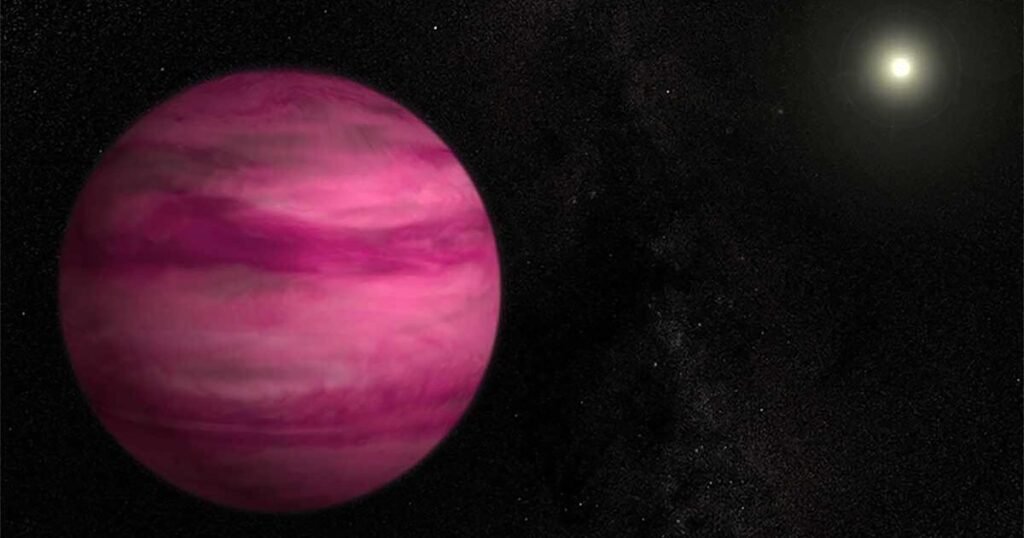
Researchers studying the universe’s “Pink Planet” have discovered an unexpected feature in its atmosphere: clouds made of salt.
A team of astronomers led by Northwestern University used the James Webb Space Telescope to discover a salty cloud atmosphere unlike anything previously observed. The findings were published Thursday in The Astronomical Journal.
The so-called Pink Planet, formally known as GJ504b, was discovered in 2013 and is technically not a planet but rather a “planetary-mass companion” because it could be a giant exoplanet or a small brown dwarf orbiting a star, according to Northwestern.
It orbits a sun-like star located 57 light-years from Earth and is 550 degrees Fahrenheit, which is hot by Earth’s standards but extremely cold for a giant planet. An exoplanet is usually between 1,000 and 2,000 degrees, according to the university.
“We were very surprised, because people have theorized that salt clouds might exist in the atmospheres of companions at these temperatures of, say, 500 to 700 degrees Fahrenheit, but people in general just don’t observe any kind of signatures of clouds in such temperatures, so we were very surprised,” Aneesh Baburaj, the leader of the study, told CBS News.
NASA/Goddard Space Flight Center 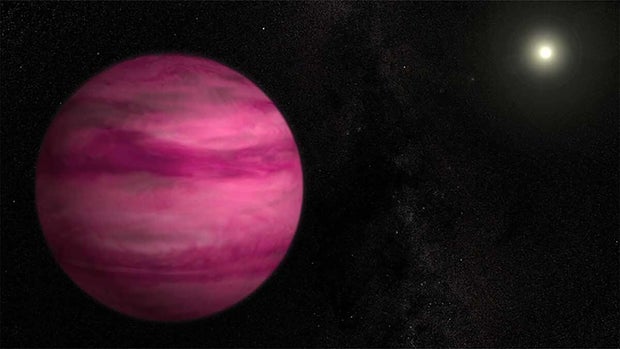
The planetary-mass companion is estimated to be 25 times Jupiter’s mass and between 2.5 billion and 4 billion years old, which explains its lower temperature, as giant planets cool with age, according to Baburaj, a postdoctoral associate at Northwestern’s Center for Interdisciplinary Exploration and Research in Astrophysics.
Its low temperature has made it difficult for astronomers to study it from Earth, as multiple teams worldwide have tried to observe its light but have failed, Baburaj said. But with the Webb telescope, it took researchers 2 hours to conduct a successful observation.
The James Webb Space Telescope captures infrared images, which cannot be seen by the human eye, and spectra to spread light out to reveal chemical fingerprints.
After capturing the Pink Planet’s faint light, researchers created a light “fingerprint” that revealed the elements and molecules in its atmosphere, including water vapor, methane, carbon dioxide, ammonia and other molecules. Researchers found the observations only made sense when they included salt clouds in their model, suggesting the clouds were affecting the light detected by the telescope.
“We were really, really amazed by how easy it was to detect with James Webb, as opposed to like it had been close to impossible from the ground,” Baburaj told CBS News.
He explained that salt clouds represent a kind of middle ground in planetary atmospheres. On Earth, clouds are made of water, and on Jupiter, they’re made of ammonia, while much hotter worlds can have clouds of silicates. But in environments that are too hot for water or ammonia clouds and too cool for silicate clouds, salt clouds can form instead.
Baburaj told CBS News that since the Webb telescope is much more powerful than other telescopes, it can detect colder atmospheric conditions for further research.
“We will be able to detect colder and colder objects, and a lot of these objects might have these higher metal-to-hydrogen ratios compared to our sun,” he said.
You may be interested

SpaceX’s giant Super Heavy-Starship rocket blasts off on key test flight
new admin - Jul 25, 2026SpaceX launched its 13th Super Heavy-Starship rocket Friday, with the giant booster chalking up an on-target but "hard" splashdown off…

Spain Coach De La Fuente Says Argentina World Cup Final Conduct ‘Unacceptable’
new admin - Jul 25, 2026[ad_1] NEWYou can now listen to Fox News articles! As FIFA investigates Argentina’s conduct after the World Cup final, Spain…

Iran war fuels inflation, mortgage rates and gas prices
new admin - Jul 25, 2026[ad_1] The affordability crisis is revving up again.Subscribe to read this story ad-freeGet unlimited access to ad-free articles and exclusive…