
Researcher Spent Years Studying Grass for the World Cup

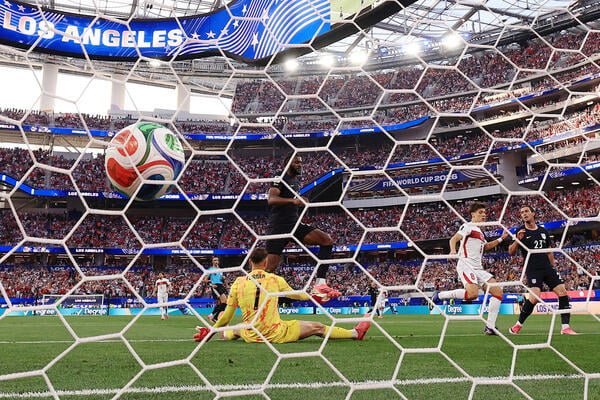
The World Cup has been underway for a little over two weeks, but the research that went into building 16 fields nationwide for the Cup’s 104 matches dates back half a decade.
Between the 16 fields and 150 practice fields, the Fédération Internationale de Football Association was facing a challenge—what was the best way to convert stadiums not designed for soccer into temporary soccer fields? It was Alan Ferguson, senior pitch management manager for FIFA, who pitched John Sorochan, a University of Tennessee at Knoxville researcher, on his idea: Sorochan and researchers at both UT Knoxville and his alma mater, Michigan State University, would use their extensive knowledge of turfgrass to study exactly that.
Over five years and hundreds of experiments, the team worked to ensure every field was up to FIFA standards. Now, that work is being watched on the world stage, highlighting the role of university research not only in spheres like health care and technology, but also sports and entertainment.
Sorochan’s work goes beyond massive events like the World Cup; his turfgrass research also aims to improve safety for everyone who participates in sports, from elite athletes to children on the playground. Inside Higher Ed talked to him about how he began studying turfgrass and what it’s meant to see his research on the global stage. The interview has been edited for length and clarity.
Q: How do you get involved with studying turfgrass in the first place?

John Sorochan
University of Tennessee at Knoxville
A: I’m born and raised in Calgary, Alberta, Canada. Growing up, my neighbor, he was a golf course superintendent, and his son, who was like a big brother to me, Craig, followed in his dad’s footsteps, but he got into golf course construction. He went to Michigan State University from Canada, and when he graduated, he got hired by Robert Trent Jones, who’s a famous golf course architect, and Robert Trent Jones moved him to southern Spain to design and shape golf courses all over Europe and even into Morocco. When I graduated high school, me and my best friend went backpacking through Europe two days after high school, and we went and saw him in southern Spain. I thought, “What a cool life.” His apartment looked over the Mediterranean—you could see Gibraltar, you could see Morocco, and then he’s going all over Europe.
I go to the University of Calgary, study political science and geology, thinking I’ll be a lawyer in the oil and gas industry. I didn’t like it. But I always remembered what Craig was doing. So I went and got a job on a golf course, fell in love with working on the golf course, and transferred to Michigan State University, thinking I was going to get it into golf course construction and design. Shortly after that, Michigan State got tapped to put grass in the Silverdome in Detroit for the World Cup in 1994. I, as a student, growing up playing, loving soccer—I went and asked Trey Rogers if I could work for him, and I started working for him on that project. I literally help put the sand in, tamp sand in these modules, laid the sod, mowed it. I looked after it. That got me involved in the research and the science part of it.
Q: So part of your origin is the World Cup itself.
A: Yeah, that’s what got me into wanting to do research. We got to go jump on the roof of the Silverdome after the World Cup. It’s like a big trampoline, a giant one, and then you— There’re these little valves, you could pop them out and you look down, and the air is holding you up, and you’re a couple hundred feet above the ground. So once the pucker factor set in, I was like, “Whoa, I can see the field after,” and I started looking and you can see the wear patterns. It looks like a diamond. It’s put inside for 30 days with no grow lights, no vacuum ventilation, no natural sunlight. So, once you got [the field] inside, it started declining over those 30 days and was in survival mode. I thought, “How do we make this better?” That’s what inspired me to want to do research and grow grass indoors, which is what I’m doing today.
Q: So jumping forward to the World Cup 2026. When you first got tapped for this, what were the first steps? Where do you start for something this big?
A: When we first got asked, when Alan [Ferguson] asked me over a cup of tea and biscuits in an East London café eight years ago, we didn’t know which stadiums were going to be hosting it. I asked, “Will there be any indoor stadiums?” And he goes, “I can almost assure there’ll be one or two indoor stadiums.”
We started looking at the geography of Canada to Mexico. From Vancouver to Mexico City is completely different and everything in between. So I knew that the summer tournament, you would have to have different grasses. [The challenge was] how do we make the different grasses, play, perform and be as similar as possible for the World Cup, knowing that Miami’s going to be Bermuda grass and Boston’s going to be a blue rye mix of cool-season grasses. I’d fortunately been doing research with that previously, because the MLS [Major League Soccer] happens to have all those types of conditions, as well. So, I had a grad student doing soccer research on the different surfaces and how the ball interacts with the surfaces in particular.
Q: What is one of the craziest things that you guys had to test or look into?
A: We’re looking at construction types, converting these indoor stadiums or even synthetic turf stadiums, to natural grass. We started looking at things where we took a concrete floor, which is what they have in Dallas and Houston—what can you do to build above that to have a pitch, a soccer pitch, that the ball’s going to bounce, a player’s going to run and cut and feel above that concrete? What’s it going to feel like compared to Philadelphia or Kansas City, where they have 12 inches of sand?
We did all sorts of research projects, probably 30 or 40. Our litmus test was a soccer ball bounce. FIFA has a criteria that, when you drop a ball from two meters, it has to bounce between 60 centimeters and one meter. We learned that if you have a minimum of three inches of sand and a drainage layer, you can’t pick up the feel of the concrete below that surface.
Q: I’ve seen headlines that some players don’t like some of the fields. What do you think the differing reception is coming from?
A: I can’t go to too much detail because FIFA’s got a response to all of that. But what I’m going to say is all 16 stadiums are built and constructed to FIFA requirements. And they are all passing the protocols of the ball bounce in every one of these stadiums—the traction is what’s supposed to be in all these stadiums.
But when you think of an F1 car, if it’s raining, they put on their rain tires. If it’s not raining, they still have soft, medium and hard tires that they run on dry conditions. And they give them different performances. When you have players that have played in England and they only play on ryegrass, which is a cool-season grass, and it’s always cool and damp, they always wear screw-in cleats to give them extra footing attraction. When you go onto a surface that’s Bermuda grass, the way that Bermuda grass grows is going to give you more traction.
There are three components: There’s the athlete, the surface and the shoes. We need to be communicating— You got to know during your warm-ups that these shoes make a difference. If it feels too hard on your foot, it’s likely they’re wearing the wrong cleat.
Q: In terms of your research outside of the World Cup, is all your research focused on sports specifically, or do you get into other realms?
A: It’s still a sport, but I still do a lot of putting green research for golf. How does the ball roll on a green, right? It needs to be like a pool top. I look at different grasses and management of warm- and cool-season putting green surfaces. You want a ball to come in and hit but not bounce off the green, but not plug and be too hard. And then once it’s on the green, how does it roll true on that green? Not like a Plinko board or something.
Then I do everything from sod establishment to home lawns. So growing grass and working with sod producers, how to best grow different varieties of grass for home lawns. I’ve done research on cemeteries and trying to reduce inputs around headstones so they don’t have to mow as much.
Q: It sounds like so much of this has to do with botany, but it also sounds like it has to do with physics, with the ball rolling. Is that accurate?
A: There’s physics and there’s also biomechanics, because we’re looking at athletes. I work with biomechanists and kinesiologists at the University of Tennessee and University of Memphis. I look at it from the ground up and they look at it from the athlete down and we kind of have a marriage that comes together. I’ve got some great colleagues here at the University of Tennessee and at University of Memphis that I rely a lot on for their expertise. And even my turfgrass grad students, I’ve had several of them take anatomy and biomechanics classes as part of their graduate classes. Just to learn enough to be dangerous on that side.
Q: To close this out, what it’s been like to watch your work on the world stage? I know it’s not the first time, considering you’ve worked on a World Cup before, but what’s it like to watch the whole world watching what you’ve done?
A: FIFA invested a lot of money to do this research. Alan Ferguson had the vision: “I want evidence-based science to support what we expect for all these World Cups.” He went and sold it to the leadership at FIFA all the way up to the president, and their investment in this is going to leave a huge legacy. It’s also enabled me, as a professor at the University of Tennessee, to come up and help advance ideas that I was doing before.
But it comes from my leadership here at the University of Tennessee, as well. The chancellor created what’s called the Chancellor’s Innovation Fund, which is like a Shark Tank. And all these people got to submit their ideas, all these super cool ideas, and me and my technician came in with this device that uses a soccer cleat and we smash a foot into the ground and we measure the surface. And we won. We won the Chancellor’s Innovation Fund, and that kick-started to help us develop this technology. And this is the device being used for the World Cup and Club World Cup to measure the performance and consistency, uniformity of all the surfaces and what the players are actually feeling as well. And it all started with the investment of the university supporting ideas that professors have—the just crazy, wacky ideas that we have.
The legacy effect of this, going forward, is going to be tremendous, because that device can now go look at synthetic turf and even city park and rec fields and say, “This is what we need to make surfaces safer for the children that are playing on them.” It’s not just these F1 racers, but the little go-kart racers as well, which are the little children running around, like, nonstop.
You may be interested
'I've tested home scents for 4 years and this £20 room spray is my new favourite'
new admin - Sep 13, 2026[ad_1] After four-plus years of testing home fragrances, our reporter thinks she's found a new favourite. [ad_2] Source link
4 Roald Dahl books will remain relevant forever thanks to 1 key reason
new admin - Sep 13, 2026Roald Dahl's books, I believe, are timeless classics unlikely to go anywhere soon, as generations and generations of kids have…

Wisconsin Congressman Tom Tiffany suffers minor injuries after emergency landing in a lake
new admin - Sep 13, 2026Wisconsin Congressman Tom Tiffany said Sunday he sustained minor injuries after the plane he was traveling in made an emergency…