



PVA’s history and the fight for veterans’ rights 1946

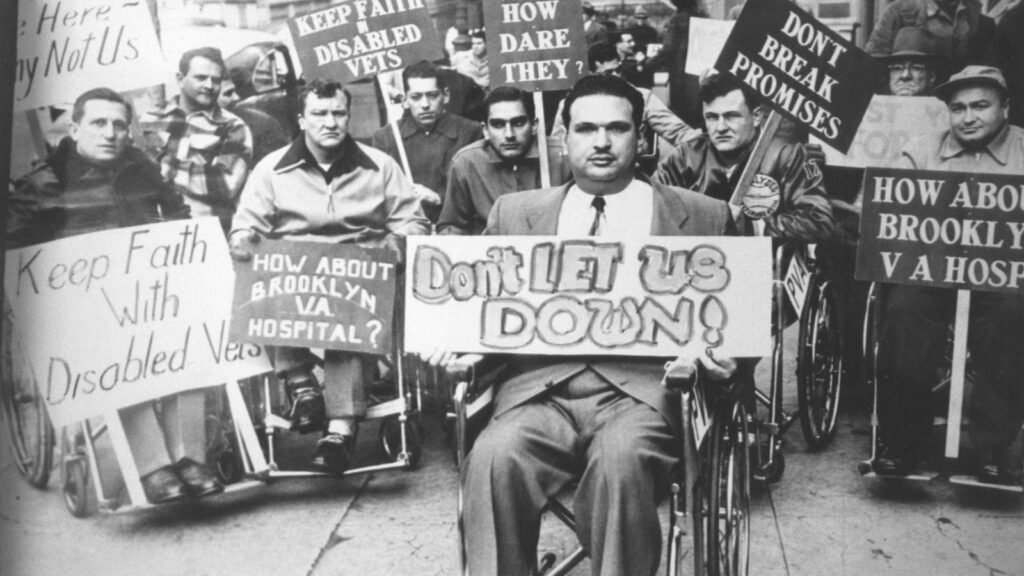
Joseph A. Jordan Jr. was only two years out of high school when he enlisted in the U.S. Army in 1943 during the height of World War II. Two years later, while stationed in France, Jordan’s jeep rolled while traversing a minefield in northern France. The crash left him permanently paralyzed from a spinal cord injury and he was sent back to the United States to recover. In many ways, his battle was only beginning.
Jordan, like many of his military comrades, returned stateside with mobility challenges and unique medical needs, but found a world that was not ready for their arrival. They were unable to access their homes, navigate public transportation, or participate in society. Medical knowledge was limited, rehabilitation was still developing, and many veterans remained in hospital wards unsure of what their futures might hold. Some were described as “dead-enders” or “no-hopers.”
Unwilling to accept this as their new normal, these veterans banded together, just as they did in combat overseas, to battle their new reality head-on. They wanted more than survival. They wanted homes, careers, families, and meaningful lives outside an institution. And they wanted it for everyone.
In January of 1946, 70 paraplegic veterans gathered in the Recreation Hall of the Red Cross at Birmingham General Hospital in Van Nuys, California, to map a pathway for their advocacy. This marked the first meeting and formation of Paralyzed Veterans of America (PVA), a nonprofit Veterans Service Organization that provides support and services for veterans with spinal cord injuries and diseases (SCI/D), like multiple sclerosis (MS) and amyotrophic lateral sclerosis (ALS).
Six months later, the organization launched one of the earliest and most prominent disability publications dedicated to individuals with spinal cord injuries and diseases, PN Magazine, or Paraplegia News. Still in production today, PN continues to be a vital resource for news, information, and support tailored to the disability community.
What began as a way to reclaim their lives outside of hospital beds laid the foundation for America’s adaptive sports movement. Ten months after PVA was founded, its members organized the nation’s first wheelchair basketball game while receiving care at Birmingham Veterans Administration Hospital. They played a team of doctors and won, 16-6, then formed a team that played exhibition games around the country.

A pioneer in adaptive sports, PVA played an important role in demonstrating how athletics could support rehabilitation, build confidence, and create opportunities for both veterans and all people with disabilities. Today, PVA co-hosts the National Veterans Wheelchair Games with the Department of Veterans Affairs (VA), continuing an idea born from veterans demanding the right not merely to recover, but to compete.
In 1947, during PVA’s first board meeting in Richmond, Virginia, Jordan, who was Black, encountered another barrier. The hotel turned him away due to Virginia’s segregation laws. His fellow PVA members, including PVA’s first president Gilford “Gil” S. Moss, had a choice: hold the meeting without him, or fight. Moss fought and won, taking the matter to the press, standing behind Jordan, and making sure he entered the hotel alongside all its members.
When reflecting on the incident, Moss declared “spinal cord injury knows no bias and neither does PVA.” Again and again, PVA has confronted a problem and made it the starting point for broader change. “You advocate for one person because one person matters,” said U.S. Navy SEAL veteran, former PVA National President, and host of “Voices of PVA” podcast Al Kovach. “But you keep fighting because you know that one victory can change the lives of many.”
In the decades to follow, PVA members continued to advocate for their rights and ignite change with the same devotion to service and spirit of determination that drove its founders. Among the nonprofit’s broadest accomplishments is its championing of accessibility, SCI/D care, and VA benefits support.
In the late 1940s, PVA members worked with architects to develop accessible home designs. They brought architectural models to Congress, testified, and lobbied for change. Their efforts led to Public Law 702 in 1948, the first federal program to provide disabled veterans specialty adapted housing grants to modify their homes.
In May 1970, a Life Magazine article relayed the deplorable conditions encountered by veterans at the Bronx VA Medical Center, specifically those with spinal cord injuries. The article stirred the nation and the public outcry that ensued served as the impetus for a complete transformation in the way the VA treated veterans with SCI/D. The deplorable conditions led PVA to create a Field Advisory Committee and become the only nonprofit invited to conduct annual site visits at every VA SCI/D center across America. In the five decades that followed, the VA rebuilt itself to become the leading provider of care for veterans with SCI/D and the benchmark for all other health systems in the world offering care to people with similar conditions. Today, that partnership continues, with PVA members, licensed architects and medical professionals on staff regularly monitoring care and identifying opportunities for continued improvement.
The needs of a veteran with a catastrophic disability rarely fit one category. Recovery can lead to questions about benefits, healthcare, housing, transportation, employment, legal rights, recreation, and long-term care. PVA has spent eight decades building expertise around each person’s journey.
“We are regarded in the broader veterans community as the ‘subject matter experts’ on a wide range of topics that veterans with catastrophic disabilities have earned and deserve,” said PVA Chief Executive Officer Carl Blake.
Last year alone, PVA helped veterans file nearly 27,000 VA benefits claims, securing more than $279 million in new benefits for veterans with SCI/D. It also regularly publishes PVA Clinical Practice Guidelines and Consumer Guides that help not only skilled physicians but also patients, their families, and caregivers stay abreast of their care and navigate life after injury or diagnosis. Today, PVA’s publications have reached more than 60 countries in four languages.
Lived experience and professional expertise is why PVA describes itself as one of one: a nonprofit unlike any other that is built to serve catastrophically disabled veterans and whose work has changed life far beyond it.
“PVA is one of one because we use our status as a veterans’ organization to make an impact on a much broader community, particularly the community of people with disabilities,” Blake said. “Our impact stretches far beyond veterans benefits and healthcare to the greater disability community.”
And there are still barriers to confront. PVA National President Robert Thomas, an Army veteran and wheelchair user, points out that “accessibility and equal participation remain unfinished work more than three decades after the Americans with Disabilities Act became law.”
The men and women who founded PVA once fought for the chance to survive an injury medicine barely understood. The generations that followed fought for the right to live fully and independently.
For veterans, such as Jordan, who would eventually become an accomplished lawyer and activist, PVA’s mission has extended beyond the creation of a safer, accommodating world for disabled veterans to include disability civil rights advocacy for everyone.
You may be interested

Suspect arrested after fire “completely engulfed” Hitler’s Eagle’s Nest mountain retreat in Germany
new admin - Oct 24, 2026A suspect has been detained in Germany following a fire at Adolf Hitler's mountain retreat, known as Eagle's Nest, German…

Woman bullied for posting weight loss video receives flood of support from kind strangers
new admin - Oct 24, 2026"The Kindness Mob," a group of half-a-million people, is helping online strangers recover from hate comments. Steve Hartman goes "On…

New 60 Minutes report on "third-country deporations"
new admin - Oct 24, 2026Within five days of being deported from the U.S., Moussa Diawara says Ghanaian officials forced him onto a flight to…